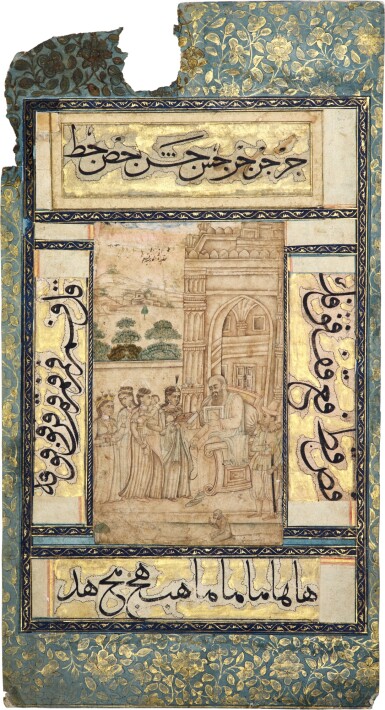
A Temple Scene, India, Deccan, late 17th century
Auction Closed
April 26, 01:36 PM GMT
Estimate
20,000 - 30,000 GBP
Lot Details
Description
brush drawing with washes of colour and gold on paper, inscription in nasta'liq, captions above, below and on each side in monumental nasta'liq in black ink reserved on a gold ground, narrow foliate blue borders, blue stained margins decorated with a gold arabesque of lotus palmettes and scrolling tendrils, verso with drawing of Layla and Majnun enclosed by further calligraphic captions and blue foliate borders
painting: 21.2 by 12.7cm.
leaf: 45.9 by 24.8cm. max.
the inscription in the sky reads tasvir-e mani kar-e siyah qalam (‘Painting by Mani, black-pen (siyah qalam) technique’).
The top line is part of a line from the Arabic poem of al-Busayri in praise of the Prophet, the Qasida al-Burda (Ode of the Mantle): ‘The day on which the Persians realised that they …’. The bottom line is a saying of Imam ‘Ali: ‘The greatest ignorance is a person’s ignorance of himself’.
The scene is based on a print of a biblical scene, of which the Presentation in the Temple is the most likely source. This was a favourite subject of the Mughal atelier and various versions are known which combine the elements seen in the current drawing.
A fully coloured version attributed to Keshav Das c.1580-85 is in the Musée Guimet (Okada 2011, fig.12), where the seated old man has become part of a Last Supper sequence to which a group of women are approaching, one holding the Christ Child. Another drawing circa 1600 in a technique similar to the current lot is in the British Library (Losty and Roy 2012, fig.71). The British Library example is perhaps the work of Kesu Khurd, Kesu the Younger, an artist who based his work on his senior colleague and who was certainly his pupil and possibly his son. Another version in the Chester Beatty Library in Dublin where the virgin is seated is ascribed to Kesu, that Leach suggests is Kesu Khurd (Leach 1995, 1.234).
The various versions of the scene suggest it was a popular one in the first half of the seventeenth century and our Deccani artist seems to have worked from an earlier Mughal original. In the Deccani version simple brushed lines enclose forms with the lightest of shading to indicate volume. Folds of drapery are simply rendered as parallel lines in a darker wash while the women’s hair is arranged in regularly repeating coils. For other Deccani Christian drawings based on earlier Mughal examples, see Falk and Archer 1981, nos.45 and 448. For a comparable treatment of the trees see Zebrowski 1983, figs.198-203
You May Also Like


