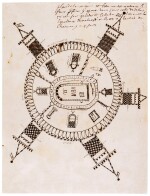

Sir John Chardin, The first European representations of Mecca and Medina, late 17th century
Auction Closed
March 31, 12:40 PM GMT
Estimate
60,000 - 80,000 GBP
Lot Details
Description
ink drawing on paper, with hand-written French inscriptions in black ink
2
28.3 by 25.7cm.; 30.1 by 23cm.
Hobhouse Ltd., London, 1985 (the larger drawing).
Sotheby’s London, 3 October 2012, lot 114 (the smaller drawing).
Oliver Hoare, London, 2015.
Oliver Hoare, Every Object Tells a Story, London, 6 May-26 June 2015, no.113.
THE FIRST EUROPEAN REPRESENTATIONS OF MECCA/MEDINA
This drawing of the Prophet's tomb at Medina represents one of the earliest attempts by a European to depict the Holy Places of Islam, and can be attributed to the French traveller and merchant Sir John Chardin (1643-1712). Depictions of Mecca and Medina by Europeans are scarce. Chardin made these drawings according to information he had been given by a Muslim he had met on his travels, who had been on the Hajj. The smaller drawing depicting a map of Prophet Muhammad’s tomb appears to be unfinished. It may have been made as a copy to be donated to The Royal Society. The larger drawing is complete, with a French inscription at the top, ‘plan de la meque et lieu ou est enterre le faux profete y avant deux cours celle de dehors qui est fort grande et celle de lieu est la Sepulture de Mahomet et les os à l'entrée de Chascune y a 4 portes’. It is accurate in its depiction of the colonnade, the Ka’aba, the buildings and minarets. The inaccurate elements are the circular depiction of the shrine, placing the shrine in the Ka’aba and illustrating the two holy sites of Mecca and Medina as one. (O. Hoare, Every Object Tells a Story, London, no. 113.) Although Chardin took on his travels two professional artists including Grélot, the present drawings are not their work, and thus are most probably by Chardin himself.
Polyglot and traveller John Chardin was born in Paris in 1643, and spent eleven years in the Middle East. He gained access to the Persian court and was appointed a royal merchant by Shah 'Abbas II. After travels in Persia, Turkey, India and Georgia, Chardin settled in England, where he was knighted by Charles II for his services to the East India Company. He also published an account of his voyages, Voyages en Perse et Autres Lieux de l’Orient (the first volume in 1686 and further sets in 1711), which have been widely praised for their breadth of knowledge and accuracy. As a royal merchant, Chardin was able to gain access to court information on politics and patronage which would otherwise be unavailable to foreigners, and his works have become an important non-Persian source of information on the Safavid and Ottoman empires.
John Evelyn (1620-1706) was one of the founders of the Royal Society and moved in the company of the great scientists, artists, writers and architects of the time. The arrival of Jean Chardin in London in 1680 after his travels provided an opportunity for Evelyn to acquaint himself with the Orient. A friendship developed between the two. Although it is unclear when Chardin’s drawings may have entered Evelyn’s collection, his famous diary is an important historical source of the time. Excerpts from his diary records meetings between him and Jean Chardin at several occasions between 27 August 1680 and 18 May 1705.