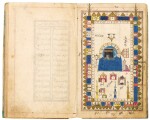

A compendium of works relating to the Hajj, including Muhyi al-Din Lari (d.1526-27), Futuh al-Haramayn, probably Central Asia, probably Bukhara, first part dated 1142 AH/1729 AD
Auction Closed
March 31, 12:40 PM GMT
Estimate
15,000 - 25,000 GBP
Lot Details
Description
Persian manuscript on paper, 62 leaves plus 7 flyleaves, comprising two works, each with an illuminated headpiece, the first section with 26-28 lines to the page, written in nasta'liq script in black ink, important words in red, text within gold and back rules, the second section with 15 lines to the page, written in nasta’liq in black ink, titles in red, within gold, black and red rules, outer margins ruled in red, each section with an opening illuminated headpiece, containing 19 illustrations including depictions of Mecca and Medina, in brown stamped leather binding, the paper doublures with cut-out gilt tooled medallions
26 by 15.8cm.
Acquired in Bukhara, Uzbekistan, 14 March 1971 (according to a note previously with the manuscript).
Private collection, Germany, until circa 2000.
Private collection, UK.
The Futuh al-Haramayn is a renowned guidebook to the Holy Cities of Mecca and Medina, written by Muhi al-Din Lari for Muzaffar ibn Mahmudshah, the ruler of Gujarat, in 911 AH/1505-06 AD. It was prolifically copied in the sixteenth and seventeeth century in India, Persia, Turkey and Mecca. The first copy thought to have been made in Bukhara, dating from the sixteenth century, is in the collection of the Metropolitan Museum of Art, New York (acc. no.2009.343).
The Futuh al-Haramayn instructs Muslim pilgrims on the rituals of the Hajj and lists the religious sites they can visit. The illustrations accompanying the text usually include bird’s eye views of courtyards, buildings and religious sites. The present manuscript includes several uncommon illustrations such as drawings of The Prophet’s feet with descriptions. F.1b is illustrated with an applied stamp that includes the names of the 12 Shi’a Imams.
A Safavid copy of the same work, dated 990 AH/1582 AD, sold in these rooms, 20 April 2016, lot 17.