
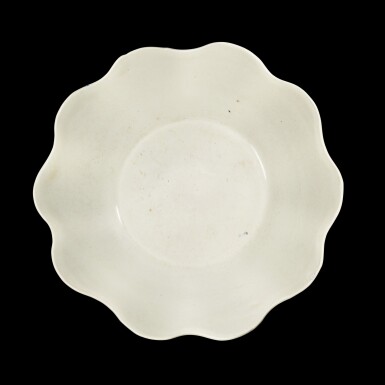
Property from the Houlezhai Collection 後樂齋收藏
A Dingyao white-glazed foliate-rim bowl with an inscribed 'guan' mark Five dynasties | 五代 定窰白釉花式侈口盌 《官》款
Auction Closed
April 29, 06:28 AM GMT
Estimate
200,000 - 300,000 HKD
Lot Details
Description
Property from the Houlezhai Collection
A Dingyao white-glazed foliate-rim bowl with an inscribed 'guan' mark
Five dynasties
後樂齋收藏
五代 定窰白釉花式侈口盌 《官》款
13.5 cm
Bluett & Sons, London (label).
Collection of Dr Carl Kempe (1884-1967), no. CK338.
Replica Shoes 's London, 5th November 2008, lot 452 (part lot).
Bluett & Sons,倫敦(標籤)
卡爾肯普博士(1884-1967年)收藏,編號CK338
倫敦蘇富比2008年11月5日,編號452(其一)
Gustaf Lindberg, 'Hsing-Yao and Ting-Yao', The Bulletin of the Museum of Far Eastern Antiquities, no. 25, Stockholm, 1953, pl. 49, fig. 44.
Bo Gyllensvärd, Chinese Ceramics in the Carl Kempe Collection, Stockholm, 1964, pl. 338.
Thomas Dexel, Frühe Keramik in China [Early Ceramic in China], Braunschweig, 1973, pl. 58c.
Margaret Medley, T'ang Pottery and Porcelain, London, 1981, pl. 115.
Gustaf Lindberg,〈Hsing-Yao and Ting-Yao〉,《 The Bulletin of the Museum of Far Eastern Antiquities》,第25期,斯德哥爾摩,1953年,圖版40,圖44
Bo Gyllensvärd,《Chinese Ceramics in the Carl Kempe Collection》,斯德哥爾摩,1964年,圖版338
Thomas Dexel,《Frühe Keramik in China[中國古陶瓷]》,不倫瑞克,1973年,圖版58c
Margaret Medley,《T'ang Pottery and Porcelain》,倫敦,1981年,圖版115
A similar and larger example, also inscribed with a Guan mark, is preserved in the Taipei Palace Museum, attributed to the 10th century, Five Dynasties - Northern Song dynasty, illustrated in the exhibition catalogue Decorated Porcelains of Dingzhou, Taipei, 2014, cat. no. I-18, where the author mentions bowls of this type were also discovered in a Five Dynasties tomb attributed to the Wang noble family of Yang Wu (year 933), and in a Liao dynasty noble consort tomb (year 959).
台北故宮博物院藏一類例,尺寸較大、亦帶《官》款,斷代五代至宋,十世紀,載於《定州花瓷:院藏定窰系白瓷特展》,台北,2014年,編號 I-18。編者指出五代楊吳貴族王氏墓(933年)及遼駙馬墓(959年)亦曾出土相類例。
_______________________________________
Old-World Charm from the Kempe Ceramics Collection
Regina Krahl
This enchanting group of ceramics, formerly in the collection of Dr Carl Kempe, displays an unmistakable old-world collecting flair. Dr Carl Kempe (1884-1967) was a Swedish industrialist, a noted tennis player, who won an Olympic medal, and an avid collector of Chinese art. His collection had two main strands: gold and silver wares and ceramics. The ceramic collection was representing the history of Chinese white wares practically in its entirety, but equally comprised many other types of stoneware and porcelain. It was housed in Kempe’s residence, Ekolsund Castle, a historic building northwest of Stockholm, recorded since the 14th century, that for centuries had served as a royal palace. The collection had largely been formed before the War, a hand-written catalogue had been compiled by Hans Öström already in the 1940s, followed by a printed catalogue written by Bo Gyllensvärd in 1964, when it comprised 900 items. The yellow Kempe labels with their distinctively designed CK logo are unmistakable.
Kempe clearly was not a collector of trophies but an inquisitive mind, whose aim was not only to assemble masterpieces and classics, but equally pieces that still required research. He readily lent to exhibitions, so that pieces from his collection were seen in two of the most important exhibitions of Chinese art of all times, at the Royal Academy of Art in London 1935/6 and at the Palazzo Ducale in Venice 1954; but also several times at the Oriental Ceramic Society in London, of which he was one of the early foreign members; as well as at the Nationalmuseum Stockholm in 1949, the Kunstindustrimuseet Copenhagen in 1950, the Musée Cernuschi Paris in 1956 and elsewhere. Sadly, many pieces included in these early exhibitions can no longer be identified, since the catalogues had few illustrations and only scant descriptions. After Kempe’s death, the collection remained for some time in the family, and a selection toured the United States, starting at Asia House Gallery, New York in 1971. Before eventually being dispersed, it was for some years on display at the East Asian Museum at Ulricehamn, Sweden. The ceramics were sold in 2008 in several highly successful auctions at Replica Shoes ’s in London and Paris, where the prices achieved established a new level of values for Song and earlier stonewares.
Of this famous Kempe collection, these twenty-one white and green wares have remained together as part of a Chinese collection, a small but rather remarkable group that includes two dated vessels (lot 3698 of 977 and lot 3690 of 1089), two items inscribed guan, ‘official’ (lots 3688 and 3692), and several other conspicuous pieces. Noteworthy among the white wares is, for example, the small tripod water vessel with paw feet and lotus décor (lot 3692). It was previously attributed to the Xing kilns of Hebei, and predecessors of similar shape appear to have been made at both the Xing and Ding kilns: one without design, with a more bluish glaze, which leaves the lower part free, was excavated at Dingzhou city, Hebei (Zhongguo gu ciyao daxi. Zhongguo Dingyao/Series of China’s Ancient Porcelain Kiln Sites: Ding Kiln of China, Beijing, 2012, p. 274, fig. 11 bottom); another, also more bluish and plain, excavated in Xi’an, Shaanxi province, has been attributed to the Xing kilns (Zhongguo gu ciyao daxi. Zhongguo Xingyao/Series of China’s Ancient Porcelain Kiln Sites. Xing Kiln of China, Beijing, 2012, p. 375 top). Guan marks, although altogether rare, were also applied at both kiln centres and were remarkably widely distributed, having been found at Tang, Five Dynasties, Liao and Northern Song sites ranging in date from the late 9th to the 11th century. With its fine ivory-toned glaze and delicate lotus design, the present piece is, however, more likely to have been made in the Ding region.
Another Ding piece must be mentioned, the bowl with its charming, crisply moulded decoration of boys frolicking among peonies (lot 3695). Two pieces probably from the same mould are preserved in the National Palace Museum, Taipei (Dingzhou hua ci. Yuan zang Dingyaoxi baici tezhan/Decorated Porcelains of Dingzhou. White Ding wares from the collection of the National Palace Museum, National Palace Museum, Taipei, 2014, nos II-108 and 109), and fragments with very similar motifs were excavated from the Jiancicun site, Dingyao (Zhongguo gu ciyao daxi. Zhongguo Dingyao/Series of China’s Ancient Porcelain Kiln Sites: Ding Kiln of China, Beijing, 2012, p. 289, fig. 62).
One of the earliest green wares in this group is an irresistibly modelled owl vessel, its surface textured by stamping, pricking and incising (lot 3691). It is a rare individually fashioned example from kilns in the Yue region of northern Zhejiang, which otherwise tended to produce in quantity. Gyllensvärd duly featured it in one of the very few large illustrations in his catalogue.
A similarly endearing aspect adheres to another small item, the little vessel with four tubular spouts, whose crackled glaze, however, identifies it as a serious Hangzhou guan product (lot 3703). Variously called a flower or an incense holder, it is in any case a classic Southern Song desk item signalling the exquisite taste of its owner.
Most of the pieces in this group are easy to attribute at our present state of knowledge, so we can correct Gyllensvärd’s misattribution of a celadon bowl to Korea, which would seem to be Chinese (lot 3706). Yet, continuous excavations and the discovery of ever new kiln sites in China raise intriguing new questions. Excavations in Henan province, for example, have brought to light several manufactories – including the imperial Ru kilns of Baofeng – that made wares of Jun type, with blue glazes, with copper-splashed blue glazes and with green glazes, besides the best-known workshops of these wares at Yuntai. What at first glance looks like a classic green Jun bowl in the collection, may well have been made at one of the kiln centres in Ru territory (lot 3699). The Donggou kilns located at Dayu to the east of Ruzhou city, north of Baofeng, yielded not only wares with Jun glazes, but also celadon, white wares, white wares with black painted designs, as well as biscuit-fired pieces and kiln furniture, among them a green-glazed ‘Jun’ bowl of very similar shape as the present piece, but slightly larger (Henan xinchu Song Jin mingyao ciqi tezhan [Special exhibition of porcelains recently excavated from famous Song and Jin kilns in Henan], Poly Art Museum, Beijing, 2009, p. 154 top), and pieces of similar glaze colour and with similar treatment of foot and base, both partially glazed, with a ring on the base wiped nearly free of glaze (Gugong Bowuyuan cang Zhongguo gudai yaozhi biaoben [Specimens from ancient Chinese kiln sites in the collection of the Palace Museum], vol. 1: Henan juan [Henan volume], Beijing, 2005, no. 470). A re-evaluation of his collection in the light of such new discoveries would most likely have pleased its former Swedish owner.
古韻猶香:肯普中國陶瓷舊藏
康蕊君
肯普中國陶瓷珍藏,蒐羅萬象,風采迷人,展現舊時收藏家之特色與風華。卡爾肯普博士(1884-1967年),為瑞典實業家,亦是知名網球選手,曾獲得奧運獎牌,同時也是一位熱愛中國藝術的收藏家。他的收藏,以金銀器、陶瓷,兩大路線為主,陶瓷收藏甚為廣泛精深,猶以歷代白瓷最豐。其珍藏貯於其宅邸,Ekolsund 城堡,位於斯德哥爾摩西北方之一幢歷史建築,可溯至十四世紀,曾為皇家宮殿。肯普珍藏多入藏於二次世界大戰前,1940年代已由 Hans Öström 整理一份完整手寫圖錄,1964年,Bo Gyllensvärd 編寫之收藏圖錄,正式印行出版,內含九百件藏品。肯普藏品特有黃色收藏籤,書特別設計之縮寫「CK」,令人過目難忘。
關於收藏方針,肯普並非一昧追求高價稀珍,而是以求真、好學之心為礎,各類經典傑作及尚須研究之器,均見蒐藏。肯普熱心借展藏品,史上二大中國藝術展,1935至1936年倫敦皇家藝術學院、1954年威尼斯總督宮展覽,均見其珍藏展出。肯普為倫敦東方陶瓷學會早期少數海外會員之一,曾數度參與學會展覽,如1949年斯德哥爾摩國立博物館、1950年哥本哈根藝術與設計博物館、1956年巴黎賽奴奇亞洲藝術博物館等等。可惜的是,上述展覽圖錄,多僅以簡略文字敘述展品,罕有照片相佐,因此難以十足確認肯普借展品為何。肯普過世後,藏品留予遺族,一部分曾至美國巡展,以1971年紐約 Asia House Gallery 為首站。此後多年,展於瑞典烏爾里瑟港東亞博物館,直至最終拍賣之時。肯普中國陶瓷珍藏於2008年倫敦與巴黎蘇富比多場拍賣出售,成績傲然,將宋代瓷器、高古陶瓷之價格推向更高境界。
肯普舊藏中,此批二十一件白瓷與青瓷,為同一私人藏家所珍貯,包含二件紀年瓷器(拍品編號3698紀年977、拍品編號3690紀年1089),二例書「官」字銘文(拍品編號3688及3692),及數例知名藏品。白瓷中最引人注目者,如蓮瓣紋三獸足水盂(拍品編號3692),原斷為河北邢窰器,類同器形可見於邢、定窰,如河北定州出土一件無紋例,釉色泛青,下部無釉,錄於《中國古瓷窰大系:中國定窰》,北京,2012年,頁274,圖11(下);另一例,一樣無紋且釉色泛青,出土於陝西西安,斷為邢窰,同上,頁375(上)。「官」字銘文,雖少見,但邢、定二窰均有作例,唐、五代、遼、北宋窰址皆有標本,使用年代甚廣,自九世紀晚期至十一世紀。本品釉色牙白,蓮紋細緻,應造於定州一帶。
另一件重要定瓷為拍品編號3695,模印牡丹童子紋盌,紋飾清晰,優雅迷人。台北國立故宮博物院藏二例,或出自同一模器,錄於《定州花瓷:院藏定窰系白瓷特展》,台北,2014年,編號 II-108、109。澗磁村定窰遺址出土殘片,亦見相似紋飾者,刊於《中國古瓷窰大系》,前述出處,頁289,圖62。
此批珍藏中,年代最早之青瓷,要屬拍品編號3691,鴟鴞形蓋盒,器表使用大量技法裝飾,印、勾、劃、刻等等。浙江北部越窰製瓷,多為大量批製,罕見如此各別特製之例。在 Gyllensvärd 的專書中,亦特為此品刊登大圖版。
同樣備受珍視的,還有拍品編號3703,冰裂青釉,帶四管,屬杭州官窰器,昔稱香插或花插,應為南宋書案陳設雅器。
依據現今陶瓷史研究,多數藏品都得以更正確斷代與辨別窰址,遂能更正 Gyllensvärd 對其中一青釉盌之判斷,前誤認為高麗瓷,應屬中國陶瓷(拍品編號3706)。同時,中國各地持續進行的考古發掘、新窰址之發現等,亦帶來許多新的問題。河南考古發現的數處瓷窰遺址,除了廣為人知的鈞台窰以外,如寶豐汝官窰,亦曾燒造類鈞瓷,有天藍釉、或帶紫斑、或綠鈞等。初見拍品編號3699,宛如典型綠鈞瓷,或原造於汝州窰址。汝州東郊大峪東溝窰,位於寶豐北部,不僅出土鈞瓷,亦見青瓷、白瓷、黑釉劃花白瓷,還有素胎、窰器等,其中一件綠鈞盌,器形與本品相似,尺寸較大(《河南新出宋金名窰瓷器特展》,保利藝術館,北京,2009年,頁154上),並參考與本品相類之器,釉色、足底作法相近,僅局部上釉,底部一圈幾乎無釉,載於《故宮博物院藏中國古代窰址標本》,卷1:河南卷,北京,2005年,編號470。藉由最新考古發現,重新爬梳肯普舊藏,若泉下有知,應甚喜也。