
PROPERTY FROM AN IMPORTANT PRIVATE EUROPEAN COLLECTION | 歐洲重要私人收藏
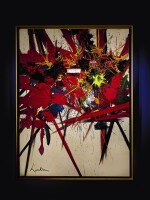
GEORGES MATHIEU 喬治・馬修 | DÉSESPOIR DE LUMIÈRE 希望之光
Auction Closed
October 5, 12:37 PM GMT
Estimate
700,000 - 1,500,000 HKD
Lot Details
Description
PROPERTY FROM AN IMPORTANT PRIVATE EUROPEAN COLLECTION
GEORGES MATHIEU
1921 - 2012
DÉSESPOIR DE LUMIÈRE
oil on canvas
signed in French; titled in French on the reverse
executed in 1988-1989
AD Galerie label stamped to the stretcher on the reverse
130 by 97 cm; 51 ⅛ by 38 ⅛ in.
----------------------------------------------
歐洲重要私人收藏
喬治・馬修
1921 - 2012
希望之光
油畫畫布
一九八八至一九八九年作
款識
Mathieu(左下)
DÉSESPOIR DE LUMIÈRE(畫框)
130 by 97 cm; 51 ⅛ by 38 ⅛ in.
AD Galerie, Montpellier
Important Private European Collection
----------------------------------------------
蒙彼利埃,AD畫廊
歐洲重要私人收藏
Metz, Maison de la Culture, Mathieu, 14 October - 15 November 1989
----------------------------------------------
梅斯,文化館〈馬修〉一九八九年十月十四日至十一月十五日
Mathieu: 50 ans de création, Hervas, Paris, 2003, p. 613, 614
----------------------------------------------
〈喬治・馬修:創作50年〉(巴黎,赫瓦斯出版社,二〇〇三年),613、614頁
This work will be included in the Catalogue Raisonné of the artist, currently being prepared by Le Comité Georges Mathieu (n°GM80034)
This work is accompanied by a certificate of authenticity issued by Le Comité Georges Mathieu
"Sacred Monster of Contemporary Painting": Georges Mathieu's Barbaric Period
Georges Mathieu was the first Western artist to incorporate calligraphy into abstract painting during the post-war period. His lyrical abstractionist art was world leading, attracting the attention of Chinese masters who lived in France such as Zao Wou-Ki and Chu Teh-Chun, as well as the Gutai Group in Japan. He launched action painting in a globalized context. In 1975, Mathieu was elected as a fellow to the Academie Des Beaux Arts in France, and his career continued flourish in a manner as glamorous as his art. Presented in the current season, Désespoir de lumière (Lot 1021) symbolizes the swift arrival of Mathieu’s "Barbaric Period" from the 1980s, at a moment when the artist was exploring new frontiers. He used even more explosive brushstrokes in an escalation of dramatic clashing colors, displaying the prowess of a king on large-format canvases.
The exhibition history of Désespoir de lumière was particularly important for a number of reasons. As the work was completed in 1989, Mathieu was invited by Maison de la Culture de Metz in France to hold a solo exhibition. It was the twentieth anniversary of the cultural center as well as Mathieu’s first return to the venue after two decades, bearing witness to the artist’s impressive development. For this occasion, which was significant to both parties, the artist selected twenty new pieces all meeting the world for the first time. Among the twenty, the artists chose Désespoir de lumière as the featured work. Since the 1960s, Maison de la Culture de Metz had been actively promoting local cultural exchanges, holding exhibitions for masters such as Pablo Picasso, Marc Chagall and Bernard Buffet, demonstrating that art was not only active in Paris but also in Metz in the Northeast region of France. Mathieu once openly praised events by Maison de la Culture de Metz for their depth and breadth, which he said should be “an honor to all the cultural centers of France."
In an exhibition review published in Mathieu: 50 ans de création, a critic described Mathieu as
“one of the sacred monsters of contemporary painting” and heaped praise on the new series as the artist’s best interpretation of his time: “With its exhibition at the Maison de la Culture de Metz opens a new period that we could qualify as ‘barbaric.’ We see a disturbing strangeness emerging from shapes and colors, a splendor so unusual that desperately tries to ward off the convulsions of our world in disarray.” The year 1989 was a period of unrest and turmoil throughout the world. In this context, it is fascinating to consider why Mathieu chose the title Désespoir de lumière for the present work. The artist’s employed his classic splash technique, with colors and brushstrokes dancing and soaring, the red, blue and ink colors, suspended in the sky, overlapping one another.Meanwhile, a brilliant golden light bursts from beneath the layers of colors, composing an emotionally stirring ode to life, leaving the beholder with a lyrical portrayal of an extraordinary time.
----------------------------------------------
註:畫背印有AD畫廊標籤
本作將收錄於喬治・馬修委員會正籌備編纂的藝術家作品集(編號GM80034)
附:喬治·馬修委員會開立之作品保證書
「當代繪畫的神聖奇獸」:馬修的狂野時代
戰後時代,喬治・馬修是首位將東方書法融入抽象繪畫的西方藝術家,他的抒情抽象主義獨步全球,吸引趙無極、朱德群等旅法華人藝術巨擘與之並肩、相映成輝,甚至啟發了遠在日本的具體派,由此開啓行動繪畫在全球化語境下的藝術形式。喬治・馬修於七〇年代獲選為法蘭西學院美術院士,其藝術發展經歷,就如其繪畫一般華麗燦爛,令人炫目。本季登場的《希望之光》(拍品編號1021),代表了馬修於八〇年代再尋突破的「狂野時期」全速降臨,其以更具爆發力的筆觸,掀起更劇烈的顏料碰撞,在如同戰鬥場般的大尺幅畫布上,展現出超然的王者風範。
《希望之光》的展歷尤爲珍貴,於創作完成的1989年,馬修受邀於法國梅斯文化館舉辦個展,而當年不僅適逢文化館成立二十周年,亦是馬修相隔廿載以來再次回到該館展出,可謂見證著藝術家的事業走過輝煌時代;而為了這次對兩方而言皆具重大意義的展覽,馬修特意挑選了以《希望之光》為首之二十件從未曝光的新作,以表誠意。自六〇年代以來,梅斯文化館致力推動本地文化交流,並曾為畢加索、夏加爾、布菲等多位知名藝術家舉辦展覽,引證藝術活動並不只活躍於首度巴黎,位於法國東北部的梅斯亦同樣精彩,馬修更曾公開讚揚梅斯文化館所舉辦的節目廣度與深度兼備,應當是「所有法國文化中心的榮譽」。
載於《喬治・馬修:創作50年》内的一篇當年展覽評論,激昂地為「狂野時期」的馬修冠上「當代繪畫的神聖奇獸」 的雅號,並盛讚這一系列的新作不僅是馬修獻給「文化館最好的生日禮物」,亦是對當下時代最好的演繹:「在梅斯文化館展出的一系列『狂野時期』新作中,我們能夠看到一種奇妙的力量,從形狀與色彩之間爆發,畫中非同凡響的壯麗觀感,拼命地試圖阻止我們外在的世界陷入混亂。」 1989年,世界各地經歷社會動盪,而馬修為本作取名《希望之光》,頗爲耐人尋味;畫中可見藝術家採取了一貫大筆潑灑的技法,色彩與筆觸激揚飛舞,懸掛半空的紅、藍、墨色肆意交疊,卻無礙耀目的金黃光芒從其中綻放而出,於混沌之間譜出了激昂的生命讚歌,為大時代留下懾人的抒情寫照。