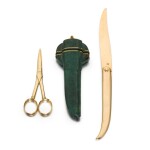

A rare pair of shagreen-cased gold scissors and matching folding knife, Louis Siriès, Florence, circa 1740
Lot Closed
May 26, 12:22 PM GMT
Estimate
4,000 - 6,000 GBP
Lot Details
Description
A rare pair of shagreen-cased gold scissors and matching folding knife, Louis Siriès
Florence, circa 1740
plain scissors with cuffed crossover and reeded collars, the elegantly shaped slightly tapering folding knife with grooved sides, the original fitted case decorated with gold clous and set with a gold suspension loop, each with maker's initials
knife and scissors each 10.1cm., 4 in. high; the case 12.3cm., 4 7/8 in. high
3
Louis Siriès, born around 1686 in Figeac in the Southwest of France, was one of the most admired engravers of his day. He was appointed orfèvre priviligié du Roi to Louis XV, but in 1740 he settled in Florence, where he became the artistic director of the Grand Ducal Gallery in 1748. Siriès was largely responsible for introducing a new vibrant colour scheme, as well as landscapes and figurative scenes, to Florentine mosaic work, mainly after designs by Giuseppe Zocchi (1711-1767). Florentine pietre dure work had previously mainly been characterised by flowers and birds on a black marble ground, corresponding to the official taste of the last Medici Grand Duke Gian Gastone, who had died in 1737 (Anna Maria Massinelli, The Gilbert Collection. Hardstones, London, 200, p. 11).
Siriès's earliest known engraved gems are dated 1733. More than twenty years later, he published a catalogue of 168 gems he had engraved, which were then purchased as a whole collection by Empress Maria Theresa in 1757; many of which survive in the Hofburg in Vienna.
Plain gold objects, such as the present lot, created by an artist who had became so famous for his extraordinary skill in gem engraving may seem somewhat surprising at first, but is perhaps less so when remembering that, according to Forrer’s Biographical Dictionary of Medallists (London, 1904-1923), Louis Siriès was also known to his contemporaries for his microscopic jewels, the details only visible under a lens. Among these was a pair of gold scissors, less than half a centimetre long yet able to cut paper. Siriès's endeavour to achieve ‘supposed impossibilities, and the perpetual aiming after originality; dreading nothing so much as the being thought an imitator of the ancients’ becomes evident in the perfect shape of knife and scissors in the present lot, as well the avantgardist, somewhat reduced elegant plainness and simplicity of silhouettes which one is yet to find in other works of art made in Italy in the 1740s, a period usually associated with the undulating exuberance of the rococo.
Only very few marked gold objects by the elusive Louis Siriès are known; for the only other scissors recorded so far, see Replica Shoes ’s London, 10 June 1993, lot 310, and Replica Shoes ’s London, 9 June 1994, lot 90.
For a signed and marked etui, see lot 24 in this sale.
You May Also Like


