
Philippe Auguste Hennequin
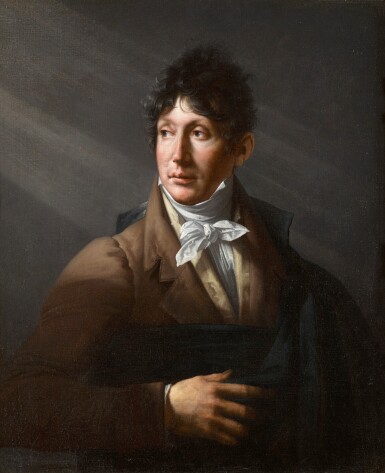
Portrait of a gentleman, half-length, wearing a brown coat, blue cloak and white cravat
Lot Closed
April 29, 03:46 PM GTNN
Estimate
8,000 - 12,000 GBP
Lot Details
Description
Philippe Auguste Hennequin
Lyon 1762 - 1833 Leuze
Portrait of a gentleman, half-length, wearing a brown coat, blue cloak and white cravat
remains of a signature, lower left
oil on canvas
74 x 60.2 cm.; 29⅛ x 23¾ in.
A contemporary of Pierre-Paul Prud’hon (1758–1823) and Anne-Louis Girodet (1767–1824), Philippe-Auguste Hennequin was born in Lyon on 10 August 1762. Around the age of ten, he joined the atelier of the painter Allenet, contrary to his father’s wishes. He continued his formal training at the Académie des Beaux-Arts de Lyon, where he enrolled in 1774 under the guidance of the Swiss painter Per Eberhard Cogell (1734–1812), who would become director of the Académie in 1785, after the death of Donatien Nonotte. In 1779, while in Paris, he was introduced by the abbot of Grimonville-Larchant to the Duke Armand-Joseph de Béthune-Charost (1738–1800), who granted him a pension of 600 livres per year. A year later, the abbot also introduced Hennequin to Jacques-Louis David (1748–1825); Hennequin was one of the master’s first pupils, quickly becoming the manager of David’s workshop. In 1784, he moved to Rome, where he admired the works of the Old Masters. He returned to France in 1790, settling initially in his native Lyon, and five years later, in Paris. Hennequin participated regularly at the Salon and was awarded the Grand Prix both in 1799, for his Triumph of the French People, Allegory of the Tenth of August (which now exists only in fragments), and in 1800, for The Remorse of Orestes (Musée du Louvre, Paris, inv. no. 5322). Upon the return of the Bourbons, he went to live in Liège and later settled in Tournai where, in 1827, he became director of the Académie de Tournai.
The present portrait, a fine example of Hennequin’s technical and artistic accomplishment, portrays a middle-aged gentleman wearing a high wing-tipped collar and a crisp, yet nonchalantly-tied cravat, over a cream, satin waistcoat. Over this, he wears a brown jacket with the iconic M-shaped notch lapel that was fashionable in early nineteenth-century Europe. Adding to his distinctively dandyish flair, the sitter is also shown wearing an emerald coat, casually draped over his left shoulder, with his right hand visible and elegantly held above his waist. The foppish curls of dark brown hair frame his face, while attention is concentrated on his dewy eyes, with heavy eyelids, which gaze pensively into the distance, encapsulating the thoughtful and romantic sent.mes nt of the era, in which the world order was being overturned by new radical socio-political philosophies and enlightenment ideals. The commanding stance and sartorial brilliance of this gentleman herald him as a fashionable, urbane and intellectual man, whose identity so far remains unknown.
Another portrait by Hennequin which presents close formal and compositional similarities with the present work is that believed to be a self-portrait, signed and dated 1812, in the Musée des Beaux-Arts de Caen (inv. no. 75.3.1). The heads of both sitters are turned sharply to the right, looking into a strong shaft of light, which streams in from the top left side of the canvas, creating a dramatic, romantic effect, which highlights the variety of textures of the fabrics worn by the sitters, while also illuminating the delicate rendering of their flesh and their tousled hair.