
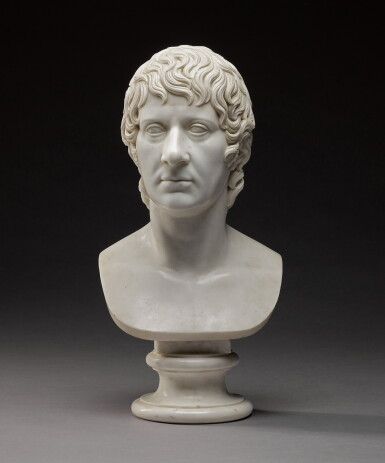
Attributed to Lorenzo Bartolini (1777-1850)
Bust of a Gentleman
Lot Closed
April 29, 03:12 PM GTNN
Estimate
10,000 - 15,000 GBP
Lot Details
Description
Attributed to Lorenzo Bartolini (1777-1850)
Italian, early 19th century
Bust of a Gentleman
marble
57 cm., 22½in.
The Florentine sculptor Lorenzo Bartolini was one of the leading exponents of Neoclassicism after Antonio Canova and Bertel Thorvaldsen. Bartolini studied in Paris at a young age, where he became acquainted with both Ingres and David, who influenced his artistic development. A significant moment in his career came in 1807 when he was appointed Director of the newly founded Académie des Beaux-Arts at Carrara by Napoleon's sister Elisa Baciocchi, then Princess of Lucca and Piombino and later Grand Duchess of Tuscany. Bartolini had sole oversight over the preparation of models for production in the Carrara sculpture workshops, which were charged with creating portraits of the Imperial family to be distributed across the Empire. Funded by the Banque Élisienne, which gave financial aid to sculptors, some 1200 or more marble replicas (of varying quality and measurements) of the ‘official’ portrait bust of Napoleon by the French sculptor Antoine-Denis Chaudet (1763-1810) were made at the Carrara workshop controlled by Elisa between 1807 and 1809.
Following Napoleon's downfall in 1815 Bartolini successfully reinvented himself as a sculptor of portraits of visiting Grand Tourists. Mary Berry, recording her first.mes eting with Bartolini, noted: ‘2 October 1817 In the morning we went to Bartolini’s, the sculptor. He makes very good likenesses in his busts; but he works to sell, and not to immortalise his name. One group, however, of a Venus and a Cupid, and a figure of a Nymph, are really fine. He would part with them for almost nothing, to show what he can do in marble of his own composition.’ Despite his success, Bartolini was viewed with suspicion by many in part due to his closeness to the fallen Napoleonic regime. In 1820, his friend Ingres, who stayed in Florence with Bartolini and shared a studio with the sculptor, wrote to a friend: ‘[Bartolini] is surrounded by enemies of every kind, who [do not comprehend] his great talent which, among them, resembles a bright shining light in the midst of chaos; he has an honest mind and despises everything that is bourgeois.’ Bartolini's plaster models are preserved in the Galleria dell'Accademia.
The present bust, with its superbly carved hair, arranged in twisting and curling locks, recalls a number of Bartolini's portrait busts. Compare the hair in particular with the sculptor's portrait of Louis Bonaparte, King of Holland, at the chateau de Malmaison (inv. no. M.M.40.47.6954). Note also the incised eyes, as in the present bust. Bartolini often incised the eyes of his busts, which lent to them a more lifelike appearance and contrasted with portrait busts by his contemporaries Canova and Thorvaldsen. A further comparison is found in the bust of Felix Baciocchi by Bartolini in the townhall, Ajaccio (inv. no. MNA839124).
RELATED LITERATURE
F. Falletti, S. Bietoletti and A. Caputo (eds.), Lorenzo Bartolini. Beauty and truth in marble, exh. cat. Galleria dell’ Accademia, Florence, 2011