
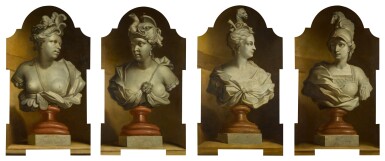
French School, circa 1730
Allegories of the Four Continents
Lot Closed
April 29, 02:54 PM GTNN
Estimate
30,000 - 40,000 GBP
Lot Details
Description
French School, circa 1730
Allegories of the Four Continents
a set of four, all oil on canvas, irregular shape
each: 137 x 39 cm.; 54 x 15⅜ in.
(4)
Painted en grisaille and with skilful chiaroscuro, four busts representing personifications of Asia, America, Europe and Africa stand on fluted circular socles that, with their warm red colour, accentuate the ivory tones of the statues. Most likely commissioned for a specific setting, as the distinctive shape of their frames suggests, these trompe-l'œil canvases were painted in France about 1730, as parallels with both paintings and sculptures from the period suggest.
In the eighteenth-century, the iconography of the four continents followed an established tradition that had its roots in the Renaissance, as codified by Cesare Ripa’s Iconologia, a compilation of emblems – first published with no illustrations in 1593 and then with plates in 1603 – that rapidly became a key source for artists across Europe.
Thus the camel, given its association with commerce and its geographical distribution across the Arabian Peninsula and along the Silk Road, represents Asia, while the horse, thanks to its central role in European warfare and connection with the nobility, is synonymous with Europe. Each animal features prominently on the headdress of its respective continent in the present paintings. Africa in turn is characterised by a helmet formed of an elephant’s head and trunk, and by a clasp fastening her cloak shaped like a lion’s face, in reference to the continent’s fauna, unfamiliar yet famous throughout Europe. America wears a flamboyantly plumed diadem, which would have no doubt evoked for contemporary viewers a sense of the wondrous and exotic, and corresponded to images of indigenous tribes circulated in Europe through prints.
In eighteenth-century Europe, personifications of the continents were part of a narrative that exalted the dominance of Western nations over the known world. They symbolised European rulers’ power and their renown across the oceans, and as such constituted a subject of choice for royals and their courts. For example, King Louis XIV of France (1638-1715) – the Sun King – had four full-length statues of the continents in his gardens at Versailles, that had been executed as part of the Grande Commande of 1674, upon designs by his court painter Charles le-Brun (figs. 1-4, now inside the Château de Versailles; inv. nos. MR 2085; MR 1792; MR 2050; MR 1872). Around the same t.mes , le Brun also painted the walls of the Ambassadors’ staircase at Versailles with trompe-l'œil representations of the nations of the world, grouped into the four continents (now known through copies and his preparatory drawings, due to alterations to the staircase in 1752). In addition, one set of marble busts representing personifications of the four continents, dated to the seventeenth century, can be admired to this day in the Jardin Amphithéâtre of the Grand Trianon at Versailles, alongside two other busts, of Asia and Europe, that most likely belonged to a second set of four continents, now surviving only partially (figs. 5-10). In terms of composition, these busts display a degree of formal parallel with the ones pictured in the present canvases, namely in their format – with the figures terminating just under the chest and shoulders and always turning their heads to one side – and in their arrangement of the robes, which always features a diagonal element in the drapery.