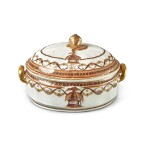

A Chinese Export 'Washington Memorial' Vegetable Tureen, Cover and Liner Qing Dynasty, Jiaqing Period, 1800-02
清嘉慶 1800-02年 粉彩「華盛頓紀念碑」圖蓋盌
Auction Closed
April 21, 08:50 PM GMT
Estimate
15,000 - 25,000 USD
Lot Details
Description
A Chinese Export 'Washington Memorial' Vegetable Tureen, Cover and Liner
Qing Dynasty, Jiaqing Period, 1800-02
清嘉慶 1800-02年 粉彩「華盛頓紀念碑」圖蓋盌
for the American market, the center of the cover and tureen painted with an eagle with its wings spread perched above a monument inscribed WASHINGTON and a monogram reading JLS within an oval reserve, the liner similarly decorated
11 in. (28 cm.) long across handles
The Collection of Roy and Ruth Nutt
Sotheby's New York, January 23, 2015, lot 168
Hirschl & Adler, New York
Wolf Family Collection No. 1292 (acquired from the above on December 19, 2018)
The present example is part of an iconic Chinese export service made for the American market in the very beginning of the 19th century. All pieces from this service depict a memorial, presumed to be George Washington's grave, and were therefore made after his death on December 14, 1799. An octagonal plate is in the collection of the Metropolitan Museum of Art, illustrated in Clare Le Corbellier, China Trade Porcelain: Patterns of Exchange, New York, 1974, pp.118-119, cat. no. 50. The author notes that the devices depicted in the center of the plate are standard representations of mourning, that would have been instantly understood by the American audience, who were familiar with mourning embroideries by the turn of the 18th century. The identification of the monogram has puzzled scholars since the 1950s, with many publications describing the monogram as reading JRL, and attributing it to either Philadelphia trader John R. Latimer, active in China between 1815-1833, or Judith and Robert Lewis, the son and daughter-in-law of George Washington's sister Betty. Both have been dispelled as possible attributions, and while Le Corbellier describes the example in the collection of Metropolitan Museum of Art as bearing the monogram PAS, it is possible that due to the wear on the plate, the original JRS monogram has been worn away to appear as PAS.
The service was actually made for Joseph Sims, a China trader, and Rebecca, his wife, of Philadelphia. This attribution was made after the discovery of a hand-written provenance note accompanying three examples of the service donated to Kenmore, a plantation house museum in Fredericksburg, Virginia. Other shapes surviving from this service include rectangular platters, a tureen cover, a jardinière, sauce tureen, pots de creme, a coffee can, an octagonal hot water dish and an oval platter (lacking strainer). It is interesting to note that most shapes extant, including the present oval vegetable dish with divided liner, are either completely unique examples, or survive in very small numbers.