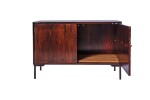

Geraldo de Barros
Sideboard, Brazillian "Jacaranda"
Lot Closed
August 5, 06:10 PM GMT
Estimate
8,000 - 12,000 USD
Lot Details
Description
Geraldo de Barros
1923-1998
Sideboard, Brazillian "Jacaranda"
Rosewood and metal
28 by 39¾ by 15¾ in.
71 by 101 by 40 cm
Please note that while this auction is hosted on Sothebys.com, it is being administered by the Aspen Art Museum, and all post-sale matters (inclusive of invoicing and property pickup/shipment) will be handled by the Aspen Art Museum. As such, Replica Shoes ’s will share the contact details for the winning bidders with the Aspen Art Museum so that they may be in touch directly post-sale.
As such, there is no buyer's premium in this auction - all sale proceeds will go directly to the Aspen Art Museum to support its programs. Certain amounts paid above the value of the property or services provided may qualify as a tax deductible donation to the museum. Replica Shoes ’s does not offer tax advice. Please consult your tax advisor, and for any tax related inquiries please contact bid@aspenartmuseum.org at the Aspen Art Museum.
Kindly donated by Ulysses de Santi and Graham Steele
Geraldo de Barros (b 1923, Sao Paulo) is one of the main exponents of concrete art in Brazil. In 1947, he joined Foto Cine Clube Bandeirantes, the pioneer nucleus of Brazilian modern photography. Three years later, working under the influence of the Gestalt theory, his seminal solo show Fotoformas, is held at the São Paulo Museum of Art (Masp). In a season of studies in Europe, he comes across the Hfg - Hochschule für Gestaltung [Superior School of Form] in Ulm, Germany, then directed by Max Bill, one of the leading theorists of concrete art. Back in São Paulo, he participated in the foundation of Grupo Ruptura, which marks the beginning of concretism in Brazil. The HfG and its Gute Form [good form] is also the engine for adhering Barros to the furniture factory Unilabor in 1954, where he worked as a designer. In the 1960s and 70s, with the company Hobjeto, he expands the possibilities of serialization. Inside the factory he makes a series of artworks in Formica in which he takes up the concepts of concretism. He was also a graphic designer and part of a group of pop artists, Rex. Barros died in 1998, in São Paulo.


