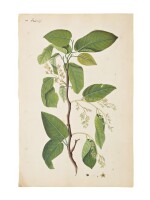

A branch of the Banyan (Ficus Benghalensis) and a branch of the Sal Tree (Shorea Robusta), Company School, late 18th century
Auction Closed
October 27, 10:37 AM GMT
Estimate
10,000 - 15,000 GBP
Lot Details
Description
pencil, pen and ink, watercolour on paper, the first with a Latin identification inscription in pencil at upper centre, further numbered ''311'' in Arabic numerals and inscribed ''barghad'' in nasta'liq script in black ink at upper left; the second numbered ''166'' in Arabic numerals and inscribed ''shakh-e darakht-e shankhu'' in nasta'liq script in black ink at upper left, the paper watermarked either 'Portal & Bridges' or 'GR' (Georgius Rex)
2
41.8 by 27.7cm. (16 ⅜ by 10 ⅞ in.); 41.8 by 27.7cm. (16 ⅜ by 10 ⅞ in.)
Viscount Torrington, perhaps George Byng, 6th Viscount Torrington (1768-1831), acquired circa 1815 or earlier
Bonhams, London, 25 October 2007, lot 433 (complete album)
Bonhams, London, 21 April 2015, lot 210
Bonhams, London, 25 October 2007, lot 433 (complete album)
Bonhams, London, 21 April 2015, lot 210
These two watercolour studies originally formed part of a larger group of one hundred and eighteen paintings in the collection of the 6th Earl of Torrington (acquired circa 1815). These drawings date to the late eighteenth century and are characteristed by their scientific nature. They are inscribed with their Latin name together with a Persian title and number. They follow the system of classification of Carl Linnaeus, a Swedish naturalist and explorer who, in 1735, devised a uniform structure for the naming and classification of plants and animals. Such academic rigour was a reflection of the period which saw strong interest from both professionals and private amateurs in the field, notably from those living in India. The East India Company further promoted this due to the potential economic, agricultural and medical advantages that could be gained through this study.
A similar watercolour of the banyan flower, originally commissioned by William Roxburgh, is in the Royal Botanic Gardens at Kew, where described as: "Banyan is a type of strangling fig native to India and Pakistan. Known in Hindu mythology as 'the wish-fulfilling tree', banyans represent eternal life" (http://powo.science.kew.org/taxon/urn:lsid:ipni.org:names:852482-1).
The sal tree, which is native to the Indian subcontinent, also translates as 'house' in Sanskrit, possibly in reference to the use of its wood.
A similar watercolour of the banyan flower, originally commissioned by William Roxburgh, is in the Royal Botanic Gardens at Kew, where described as: "Banyan is a type of strangling fig native to India and Pakistan. Known in Hindu mythology as 'the wish-fulfilling tree', banyans represent eternal life" (http://powo.science.kew.org/taxon/urn:lsid:ipni.org:names:852482-1).
The sal tree, which is native to the Indian subcontinent, also translates as 'house' in Sanskrit, possibly in reference to the use of its wood.
You May Also Like


