
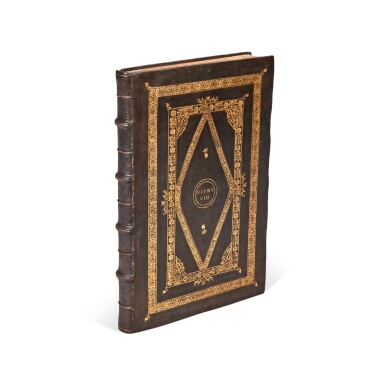
Vitruvius, De architectura libri decem traducti in vulgare, Como, 1521, contemporary Venetian morocco gilt
Auction Closed
July 9, 02:57 PM GMT
Estimate
70,000 - 100,000 GBP
Lot Details
Description
Vitruvius Pollio, Marcus. Di Lucio Vitruvio Pollione de architectura libri dece traducti de latino in vulgare affigurati: Commentati & con mirando ordine insigniti: per il quale facilmente potrai trovare la multitudine de li abstrusi & reconditi vocabuli a li soi soci & in epsa tabula con summo studio expositi & enucleati ad immensa utilitate de ciascuno studioso & benivolo de epsa opera. Como: Gottardo da Ponte [for Agostino Gallo and Luigi Pirovano], 15 July 1521
First edition in Italian, and the first edition of Vitruvius in any modern language. A tall crisp copy in a contemporary Venetian binding. "The most beautiful of all the early editions" (PMM, p.16).
The translation is by Cesare Cesariano (1475-1543), a Milanese architect and artist who also produced many of the woodcuts, as well as Benedetto Giovio and Bono Mauro, who stepped into complete the work after Cesariano's dispute with the printer. Information about the production of the book is provided in the letter at the end by the sponsors of the printing, Agostino Gallo and Aloisio Pirovano, and the contract regarding the financing of the printing was dated 11 April 1521. For the section on music theory, Cesariano consulted Franchino Gaffurio, and two illustrations from Gaffurio's De harmonica musicorum instrumentorum opus (also printed by Gottardo da Ponte, in Milan in 1518) are reused here. Cesariano's translation, based on the text of the Sulpitius editio princeps and Giocondo's, was superseded in 1556 by Daniele Barbaro's version (lots 653-656).
The Fugger Binder was active from the 1530s to the 1550s; most of the tools used on this binding are visible in the binding on a 1499 Simplicius now in All Souls, Oxford (illustrated in Hobson, Renaissance Book Collecting, p. 126), though the rose and staff stamp was used by Hobson's Emblematic Binder (ibid., p.86), who was active at the same time. Another copy of this edition bound by the Fugger Binder is in the Huntington Library (ibid., Appendix 8, no. 17).
Folio (424 x 283 mm). Roman type, 76 lines plus headline. collation: π8 A-Z8: 192 leaves. Title-page with woodcut printer's device, 116 woodcut illustrations (including 10 full-page), woodcut initials. (Slight staining around library stamp on title-page.)
binding: Venetian brown morocco by the Fugger binder (433 x 297 mm), plausibly early 1530s, outer frame of repeated gilt arabesque stamp, inner frame of repeated gilt leafy branch and rose stamp, gilt fleuron at corners, central lozenge-shaped frame with small repeated arabesque stamp, in centre a roundel lettered "VITRV|VIO" on upper cover and empty escutcheon on lower, stubs from four pairs of ties, spine tooled in blind, edges gilt and gauffered to a knotwork design. In a modern morocco drop-backed folding box by Ateliers Laurenchet. (Binding heavily restored at edges and ends of spine.)
provenance: Early shelfmark to front pastedown "N.o [?16] | litt. V. No 2" (the same shelfmark found in the Brooker copy of Contile's Ragionamento sopra la proprieta delle imprese, in an Augsburg binding with Fugger arms, lot 493 in this sale) — Counts (later Princes) of Waldburg, with eighteenth-century armorial ink stamp lettered "Furstl. Val. de. Wolf. Bibliothek" — sold in 2004 by Prince Johannes Waldberg-Wolfegg (who sold the Waldseemüller world map to the Library of Congress in 2003, with the present copy of Vitruvius part of the commission paid to the booksellers involved in the transaction) — Thomas-Scheler, Livres précieux (2004 Biennale catalogue), item 4, with bookseller's label on upper pastedown. acquisition: Purchased in 2004 from Thomas-Scheler, Paris. references: BAL RIBA 3519; Edit16 49742; Mortimer, Harvard Italian 544


