
Important Gold Boxes from a Private European Family Collection
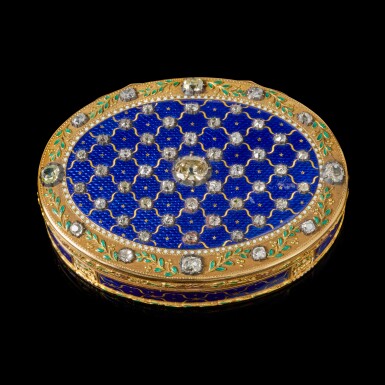
An unusual jewelled two-coloured gold and enamel snuff box, probably Berlin or Geneva, circa 1780
Lot Closed
May 16, 01:46 PM GMT
Estimate
20,000 - 30,000 CHF
We may charge or debit your saved payment method subject to the terms set out in our Conditions of Business for Buyers.
Read more.Lot Details
Description
oval, all sides decorated with semi-translucent royal blue enamel over chevron engine-turning, inlaid with tiny gold paillon stars within scrolls, the lid further embellished with collet-set diamonds at the intersections, within chased gold borders of roses and leaves picked out in green enamel around further eight diamonds, on a sablé ground, the sides with dividers formed of classical vases in white and green enamel, the left rim with a later control mark and French hibou control marks,
7.7 cm; 3 in. wide
Sotheby's New York, The Rene Fribourg Collection IV, Gold Snuff Boxes, Miniatures and Objects of Vertu, 14 October 1963
Unlike the strict rules that existed in France and other centres for hallmarking gold, there was no fully regulated hallmarking system in place in Germany. Therefore many boxes of German origin are marked with initials of bijoutiers that are yet to be discovered, while others were left entirely unmarked.
For several decades, most of these 'mystery' boxes made in the late eighteenth and early nineteenth centuries were attributed to Geneva, partially also due to a lack of alternative attributions, until Hanau was discovered as another important centre for the production of Galanteriewaren about twenty-five years ago (see also cat. no. 44 in this collection).
Contemporary writers in Germany and specifically in Berlin, however, such as Jean Pierre Erman and Pierre Chrétien Reclam, record that there were many goldsmiths active at the period, among them the Théremin brothers and the Prussian court jewellers Frères Jordan (J. P. Erman, P. C. Reclam, Mémoires pour servir à l'histoire des réfugiés françois dans les États du roi, vol. 5, Berlin, 1786). Recently Haydn Williams was able to prove that more than even thousand gold boxes were made by one Berlin-based firm alone over the course of twenty-five years (see Haydn Williams, 'The FJ conundrum', in Haydn Williams, 18th-Century Snuff Boxes: The David & Mikhail Iakobachvili Collection, vol. I, London, 2024, pp. 409-411).
More research will undoubtedly identify more examples of gold boxes made in Berlin in the last quarter of the eighteenth century, such as the present box. With many workshops and the infrastructure for creating, selling and purchasing bijouterie in Berlin already set up under the Royal Patronage of Frederick The Great a couple of decades earlier, it would seem logical that the industry continued to flourish in the later eighteenth century as well.
You May Also Like


