
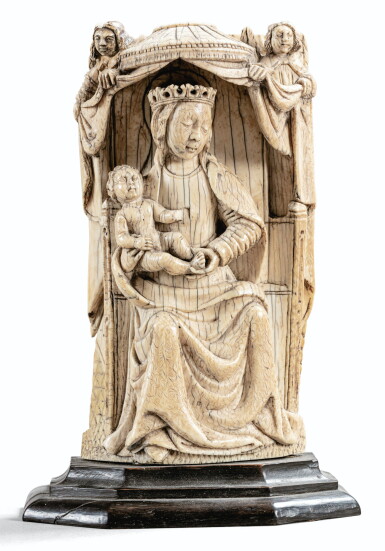
NORTHERN NETHERLANDS, 15TH CENTURY | VIRGIN AND CHILD SEATED UNDER A CANOPY
Auction Closed
December 3, 07:24 PM GMT
Estimate
12,000 - 18,000 EUR
Lot Details
Description
NORTHERN NETHERLANDS, 15TH CENTURY
VIRGIN AND CHILD SEATED UNDER A CANOPY
ivory group; on a octogonal ebonised wooden base
n°969 inscribed with ink under the base; remains of a red wax stamp
17,5 cm x 9,5 cm; 6⅞ by 3¾ in.
__________________________________________________________________
PAYS-BAS DU NORD, XVE SIÈCLE
VIERGE À L'ENFANT SOUS UN BALDAQUIN
groupe en ivoire; sur un socle octogonal en bois noirci
numéroté n°969 à l'encre sous le socle ; reste d'un cachet en cire rouge
17,5 cm x 9,5 cm; 6⅞ by 3¾ in.
Former Henri Oppenheimer collection;
Christie's London, 15th July 1936, lot 118;
Jacques Bacri collection, Paris.
__________________________________________________________________
Ancienne collection Henri Oppenheimer ;
Christie's Londres, 15 juillet 1936, lot 118 ;
Collection Jacques Bacri, Paris.
Burlington Replica Handbags s Club, 1923, cat. n°158.
__________________________________________________________________
Burlington Replica Handbags s Club, 1923, n°158.
Related Literature
Burlington Replica Handbags s Club, exh. cat. London, 1923, cat. no. 158, p. 91;
R. Koechlin, Les Ivoires Gothiques Français, t.II, Paris, 1924, no. 984, p. 361;
R. H. Randall Jr., "Dutch Ivories of the Fifteenth Century", Nederlands Kunsthistorisch Jaarboek (NKJ) / Netherlands Yearbook for History of Art, 1994, vol. 45, pp. 127-139;
S. Vandenberghe, Ivory in Bruges: Treasures from Museums, Churches and Monasteries, Bruges, 2010;
J. Warren, Medieval and Renaissance sculpture. Sculptures in Stone, Clay, Ivory, Bone and Wood, exh. cat. Ashmolean Museum, Oxford, 2014;
P. Williamson, G. Davies, Medieval Ivory Carvings 1200-1550, Part I, London, 2014, pp. 68 -69, cat. no. 17;
P. Williamson, The Wyvern collection, Medieval and later Ivory carvings and Small sculptures, Londres, 2019, cat. 156, p. 303.
__________________________________________________________________
Références bibliographiques
Burlington Replica Handbags s Club, cat. exp. Londres, 1923, cat. no. 158, p. 91 ;
R. Koechlin, Les Ivoires Gothiques Français, t.II, Paris, 1924, no. 984, p. 361 ;
R. H. Randall Jr., “Dutch Ivories of the Fifteenth Century”, Nederlands Kunsthistorisch Jaarboek (NKJ) / Netherlands Yearbook for History of Art, 1994, vol. 45, pp. 127-139 ;
S. Vandenberghe, Ivory in Bruges: Treasures from Museums, Churches and Monasteries, Bruges, 2010 ;
J. Warren, Medieval and Renaissance sculpture. Sculptures in Stone, Clay, Ivory, Bone and Wood, cat. exp. Ashmolean Museum, Oxford, 2014 ;
P. Williamson, G. Davies, Medieval Ivory Carvings 1200-1550, Part I, Londres, 2014, pp. 68 -69, cat. no. 17 ;
P. Williamson, The Wyvern collection, Medieval and later Ivory carvings and Small sculptures, Londres, 2019, cat. 156, pp. 303.
This rare crowned Virgin and Child, enthroned beneath a canopy whose curtains are being drawn back by angels, was made in the fifteenth century, probably in the Netherlands. The ivory, whose small size suggests that it was produced for private devotion, was in the collection of the banker Henry Oppenheimer (1859-1932) until his death. It was described as French when it was shown in the 1923 exhibition of the finest European ivories at the Burlington Replica Handbags s Club (op. cit., no. 158, p. 91.) in London, but an attribution to a regional school is in reality more complex, given the work's unique qualities. However, the physiognomy of the figures, with their round faces and bulging foreheads, as well as their slender fingers, suggests a Netherlandish origin.
In France, the making of ivory objects was somewhat interrupted at the beginning of the fifteenth century because of the economic consequences of the Hundred Years' War, but other centres of production emerged across Europe. In Flanders and the Netherlands, the art flourished particularly in Bruges and Utrecht, where a fresh approach to the traditions and methods of ivory carving evolved. A Virgin and Child Enthroned in the Wyvern collection (h. 7.8 cm; inv. no. 0139), probably made in Bruges in the late fifteenth century, is a good example of ivory sculpture in the round and comparable to the present object. These ivories are today the subject of renewed interest, especially from museums and collectors, as seems to be indicated by the Musée du Louvre's recent acquisition of a Virgin and Child produced in the Netherlands in around 1500 (inv. no. OA.2018.6.1).
There is also a certain similarity between the present Virgin and a Netherlandish relief in the Victoria & Albert Museum in London (inv. no. 475-1907). This was also made in the Netherlands towards the end of the fifteenth century and shows a Virgo Lactans accompanied by musician angels. The Virgin's face has the same gentle quality and the facial features are also comparable, with the prominent bare forehead. The stylistic similarities are most striking in the figures of the angels.
__________________________________________________________________
Cette rare Vierge à l’enfant couronnée trônant sous un baldaquin aux rideaux dégagés par deux anges fut réalisée au XVe siècle probablement aux Pays-Bas. L’ivoire dont les dimensions modestes laissent supposer qu’elle fût destinée à la dévotion privée, faisait partie de la collection du banquier Henry Oppenheimer (1859-1932) jusqu’à la disparition de celui-ci. Présentée en 1923 avec une origine française lors de l’exposition du Burlington Replica Handbags s Club (op. cit., cat. no. 158, p. 91.) à Londres consacrée aux plus beaux ivoires européens, l’attribution à une école régionale s’avère en réalité plus complexe au regard de la singularité de l’œuvre. Toutefois, l’étude de la physionomie des figures, aux visages ronds et aux fronts bombés, ainsi que les doigts fins font penser que son origine est à trouver aux Pays-Bas.
Tandis qu’en France la production d’objets en ivoire tend à s’interrompre au début du XVe siècle en raison des conséquences économiques de la Guerre de Cent ans, d’autres centres de production émergent à travers l’Europe. En Flandre et aux Pays-Bas, ce sont particulièrement les villes de Bruges et d’Utrecht où cet art se développe, renouvelant ainsi les traditions et les formes du travail de l’ivoire. Une Vierge à l’enfant trônante de la Wyvern collection (7,8 cm, inv. no. 0139) probablement réalisée à Bruges à la fin du XVe siècle offre un bon exemple de la sculpture en ronde-bosse sur ivoire qui apparaît dans ces nouveaux centres de créations. Ces ivoires font aujourd’hui l’objet d’un regain d’intérêt notamment par les musées, ce que l’acquisition en 2018 d’une Vierge à l’enfant sculptée vers 1500 aux Pays-Bas par le Louvre semble confirmer (inv. no. OA.2018.6.1).
On peut noter une certaine résonnance entre notre Vierge et un haut-relief néerlandais du Victoria & Albert Museum de Londres (inv. no. 475-1907). Cette œuvre également exécutée au Pays-Bas à la fin du XVe siècle présente une Vierge allaitante accompagnée d’anges musiciens. On y retrouve la même douceur dans le visage de la Vierge, ainsi qu’une physionomie proche avec un front dégagé et bombé. C’est particulièrement dans les figures des anges que les similarités stylistiques sont les plus frappantes.