ATTRIBUTED TO JOHANN KÖNIG | THOMAS THE APOSTLE BAPTISING THE INDO-PARTHIAN KING GUDNAPHAR, ALSO KNOWN AS THE BAPTISM OF THE MAGUS KING CASPAR
Auction Closed
December 3, 07:24 PM GMT
Estimate
10,000 - 15,000 EUR
Lot Details
Description
ATTRIBUTED TO JOHANN KÖNIG
NUREMBERG 1586 - 1642 AUGSBURG
THOMAS THE APOSTLE BAPTISING THE INDO-PARTHIAN KING GUDNAPHAR, ALSO KNOWN AS THE BAPTISM OF THE MAGUS KING CASPAR
Oil on canvas
50,6 x 64,5 cm ; 20 by 25⅜ in.
__________________________________________________________________
ATTRIBUÉ À JOHANN KÖNIG
NUREMBERG 1586 - 1642 AUGSBURG
LE BAPTÊME DU ROI DES INDES GOUDNAPHAR PAR L’APÔTRE THOMAS, DIT AUSSI LE BAPTÊME DU ROI-MAGE GASPARD
Huile sur toile
50,6 x 64,5 cm ; 20 by 25⅜ in.
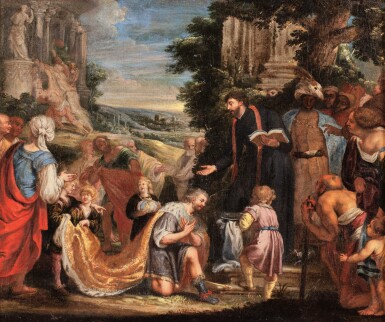
This painting can be compared to the art of Adam Elsheimer and certainly comes even closer to one of his most famous followers: Johann König. The fresh, bright colours, the meticulous attention to detail and the luminous landscape in the background – all these features recall the art of the pre-Rembrandtists, whose principal protagonist was Elsheimer and who included Lastman, the Pynas brothers and Johann König.
The iconography remains unclear. While it plainly depicts a baptism, it cannot represent the eunuch baptised by the Apostle Philip. The setting, which suggests both antiquity and the East, recalls the iconography of St Paul in Lystra, although a specific episode cannot be identified. It is much more likely that this is St Thomas baptising the Indo-Parthian King Gudnaphar I, who is often confused with the Magus King Caspar. By portraying the Apostle in a modern religious habit, was the painter seeking to suggest the soutane worn by the Jesuits? And if so, could this work be a very fanciful representation of the activity of the Jesuit missionaries, at that time expanding at a great rate?
__________________________________________________________________
Le tableau est à rapprocher de l’art d’Adam Elsheimer et, sans doute plus encore, de l’un de ses suiveurs les plus célèbres : Johann König. Aussi bien les coloris vifs et frais, que le caractère minutieux dans le traitement des détails, ou encore le paysage vibrant à l’arrière-plan, tout rappelle l’art des pré-rembranesques dont Elsheimer fut le principal acteur, et dont Lastman, les frère Pynas, et Johann König furent les continuateurs.
L’iconographie en reste cependant incertaine. S’il s’agit bien évidemment d’un baptême, il ne peut s’agir de celui de l’Eunuque par l’apôtre Philippe. D’un autre côté, l’environnement, qui évoque à la fois l’antiquité et l’orient, rappelle l’iconographie de saint Paul à Lystre, sans que l’on puisse déterminer une scène précise. Il s’agit bien plus probablement de saint Thomas baptisant le roi des Indes Goudnaphar Ier, souvent confondu avec le Roi-Mage Gaspard. En représentant l’apôtre dans un habit religieux moderne, le peintre a-t-il voulu évoquer la soutane des Jésuites ? Et faut-il donc voir dans cette œuvre une représentation très fantaisiste de l’activité des Missionnaires Jésuites, alors en pleine expansion ?