
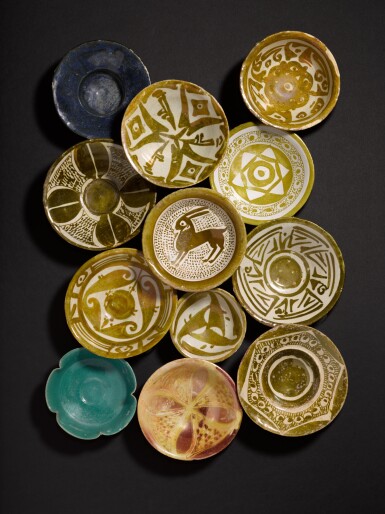
A group of twelve Abbasid lustre pottery dishes, Iraq, 9th/10th century
Auction Closed
October 23, 01:24 PM GMT
Estimate
40,000 - 60,000 GBP
Lot Details
Description
comprising nine decorated in a dark golden monochrome lustre over an opacified tin glaze with various designs including a hare, stylised palmettes, geometric motifs and pseudo-inscriptions; one decorated in polychrome lustre with a central lobed palmette; one painted in monochrome lustre with inscriptions in Kufic on a cobalt-blue ground; one with monochrome turquoise glaze and fluted sides
largest 14cm. diam.
smallest 9.5cm. diam.
Ex-private collection, Japan, 1960s/70s
The sophisticated and expensive technique of lustreware is understood to have originated in Abbasid Iraq in the ninth century. The process involved applying pigments of silver and copper oxides to a previously glazed and fired vessel. The second firing in a reduced atmosphere would cause a reaction resulting in metallic deposits with an iridescent, lustrous sheen.
Abbasid potters held a monopoly on lustreware in the ninth century, producing examples in polychrome and monochrome lustre. This group comprises examples in monochrome lustre in an array of designs from curvilinear arabesques, stylised Kufic inscriptions, and abstract geometry, as well as one example in polychrome lustre. One notable dish features a central hare on a dotted ground. A closely comparable bowl is in the al-Sabah Collection, Kuwait (inv. no.LNS 410 C, see Watson 2004, p.193, no.E.14). The group further showcase the influence of Chinese ceramics on early Islamic pottery production. The plain-glazed turquoise dish with fluted sides follows a profile found in Tang metalwork; see a Tang dynasty parcel-gilt silver bowl sold in these rooms, 14 May 2008, lot 74. The vast majority of surviving monochrome Abbasid lustrewares are decorated on a white ground. An unusual example in the present lot is decorated with Kufic inscriptions in lustre on a deep-blue glazed ground; see a shard in the Victoria and Albert Museum for an example in a comparable palette (inv. no.C1161-1947). The palette of golden lustre on a blue ground was reprised by the Fatimids and a handful of vessels survive in shades ranging from turquoise to lavender grey, including a jar sold in these rooms, 19 October 2016, lot 224.
Saba examines the Abbasids’ fascination with lustreware in relation to an understanding of abu qalamun and ‘ajib. References to abu qalamun from writers in the tenth to fourteenth century indicate that the term signified a quality of changeability particularly in reference to visual effects such as the iridescence of the plumage of a peacock. He suggests that Abbasid lustreware produces abu qalamun-like colours through the fleeting nature of its metallic sheen that shifts hue in the changing light (Saba 2012, pp.192-5). Saba relates this to the term ‘ajib that refers to a certain feeling of wonder in response to a phenomenon that cannot be fully comprehended. The brilliant, unstable nature of the colours of lustreware, he explains, defy explanation, an effect that is coupled with “pleasurable contrasts” within the choice of pattern to encourage prolonged engagement with the vessel (Saba op.cit., p.198-203).
You May Also Like


