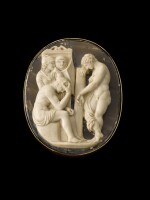

Italian, 18th century, After the Antique | Cameo with Orestes and Pylades
Lot Closed
December 16, 01:43 PM GMT
Estimate
14,000 - 20,000 GBP
Lot Details
Description
Italian, 18th century,
After the Antique
Cameo with Orestes and Pylades
chalcedony, within a mount
cameo: 59.8mm., 2.35in.
61.9mm., 2.43in. overall
The cameo follows a celebrated fragment in the Museum of Replica Handbags s, Boston (inv. no. 21.1221), which is thought to be ancient, though some scholars have dated it to the Renaissance. The fragment was said to have been discovered in the Roman Campagna by a peasant and subsequently made its way to Cardinal Albani who presented to his lover Countess Cheroffini. The composition depicts Orestes seated, with his head in his hands, whilst Pylades stands leaning against a column. Orestes was the son of Clytemnestra and Agamemnon and cousin to Pylades. The scene has been interpreted as showing the two mourning by the tomb of Agamemnon, or as the cousins' farewell before Orestes was due to be sacrificed in Tauris. Scholars have interpreted the relationship between the two as having homoerotic overtones, which is also apparent in the present cameo. The composition of the Boston fragment was reconstructed first by Berneabé based on a relief in Palazzo Mattei. Nathaniel Marchant created his own version which was formerly in the British Museum but was destroyed in World War II but is known from a plaster cast by Tassie in the same museum (inv. no. 1799,0521.83.a).