
Property from a Distinguished East Coast Private Collection
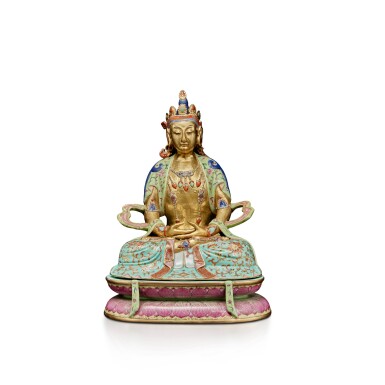
A gilt and famille-rose figure of Amitayus, Qing dynasty, Qianlong period
Auction Closed
September 18, 08:03 PM GMT
Estimate
60,000 - 80,000 USD
Lot Details
Description
lotus stand (2)
Height 11⅝ in., 29.6 cm
Amitayus, a form of the buddha Amitabha and signifying 'Infinite Life', was a particularly popular deity in the court of the long-reigning Qianlong Emperor. Countless images of the deity were produced during the Qianlong period, particularly in gilt-bronze, and large sets were often commissioned for important birthdays such as the emperor's sixtieth or seventieth; images of Amitayus in famille-rose porcelain, however, were relatively rare and only a handful of such works have survived. Of the extant examples, some figures are depicted with naturalistic skin tones, while others, including the present example, bear gilding on the surface of the body.
A closely-related example, with gilt skin and of nearly identical height, was sold in our Paris rooms, 16th December 2010, lot 196, and another similar figure with naturalistic skin tone was sold in these rooms, 23rd March 2011, lot 729. More recently, another example with naturalistic skin tone was sold at Christie's New York, 23rd September 2022, lot 918. All three noted examples differ only slightly from the present work in the decoration of the robes; in contrast to the circular medallion foliate motif on the dhoti and small stipples on the sash of the three other works, the present work has an ornate scrolling vine on both the upper and lower garments.
Such figures can also be viewed in the context of the Qianlong court's fascination with trompe l'oeil, especially the imitation in porcelain of other artistic materials through the clever use of special glazes: 'Teadust' glaze was used to imitate the patinated green of bronze vessels, while 'faux bois' glazes emulated the grain of wood. In the present case, the gilt of the figure's skin and the bright colors of the lotus base and drapery may have been meant to reproduce representations of Amitayus that were carried out in gilt-bronze and cloisonné, including an example sold at in our Hong Kong rooms, 4th October 2011, lot 1974.