
Property from the Junkunc Collection
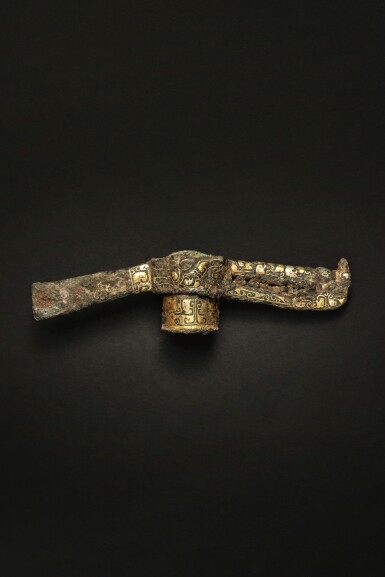
A rare gold and silver-inlaid iron finial, Warring States period - Han dynasty
Auction Closed
September 18, 08:03 PM GMT
Estimate
15,000 - 20,000 USD
Lot Details
Description
Length 7¼ in., 18.4 cm
C.T. Loo, New York.
Collection of Stephen Junkunc, III (d. 1978).
Exhibition of Chinese Arts, C.T. Loo & Co., New York, 1941, cat. no. 156.
Highly ornamented axe heads of this type were likely made for ceremonial use as a finial crowning a long pole, together with a matching ferrule to cap the foot rather than as a functional weapon used in warfare. See a related gold-inlaid metal finial, modeled in the form of a dragon head issuing a long terminal, from late Warring States period, excavated, together with its fitted lacquered wood pole and bronze ferrule, from Tomb 2 at Baoshan, Hubei province, now in the Hubei Provincial Museum, Wuhan, exhibited in Ringing Thunder. Tomb Treasures from Ancient China, San Diego Museum of Art, San Diego, 1999, cat. no. 78.
A closely related gold-inlaid iron axe-head finial, attributed to the Han dynasty, formerly in the George Crofts Collection, is now in the Royal Ontario Museum, Toronto (accession no. 925.1.28). See other related examples, including a gold and silver-inlaid bronze finial, cast with a curved bird-form terminal issuing from a dragon head, from the middle Warring Sates period, unearthed with remains of wood in the socket in Qufu, Shandong province, published in Zhongguo wenwu jinghua daquan qingtongjuan [Compendium of Chinese art. Bronzes], Taipei, 1993, no. 1018; a gold-inlaid iron finial with a bird-form terminal and a similar axe blade, attributed to the Han dynasty, sold in our London rooms, 28th May 1968, lot 13; another sold in these rooms, 8th November 1980, lot 9; a bronze axe-head finial without inlay, excavated in Changzhi, Shanxi province, published in Shanxi chutu wenwu [Excavated cultural relics in Shanxi], Beijing, 1980, no. 102.
You May Also Like


