“I have started re-reading the Thousand and One Nights with pleasure, will it be kept up?”
Thus wrote Magritte in a cheeky 1946 letter to the Surrealist writer and photographer Marcel Mariën, playing on the central theme of the famed Middle Eastern folktale known as The Thousand and One Nights or The Arabian Nights. The legend opens with the story of the king of the Persian Empire, Sultan Shahryar, realizing that his beloved wife had been unfaithful to him. Enraged and embittered, the king has her executed and resolves to marry a new bride every night, executing each the following morning before she too can dishonor him.

At last, the wise and witty young Scheherazade volunteers to become his newest bride. On their wedding night, she begins an engrossing tale, promising to finish the story the following day. So captivating is her storytelling that each night, the king begs her to begin another tale. Day by day, Scheherazade evades death until eventually, one thousand and one nights later and madly in love, the king makes her his queen.
Magritte indeed 'kept up' with his reading: shortly thereafter his work would begin to pay homage to the story, giving rise to a limited series of gouaches and the very first oil painting bearing the title Shéhérazade in 1947 (see fig. 1). One of only three oils by the same name (the others being the 1947 composition and one from 1948 held in the collects ion of Musée Royaux des Beaux-Arts in Brussels; see fig. 2), the present composition is the final and most focused of Magritte’s Shéhérazade. With his ‘pearl-woman’ at the fore, the present composition asserts itself as the quintessential Surrealist portrait, replete with literary allusion, art historical homage and the Surrealist pièce de resistance of the fragmented figure.

Having moved away from the light-hearted and feathery stylization of his ‘Renoir’ and ‘vache’ periods of the mid-1940s, Magritte had by 1950 returned to his signature style. Infused with the lively color of the preceding years yet refined to his peerless standard of draftsmanship, works like his 1950 Shéhérazade show the artist as his prime.

Placed amid a coterie of iconic motifs like his cottony sky, placid sea and the eerie single bell, Magritte’s pearl-woman at last takes her rightful place at the center of this composition. Whereas the 1947 and 1948 compositions both exist as something of a genre scene, the present work is a veritable portrait akin to his Magie noire or Fils de l’homme works (see figs. 3-4).
“I think as though no one had ever thought before me.”

Even the exemplary Le Libérateur, now in the collects ion of the Los Angeles County Museum of Art, subsumes the pearl-woman as a facet, even a prize, of the headless caped figure at center (see fig. 5). Of the various works which feature the motif in part, the present composition is the only oil to fully convey the notion of the female portrait.
Following in the great tradition of ‘The Bather’ as seen from antiquity to the Renaissance to the nineteenth century and the Modern era, Magritte draws on the canonical works of art history and reinterprets the theme through his singular Surrealist lens. Set along a coastline, Magritte’s Shéhérazade borrows from the most notable tropes of Western art, recalling Renaissance goddesses and Arcadian idylls (see fig. 6).

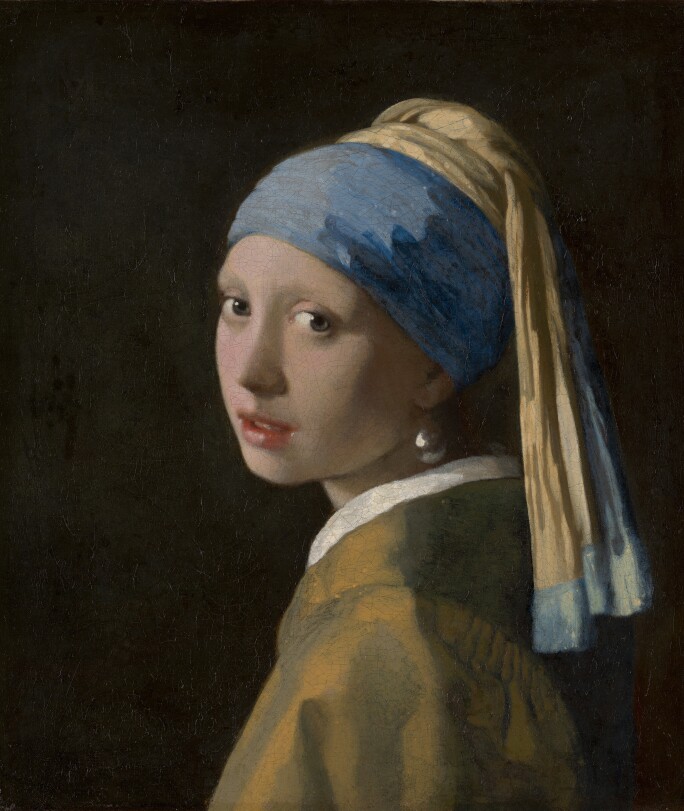
The guise of Magritte’s pearl-woman is undeniable indebted to Vermeer, whose Girl with a Pearl Earring the artist viewed many t.mes s at the Mauritshuis museum in The Hague (see fig. 7). Considered the ‘Northern Mona Lisa,’ the enigmatic tronie—a sort of archetypal rendering rather than a specific portrait—would’ve greatly appealed to the Surrealist artist whose body of work unerringly toyed with notions of visual repetition and semiotic inconsistency.
“We see [the world] as being outside ourselves even though it is only a mental representation of it that we experience inside ourselves.”
In the most literal sense, the transposition of Vermeer’s iconic pearl motif is self-explanatory in the present work. The artist’s homage to the Old Master is further aided by the substitution of Magritte’s bell for Vermeer’s earring as well as the use of nearly the same palette, albeit in differing proportions.
Such fragmentation and reimagining of the human figure was central not only to Magritte’s enduring oeuvre but the greater Surrealist philosophy. Enraptured by Freudian psychanalytical theories of the subconscious and automatism, the leading figures of the movement like André Breton, Salvador Dalí, Giorgio de Chirico, Man Ray and Marcel Duchamp prioritized the human form as a vehicle for artistic experimentation. Between their collaborative drawings like Cadavre exquis and individual works like Man Ray’s depiction of Lee Miller’s floating lips in Observatory t.mes - The Lovers or Dalí’s Mae West’s Face which May be Used as a Surrealist Apartment, the human (and often female) figure proved fertile ground for their psychic and artistic liberation (see fig. 8).

This recontextualization is evident from Magritte’s earliest Surrealist works like L’Évidence eternelle and Le Viol of the 1930s, in which the female form is deconstructed and reordered, respectively. But whereas Breton and artists like André Masson and even Joan Miró were concerned with the automatism of Surrealism, Magritte was focused on the dream-like imagery and chance encounters of objects—the ‘elective affinities’ of images as he termed them—and the reconciliation of reality and imagination. As Susan Gablik writes, “To Magritte, all the possible acts of the mind—displacement, explanation, etc.—are indifferent unless they directly evoke mystery. Painting manifests that moment of lucidity, or genius, when the power of the mind declares itself by revealing the mystery of things that appear, until that moment, familiar.” (Susan Gablik, Magritte, Greenwich, 1970, p. 72)

In the years following the execution of Magritte’s Shéhérazade, a new generation of painters would look to the artist as an icon. This new community of artists, and to some extent the American public, had first come to know the work of Magritte through Peggy Guggenheim’s Art of This Century gallery as well as Hugo Gallery and Copley Galleries in the late 1940s. The likes of Jasper Johns and Roy Lichtenstein even considered him the ‘Father of American Pop Art' (see figs. 9-11). Spurred by works like Shéhérazade, American artists of the 1950s and 60s picked up the mantle of their predecessors like Magritte. Where the Surrealists attempted a revolution of the object through radical recontextualization and transformation of the mundane, Pop artists assimilated the quotidian facets of life through their stylized depictions of consumer imagery.

Featuring one of Magritte’s most iconic images and a quintessential Surrealist portrait, Magritte’s Shéhérazade stands as an integral work amid the lineage of art history. In 1954, Magritte dedicated and gifted to his friend Stéphy Langui, who would later acquiesce to Magritte’s request to paint her, resulting in the 1961 Portrait de Femme (Portrait of Stéphy Langui). Her husband, Emile Langui was a Belgian curator and fervent Socialist and anti-Fascist activist who was involved in the Resistance and later dedicated his life to repatriating looted works, working closely with the Monuments Men. Shéhérazade remained in the Langui collects
ion until Stéphy’s death in the late 1990s; it now comes to auction for the very first t.mes
.