The original owner of this set of masks, Maurice Henry Cardiff, was an officer in the British Council who led an adventurous career spanning over three decades serving posts in Greece, Italy, Cyprus, Belgium, Thailand, and France. It was in 1959, when he began a four-year post in Mexico. Once there, he wrote One’s Man Mexico (published in 1968) under his secret pen name John Lincoln.
His wife, Leonora, a Stratford upon Avon and RADA trained actress, met the other Leonora during a luncheon shortly after the couple’s arrival to Mexico. Maurice Cardiff described meeting Carrington in his 1997 book Friends Abroad:
A month or two after our arrival, my wife, returning from a women's lunch party, told me she had sat next to a beautiful and fascinating English painter. From an early interest in surrealism, although I had not seen any of Leonora Carrington's paintings even in reproduction, I remembered she had been one of a group of surrealists [....] Now, on our first visit to her studio where we met her anarchist husband, Chiqui, to whom we became deeply attached, and were captivated by her paintings which had a magic uniquely their own, we began a friendship which was to last throughout our stay in Mexico and beyond.
It was also by this chance meeting, that the Cardiffs were introduced to the eccentric English aristocrat Edward James, the creator of the surrealist garden Las Pozas, along with Remedios Varo, and the surrealist social circle at the t.mes
.
Original cast of The Tempest posing with masks during cost.mes fitting, 1959.
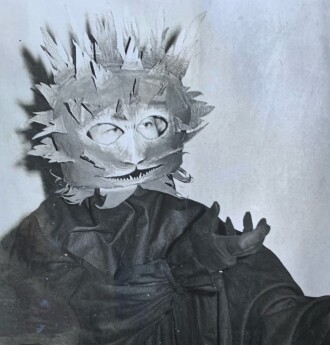

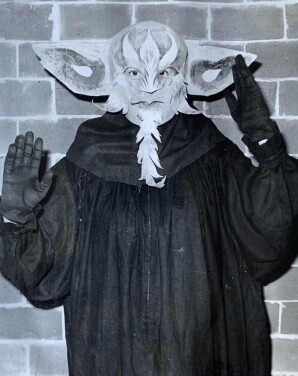
The present set of masks was a gift from Leonora Carrington to the Cardiffs in 1959, the same year both she and Leonora Cardiff collaborated on the summer-t.mes
production of The Tempest (see Figure 1)–Cardiff as director and Carrington as the production designer. Like many of the Surrealists artists in the 1950s, Carrington expanded her pictorial practice to theatre design, creating cost.mes
s and stage settings for various theatrical projects and for her own play, Pénélope, in 1957. The evolution of Carrington’s easel-paintings of the mid-1950s onwards paralleled her three-dimensional theatrical ventures. A “theatrical ambience enters into her paintings” during this t.mes
, as seen in “Temple of the Word (1954), where she evokes medieval pageantry while Sacrament at Minos (1954) hints at sacerdotal mystery plays from ancient Near East” (Susan L. Aberth, “Esoteric Interests” in Leonora Carrington: Surrealism, Alchemy and Art, 2004, p. 97).

The fluidity of Carrington’s creative multi-media practices in two-dimensional and three-dimensional formats allowed her to not only further the exploration of esoteric interests, but more importantly echo the multiplicity of the fantastic realities she sought to create. The complex matrices of the human and spiritual, the magical and illogical, the natural and rational all harmoniously comingle in a quotidian commonplace typical of Carrington’s artistic universe. It could be said that her theatrical cost.mes
s – this creation of otherworldly creatures – represent her pictorial, imaginative world incarnate; a fully realized entry of the fantastic into our normative reality.
Exhibition Links –
Margate, Turner Contemporary
https://turnercontemporary.org/whats-on/journeys-with-the-wasteland/
Tate Liverpool
https://www.tate.org.uk/whats-on/tate-liverpool/exhibition/leonora-carrington