Discursive Cursive: On Twombly’s Pivotal Blackboard Series


"Each line now is the actual experience with its own innate history. It does not illustrate - it is the sensation of its own realization."
Vibrating with lyrical vitality and poetic force, Cy Twombly’s Untitled from 1969 is a marvelously gestural iteration of the artist’s pivotal Blackboard paintings. Captivating in its large scale, the present work is part of a limited number of panoramic canvases from the celebrated series. Illustrating Twombly’s singular ability to mediate urgency and immediacy with control and order, Untitled interrogates our very understanding of mark making while tapping into a primal pursuit of the sublime. Whirling across the canvas, Twombly’s coiled lines, as though electrically charged, magnificently ignite that which lies even most deeply within the human soul. It is thereby that Untitled so triumphantly encapsulates Twombly’s driving force as an artist.
While many of Twombly’s other Blackboard paintings contain distinct strata of loops, the exact number of lines is difficult, if not impossible, to discern in the present work; in rolling currents akin to the aquatic, the white marks of Untitled are erased, overdrawn and intertwined against their smoky gray background. Sensuously, Twombly’s lines reverberate to the very edges of the canvas. While the topmost lines demonstrate a certain level of tight restraint, the lines towards the bottom of the frame begin to loosely unravel; subdued, elegant loops transform into wider, frenetic waves. Such rebellion against linearity and legibility demonstrates Twombly’s genius at its apex—though reminiscent of written language, Twombly’s lines are, here, ultimately more painterly than textual. Within the urgent yet organized chaos of the artist’s inscriptive process, a lyrical form of abstraction begins to emerge. The artist himself described the genre-defining potential and sublime effect of these works, noting: “Each line now is the actual experience with its own innate history. It does not illustrate - it is the sensation of its own realization.” (The artist cited in: Exh. Cat, New York, The Museum of Modern Art, Cy Twombly: A Retrospective, 1994, p.27)
CY TWOMBLY BLACKBOARDS IN MAJOR PUBLIC collects IONS


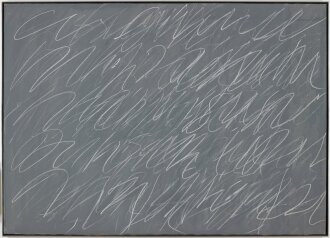


The spectacular scale of the present work amplifies the momentum of Twombly’s curving shapes that superimpose a gridded axis. Fully emergent in some areas and barely perceptible in others, this square establishes a counterpoint to the riveting lassoed lines. This grid appears as a vestige of his visual iconography from 1968 to 1970, during which the artist eschewed loops in favor of rectilinear forms that manifested his interest in advanced mathematics and the design of rocket-propelled spacecraft that reached its apex in the buildup to the 1969 Apollo 11 moon landing. Retaining some of the graphic rigor of this concurrent output, Twombly undergirds the spontaneity of his circular scrawl with an imprint of preparatory deliberation.
Untitled, in its labyrinthic angst, possesses a universal resonance through its ability to conjure the past. The primal, graphic expression that oscillates across the canvas beckons prehistoric cave paintings and other modes of expression that predate written language. Twombly’s entrenchment in the archaic is well documented, and he himself has stated: “Generally speaking my art has evolved out of the interest in symbols abstracted, but never the less humanistic; formal as most arts are in their archaic and classic stages, and a deeply aesthetic sense of eroded or ancient surfaces of t.mes .” (the artist cited in Nicola del Roscio, ed. Op. Cit., p. 199) Untitled also, through its medium and method, invokes the uninhibited liveliness of childlike expression. Rendered partially through wax crayon on a canvas that looks like a blackboard, Twombly’s proto-handwriting channels the elementary while also probings the intellectual.


“I have always thought 'Twombly' ought to be (if it isn’t already) a verb, as in twombly: (vt): to hover thoughtfully over a surface, tracing glyphs and graphs of mischievous suggestiveness, periodically touching down amidst discharges of passionate intensity. Or then again, perhaps a noun, as in twombly (n.): A line with a mind of its own."
Executed between 1966 and 1971, Twombly’s Blackboards marked a distinct shift from his Baroque paintings of the early 1960s. In the latter half of the decade, the artist returned to his monochromatic artistic roots, galvanizing them with an erotic charge. Systematically repeating his sensuous loops on canvas in order to communicate that which neither visual image nor written word could alone, Twombly began presenting calligraphy as a moving image. Untitled was created shortly after a pivotal relocation for the artist. For several years, Twombly lived and worked in Rome, but he would return to New York in 1967. The artist’s movement from Rome to New York is palpable in the present painting’s gritty, cool expression.


Though Untitled clearly engages in a dialogue with Twombly’s contemporaries, it also subverts the very limits of genre. Within the present work, the amorphous boundaries of linearity recall the minimalist pursuits of artists such as Frank Stella, while the raw and dynamic mark-making signals the energy of action painters like Jackson Pollock. It is through these varying marriages of philosophy and aesthetics that Twombly generates an entirely new method of mark-making. Art critic Pierre Restany has described Twombly’s mode of expression as: “poetry and reporting, furtive gesture and écriture automatique, sexual catharsis and both affirmation and negation of the self. As full of ambiguity as life itself...Twombly's 'writing' has neither syntax nor logic, but quivers with life, its murmuring penetrating to the very depths of things. The marks are elusive since they instinctively make for the essential." (Pierre Restany, The Revolution of the Sign, 1961, in: Nicola Del Roscio, ed., Writings on Cy Twombly, Munich 2002, p. 47)
In this auratic example of Twombly’s rich draftsmanship and renewed inspiration, the artist masterfully demonstrates an exercise between calm control and anarchic abandon. In present work, swathing lines form kinetic crescendos of sensual and intellectual catharsis that is both universal and particular to the individual. Underscoring a fundamental need for expression and interrogate existing methods of understanding. Untitled evinces an utterly new yet wholly legible visual mode.


