How Jean-Michel Basquiat Turned Art History on Its Head


“70-75 beats per minute is a normal heart rate. Once upon a t.mes in the 80s, the pace was quicker, and Jean-Michel Basquiat's pulse was faster than most... So watch the artist use it. For even now – and especially in drawings such as these – it is all still happening right before your eyes.”

Right: The present work installed in the exhibition Jean-Michel Basquiat at the Brant Foundation in New York City, March – May 2019. Art © Estate of Jean-Michel Basquiat. Licensed by Artestar, New York

Executed in 1982, Untitled (Head) is an explosion of vivid color and frenzied mark making which stands as one of the most accomplished of Basquiat’s iconic ‘Head’ paintings. Enduring as both idiosyncratic self-portraits and skull-like talismanic icons, the single ferocious figures revealed in works such as Untitled (Head) prevailed as a key conceptual anchor for Basquiat throughout his career, appearing in and dominating the majority of his best-known masterworks. Remarkable for its fierce intensity, arresting coloration and visceral aesthetic impact, Untitled (Head) is a supreme masterpiece that embodies the overwhelming power of Basquiat’s creative insurgency. Encapsulating the incredible dexterity and draftsmanship that defines the very best of the artist's works, and extraordinary for its use of India ink under the oilstick to lend depth and contrast to the composition, Untitled (Head) is a heroic depiction that reflects the explosive talent and brilliance of its author. It is an iconic work, as vivid and alive now as it was at the moment of execution. As Robert Storr commented in his essay for the Robert Miller gallery show in which the work debuted: “in drawings such as these - it is all still happening right before your eyes.” (Robert Storr, “Two Hundred Beats Per Min,” in: Exh. Cat., New York, Robert Miller Gallery, Basquiat Drawings, 1990, n.p.)

- Two Heads
- Fierce Gaze
- The Hair
- Anatomy
- Chalkboard inscriptions
-
 Two HeadsThe present work bears close comparison to one of Basquiat’s greatest works, Untitled from 1981, currently housed in The Broad Museum in Santa Monica. In its color, composition, electrifying gaze, and searing immediacy, Untitled (Head) stands as one of the artist’s greatest works, and can be seen as a lifesize version of the Broad's painting. Even in his paintings, Basquiat was drawing, and indeed the best of his paintings are characterized not by their application of paint, but by the artist’s dextrous use of oilstick.
 -
 Fierce GazeBasquiat saw the head, and especially the eyes, as “as a passageway from exterior physical presence into the hidden realities of man’s psychological and mental realms” (Fred Hoffman in: (Exh. Cat., New York, Acquavella Galleries, Jean-Michel Basquiat Drawing: Works from the Schorr Family collects ion, 2014, p. 74). His vibrant and heavily worked treatment of the eyes in these two works, luminous pupils shining through the darkness of the iris, lend these two masterworks a searing intensity that hums with explosive energy.
 -
 The HairBasquiat saw the head, and especially the eyes, as “as a passageway from exterior physical presence into the hidden realities of man’s psychological and mental realms” (Fred Hoffman in: (Exh. Cat., New York, Acquavella Galleries, Jean-Michel Basquiat Drawing: Works from the Schorr Family collects ion, 2014, p. 74). His vibrant and heavily worked treatment of the eyes in these two works, luminous pupils shining through the darkness of the iris, lend these two masterworks a searing intensity that hums with explosive energy.
 -
 AnatomyEntranced by Leonardo’s anatomical studies and Gray’s Anatomy, a book he was gifted by his mother after he was hit by a car as a child, Basquiat’s deconstruction of the human face and body is a pivotal part of his oeuvre. The emphasis in both these works on the angular shape of the jaw and deformation fo the ear, the stitches that pepper both heads and the anatomical deconstruction of the neck in the present work all betray this fascination, an iconic element of that artist’s oeuvre
 -
 Chalkboard inscriptionsThe use of white oilstick on a black background - India ink in the case of the present work, oil paint in the case of Untitled (1981) - on the craniums of both these works is an unusual detail that binds these two works together. Echoing Cy Twombly’s iconic blackboard paintings and prefiguring the text based paintings that would dominate the best of Basquiat’s output later in his career, such as Pegasus from 1987, this technique lends great depth to the composition, heightening the sense that these works allow the viewer to peer into the head of their subjects.


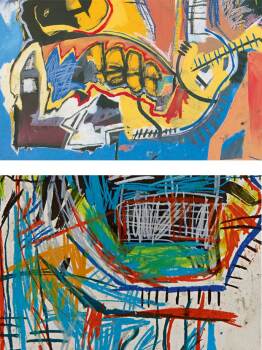


Like many of his contemporaries, Basquiat privileged the immediacy of the isolated image over narrative, and with his ‘Heads’, defiantly figurative works that saw the artist employ the full breadth of his mark-making arsenal, he found a subject which he could shape and morph to meet his ambitions. Describings the singular importance of the heads within Basquiat’s oeuvre in terms highly reminiscent of the present work, Phoebe Hoban reflects: “Start with the head. (He painted them obsessively). The Hair was a focal point… the dreadlocks, Basquiat’s own version of a crown… Next the eyes. There was that look… People said his eyes could eat through your face, see right through you, zap you like the x-ray vision of his comic book heroes.” (Phoebe Hoban, Basquiat: A Quick Killing in Art, London 1998, p. IX) Reaching its apex in 1982, Basquiat’s exploration of the human head is his crowning achievement.
He realized the universal relatability of this subject, recognizing that his viewers would see themselves in these works, using the intensity of his line, suppressed energy of his composition, and exuberance of his coloration to experience a degree of catharsis. In the case of the present work, its scorching gaze, bared teeth and fiercely delineated physiognomy express a degree of emotional intensity that evidences Fred Hoffman’s description of Basquiat’s astute observation of psycho-spiritual states of being: "What drew Basquiat almost obsessively to the depiction of the human head was his fascination with the face as a passageway from exterior physical presence into the hidden realities of man’s psychological and mental realms…they not only peer out as if seeing, but also invite the viewer to penetrate within." (Exh. Cat., New York, Acquavella Galleries, Jean-Michel Basquiat Drawing: Works from the Schorr Family collects ion, 2014, p. 74)

“Start with the head. (He painted them obsessively). The Hair was a focal point… the dreadlocks, Basquiat’s own version of a crown… Next the eyes. There was that look… People said his eyes could eat through your face, see right through you, zap you like the x-ray vision of his comic book heroes.”

The Metropolitan Museum of Art, New York
Art © 2020 The Willem de Kooning Foundation / Artists Rights Society (ARS), New York
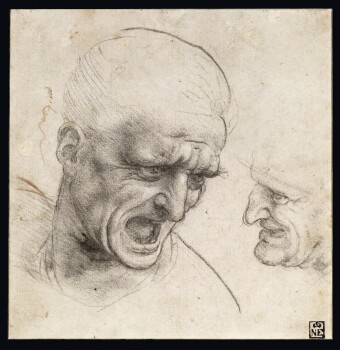
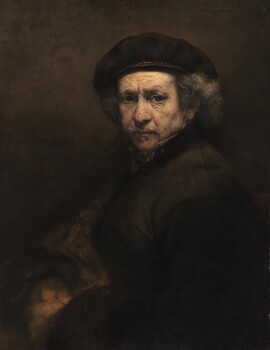
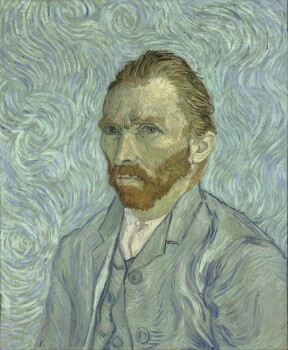
Of course, Basquiat was by no means the first artist to see the potential of the human head as a vehicle for communicating the psychology of his subject. With Untitled (Head) he locates himself within a canon of artists who have used the human head as a vehicle for psychological examination, and in doing so have created some of the most enduring masterpieces of their respective periods. Starting, arguably, with Leonardo da Vinci, whose immense influence on Basquiat was particularly pronounced in the early years of his career and can be seen in the present work through the anatomical deconstruction of the figure’s neck, and moving through Rembrandt, Gustave Courbet, Pablo Picasso and Francis Bacon, this lineage encompasses many of the artists now considered masters of their craft. Further, it is striking that many of these artists’ greatest works conjure a similar sense of isolation and existential anxiety as that generated by Untitled (Head). As a black artist in an artworld comprised almost entirely of white actors, Basquiat was keenly aware of his status as an outsider. Like many of art history’s great revolutionaries, such as Edvard Munch, van Gogh, and Egon Schiele, Basquiat considered himself as standing apart from many of his peers. Unlike those artists however, who produced their greatest work before the critical tide had turned in their favor, Basquiat's rise to fame was meteoric and unprecedented, such that the young artist had reached international prominence before the age of 25. However, like Francis Bacon and Pablo Picasso before him, Basquiat produced work that betrayed a highly developed sense of self that belied his tender years. Brimming with defiant energy and confidence, Untitled (Head) sees Basquiat take his place alongside these canonized masters, a heroic portrayal that ranks among his greatest works.
- 1505
- 1659
- 1889
- 1895
- 1912
- 1947
- 1952
- 1972
- 1982
-
 Leonardo da Vinci, Study of Two Warriors' Heads for the Battle of Anghiari, Museum of Replica Handbags s, BudapestLeonardo was Jean-Michel Basquiat’s great hero, and it comes as no surprise therefore that it is with the Italian master’s work that the head first became an effective vehicle for psychological charge. Leonardo’s ability to imbue the faces and heads of his subjects with depth and psychological ambiguity, as opposed to the more wooden or caricatured works of his predecessors and contemporaries, is one of the hallmarks of his greatness. Isolated from his body, the head in the present work vacillates between anger, pain and fear, demonstrating the enigmatic qualities that are the hallmark of Leonardo’s work.
 -
 Rembrandt, Self Portrait with Beret and Turned up Collar, National Gallery of Art, Washington, D.C.A self portrait from the height of Rembrandt’s practice, this work shows an artist beset by the strains of old age and stresses of life, even at the apex of a formidably successful career. Relentless and unforgiving in his depictions of himself, Rembrandt here uses thick whorls of paint and shocking lead whites to reveal the sagging flesh of his face, gradual reddening of his nose, and resigned sadness of his eyes. Unflinching in its honesty, Rembrandt imbues his composition with remarkable psychological charge and intensity.
 -
 Vincent Van Gogh, Self Portrait, Musée d’Orsay, ParisA trembling vision of mingled defiance and anxiety, Van Gogh’s late self portrait is defined by the starting intensity of his gaze. Hollow cheeked and emaciated, the artist stares at the viewer, surrounded by a melée of expressive pigment. One of the ultimate self-portraits by an artist forced to the fringe of society, Van Gogh’s painting betrays his isolation as well as his brilliance.
Image © National Gallery of Art, Washington D.C. -
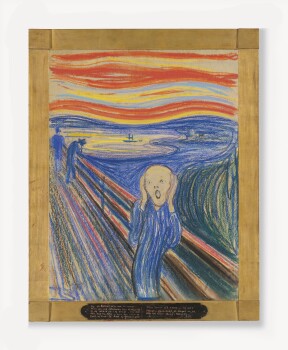
Edvard Munch, The Scream, Private collects ion, sold Replica Shoes ’s New York in May 2012 for $119, 922,500One of the most celebrated images in art history, Munch’s The Scream is a painting that has become a visual stand-in for feelings of existential anxiety. Stripped of every civilising feature, sexually-ambiguous, with facial features diminished, it appears dehumanized, spineless and organic, a portrait of pure sent.mes nt and expression.
Art © 2020 The Munch Museum / The Munch-Ellingsen Group / Artists Rights Society (ARS), New York -
 www.bridgemanimages.com
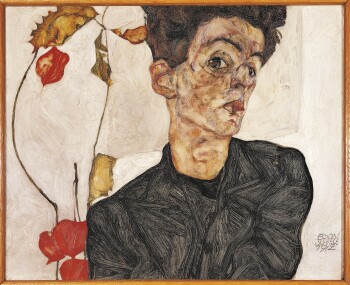
DGA592140 Self-Portrait with Fruit, 1912 by Schiele, Egon (1890-1918); Private collects ion; (add.info.: Egon Schiele (1890-1918), Self-Portrait with Fruit, 1912, oil, 32,2x39,8 cm. Artwork-location: Private collects ion Austria); De Agostini Picture Library / E. Lessing; Austrian, out of copyright Egon Schiele, Self Portrait with Chinese Lantern Plant, Leopold Museum, ViennaPulsating with raw, animal intensity, Schiele’s self portrait is both confrontational and fearful. His contorted pose, rendered in Schiele’s idiosyncratic, spiky line, reflects the discomfort of the artist’s position in society. Routinely derided for his libertine lifestyle, and later imprisoned for sexual deviance, Schiele existed on the fringes of society, and his unique style reflected this sense of isolation and abandonment. -
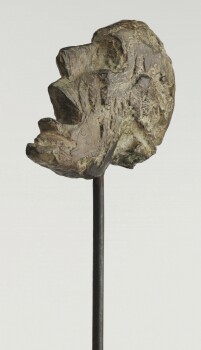
 Alberto Giacometti, Head of a Man on a Rod, Museum of Modern Art, New YorkImpaled in a fashion reminiscent of a Medieval head on a stake, Giacometti’s Head of a Man on a Rod is emotionally confrontational. Its silent scream is compounded by the deep slashes that mark the face, a head weathered by the emotional tribulations of its life. Divorced from the body, this head encapsulates the fear and horror that had gripped Europe for the preceding decade, and the enduring agony of the senseless lost of life that WWII initiated.
 -
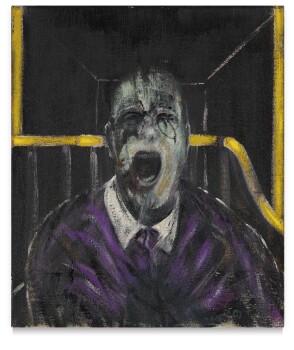
 Francis Bacon, Study for a Head, Private collects ion, sold Replica Shoes ’s New York in May 2019 for $50,380,000Another of Basquiat’s great heroes, Bacon’s riffs on Velázquez’ portrait of Pope Innocent X from 1650, where he combined the sly gaze of the Spanish master’s portrayal with the iconic scream and shattered pince-nez of a woman in Sergei Eisenstein’s Battleship Potemkin, are among the most celebrated images of the Twentieth Century. Reflecting the anguish of his era, in works such as Study for a Head Bacon locates the mouth as bestial center and agent of the primal scream, lamenting the isolation that he felt within society.
Art © The Estate of Francis Bacon. All rights reserved. / DACS, London / ARS, NY 2020 -
 Album / Replica Handbags Images
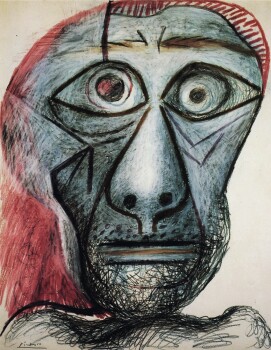
Pablo Picasso (1881-1973). Self-Portrait. Credit: Album / Replica Handbags Images Pablo Picasso, Self-Portrait Facing Death, Private collects ionPicasso rendered his own image throughout his career, with every manner of expression, but the extraordinary combination of pathos at his imminent demise and bravery in the face of death distinguishes this work as one of Picasso’s most incisive emotional portrayals. Every line in this work is essential, and the searing honesty and immediacy of the piece is partly due to the honesty of his working on paper. Like Basquiat, Picasso’s innate genius, which spanned all media, was an instinctive understanding of composition, and an ability to render emotion with a few lines that it would take an author thousands of words to convey.
Art © 2020 Estate of Pablo Picasso / Artists Rights Society (ARS), New York -
 Jean-Michel Basquiat, Untitled (Head), 1982The consummate draughtsman of the last half century, with works such as Untitled (Head) Basquiat takes his place among these canonised masters. His depictions of the human head are his most iconic works, possessing an extraordinary emotional charge unrivalled by his contemporaries. Drawing upon the influences of artists such as Leonardo and Francis Bacon, Basquiat developed an entirely unique iconographic lexicon and explosive aesthetic that stands apart from anything that had come before, and indeed anything that has come since.

The intensity and dynamism of Untitled (Head) are largely indebted to Basquiat’s instinctive and idiosyncratic mastery of line. All the artist’s most celebrated works, whether ‘Heads’, ‘Warriors’ or text heavy masterpieces such as Hollywood Africans, are defined by his use of oilstick. Basquiat was always drawing, whether he was working on paper or canvas, and it is as a function of this that his works on paper became a cornerstone of his practice. From 1983, as collage became one of his principal media, Xerox-ed drawings from his studio would become the substrate for his paintings. Rather than studies for his paintings, Basquiat’s drawings were literally foundational to his practice, and would provide the stimulus needed to work on a larger scale. This reliance on drawings as a source of inspiration is further evidenced by his Retentions of several pivotal works on paper in his own collects ion until his unt.mes ly death in 1988. This group, which included the present work, were exhibited together in his celebrated posthumous show at Robert Miller Gallery in 1990, the show that cemented the reputation of Basquiat’s works on paper as a pivotal part of his oeuvre.


The Tate, London. Art © 2020 Estate of Pablo Picasso / Artists Rights Society (ARS), New York
Right: Cy Twombly, Untitled (New York City), 1970
Private collects ion. Sold Replica Shoes ’s New York in November 2015 for $70.5 million
Art © Cy Twombly Foundation
It is easy to see the appeal of paper as a medium for Basquiat. A self-taught artist, his genius lay in his instinctive understanding of composition and unique iconographic lexicon, and the immediacy of paper as a medium provided the perfect vehicle for Basquiat’s innate brilliance. Without the possibility of correction through overpainting, his works on paper combine the aggressive urgency of Willem de Kooning’s Women from the 1950s with the deliberate rhythm and freedom of Cy Twombly’s ‘New York City’ works on paper and canvas from the ‘60s and early ‘70s. The connection to Cy Twombly is particularly pronounced in the case of Untitled (Head), with the juxtaposition of white oilstick with matte black India ink on the figure’s forehead echoing the palette of Twombly’s celebrated blackboard paintings, as well as prefiguring the monochromatic works that would become a pivotal part of Basquiat’s own oeuvre. Furthermore, the paper itself, which bears its history so lightly, with dust and footprints from the studio visible throughout, insists on the performative element of Basquiat's practice. The work is imbued with the artist's essence, not only in the contained energy of the drawing itself, but also with the ghost of the physical presence of the artist. Just as Jackson Pollock's drip paintings are indexical to the artist's physical movements as well as his psyche, so too is Untitled (Head) a ghost of the master who created it.
Spectacular Results for Masterworks on Paper


Vibrating with immediacy, consummate draughtsmanship and undeniable self-reflection, Untitled (Head) is a masterful example of Jean-Michel Basquiat’s revered corpus of works on paper. It is a work that cements him within a lineage of artists who have used the human head to render concrete the intangible, and demonstrates the young artist’s profound psychological awareness. Forged in the crucible of a New York City forced to its knees – as Glenn O’Brien described it, “The Wild. Wild. East” – works such as Untitled (Head) heralded the emergence of a new artistic vernacular, the impact of which still reverberates today (Glenn O’Brien, “Basquiat and the New York Scene, 1978-82,” in: Exh. Cat., Basel, Fondation Beyeler, Basquiat, 2010, p. 38). Its creation was a moment of enlightenment, and it remained an enduring inspiration to the artist throughout his life, a perfect combination of fury and balance. Gazing fiercely into the middle distance, with explosive blues, reds and oranges juxtaposed with the semi-reflective nature of the underlying India ink and rough expanse of paper beyond, Untitled (Head) is an enduring test.mes nt to the passionate, emotive and influential spirit of Basquiat’s incomparable and prodigious painterly mark.


