
M odulating bursts of line, form and color erupt across the surface of Cy Twombly’s Untitled from 1963, a work teetering on the threshold of legibility in a masterful interrogation of sign and symbol. An array of graffiti-like marks in silver-gray, coal black, pale pink, and scarlet, explode across the picture plane in a dynamic synthesis of scribbles, smudges, and fractious scrawls. Rendered in interspersing strokes of graphite, wax crayon, pen, and pencil, this enigmatic lexicon of signs and symbols bears the hallmark of Twombly’s legendary practice, in which figuration and abstraction, fact and fiction, and history and myth, blend and blur beyond tangible distinction.
“Twombly’s art consists in making us see things: not those which he represents… but those which he manipulates: a few pencil strokes, this squared paper, this touch of pink, this brown smudge. This is an art with a secret.”
Where the city of Rome informed his ideological framework, it also offered a sense of privacy and isolation. As an American, Twombly's expatriation permitted the artist to distance himself from the New York school of Abstract Expressionism dominated by the likes of Willem de Kooning, Franz Kline and Jackson Pollock, and establish his own visual mode. Twombly's allusion to epic narratives, grand myths and ancient history provides a profound link between conceptualism, minimalism and Abstract Expressionism. The result is a highly individual and enigmatic body of work, in which Untitled plays a formative part.

Though Untitled surely engages in a dialogue with Twombly’s contemporaries, it also subverts the very limits of genre. Within the present work, the amorphous boundaries of linearity recall the gestural pursuits of artists such as Willem de Kooning, while the raw and dynamic mark-making signals the energy of action painters like Jackson Pollock. It is through these varying marriages of philosophy and aesthetics that Twombly generates an entirely new method of mark-making. Art critic Pierre Restany has described Twombly’s mode of expression as: “poetry and reporting, furtive gesture and écriture automatique, sexual catharsis and both affirmation and negation of the self. As full of ambiguity as life itself...Twombly's 'writing' has neither syntax nor logic, but quivers with life, its murmuring penetrating to the very depths of things. The marks are elusive since they instinctively make for the essential." (Pierre Restany, “The Revolution of the Sign,” in Nicola Del Roscio, ed., Writings on Cy Twombly, Munich 2002, p. 47)
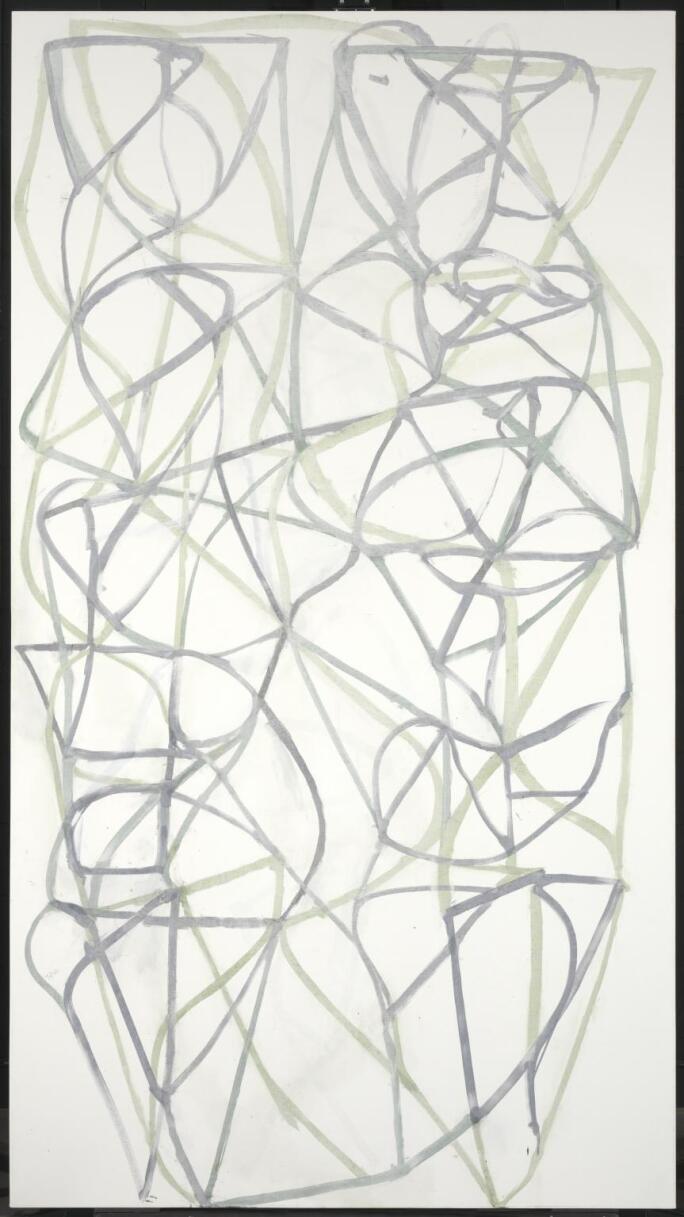
Twombly's work in the 1960s investigates the process of drawing, which veers towards —and eventually becomes— an exploration of signs and writing. As Untitled beautifully testifies, the artist analyzes the nature of visual cognition and communication by investigating semiotic sign systems: by experimenting with indeterminate iconography he questions the assumptions of conventional visual vocabularies, frames of reference, and sign systems. As with Twombly's best output, Untitled balances figuration and abstraction, continually enticing the viewer with implied meaning and challenging the cognitive deductions inherent to signifier-referent equations. The ever-present dichotomy within Twombly’s oeuvre of the automatic and the preconceived, the conscious and the intuitive, is masterfully redolent across the surface of the present work.
““I have always thought 'Twombly' ought to be (if it isn’t already) a verb, as in twombly: (vt): to hover thoughtfully over a surface, tracing glyphs and graphs of mischievous suggestiveness, periodically touching down amidst discharges of passionate intensity. Or then again, perhaps a noun, as in twombly (n.): A line with a mind of its own."
Mediating a space between spontaneity and control, Twombly’s scribbles are full of suggestive detail yet remain irresolute. Twombly reveals a captivating interest in measurements and rhythms with colorful lines steadily and progressively rising and falling, insisting on their attachment to the constraint of writing. Drawing from a wealth of subject matter as diverse as hieroglyphics to calligraphy, the present work delivers a palimpsest of history, t.mes , and space, at once confounding and compelling. Underscoring a fundamental need for expression and interrogating existing methods of understanding, Untitled evinces an utterly new yet wholly legible visual mode.

