COMPARATIVE LITEATURE
Sylvain Cordier, Bellangé, ébénistes - une histoire du goût au XIXe siècle, 2012.
Of exquisite detail and sculptural quality, the present example celebrates the fashion for silver/silvered furniture which spread from the court of Louis XIV at Versailles ever since the late 17th century and perfectly embodies the important development from the second quarter of the 19th century of an ornamental vocabulary intended to encapsulate and lend a historical tone to objects of contemporary and innovative manufacture. Combining revival motifs, traditional techniques such as the ‘Boulle’ technique with the latest technological developments combining both traditional (ebony) and modern materials (the metal used is nickel silver, an alloy of copper, nickel and zinc not prone to tarnishing and oxidisation), the table is characteristic of the ‘historicism’ movement and of the varied work of Alexandre-Louis Bellangé, to whom this centre table may be attributed to.

The attribution
The present table is similar to a description of a centre table under a list of works exhibited by Bellangé fils (i.e. Alexandre-Louis Bellangé) at the 1844 Exposition des produits de l’industrie française in Paris: ‘un guéridon en écaille, incrusté de cuivre et blanc argents, supporté trois enfants en bronze.’ (M. Gustave Halphen, Rapport sur l’Exposition publique des produits de l’industrie française de 1844, Paris, p.39). Though not an exact match, as the 1844 example featured silver marquetry on a tortoiseshell ground (and not ebony as in the present case), it was a gueridon with silver marquetry supported by three figures, thus suggesting that the present is a contemporaneous example and another version of the 1844 table. The latter table was acquired by King Louis-Philippe for the Tuileries, then given to his son the Duc de Nemours and recorded in the Tuileries inventory of 1851. It has not been seen since.

There are other interesting links between this table and the work of Alexandre-Louis Bellangé, namely:
- a gilt and silvered-bronze table formerly for the palazzo Torlonia in Rome (Cordier, op. cit., pp.546-549), featuring silvered-bronze and female terms terminating on a scroll and paw feet
- four side cabinets with cut-brass and pewter ‘Boulle’ marquetry for the apartment of Ferdinand-Philippe, duc d’Orléans, at the Tuileries (op. cit., p.639) indicating Bellangé’s mastery of the technique
- a cabinet stamped Bellangé sold at Replica Shoes
’s, London, 29 June 2007, lot 206 with similar female term figures (op. cit., p.568)
The taste for historicism in the 19th century

This table features a multitude of motifs that originate from different styles: for example, the frieze, the classical shell, the caryatids, the stylized foliage marquetry to the top in the style of André-Charles Boulle. In the 19th century, from 1850 onwards, artists and craft.mes n liked to revisit the styles of the past, in which they found enough material to renew their creations. Unlike Neoclassicism and Neo-Gothicism, whose beginnings predate it, historicism did not aim to faithfully reproduce a style of the past, but to create a new ‘inspired’ one, specific to the 19th century.
With the spread of ornamental designs, this movement, mainly predominantly architectural thus far, coexisted with a historicism of motifs that extended to the fields of interior decoration, furniture, ceramics, goldsmiths' and silversmiths' work and fashion. The role of Claude-Aimé Chenavard (1794-1838) in the development of an aesthetic inspired by the previous centuries at the turn of the 1830s is crucial. From 1827 onwards, issues of his main recueil, L'Album de l'ornemaniste, were published. Chenavard's taste is characterised by a rereading of European historical sources, as well as distant Chinese, Arab, Turkish and Egyptian civilisations. Jean-Jacques Feuchère is also an important source of inspiration for Bellangé.
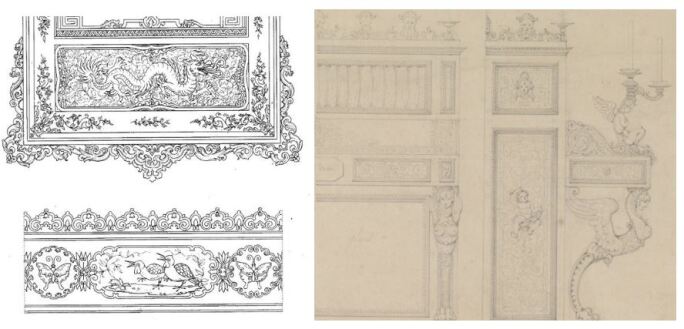
Right: a drawing for a piano attributed to Feuchère (Rijksmuseum, RP-T-2015-46-16).
In the œuvre of Chenavard and Feuchère, it is worth highlighting some of their drawings that relate to the present table:
-a drawing of Chinese motifs similar to the frieze of the present table, by Chenavard in L’Album de l’ornemaniste (Plate 4);
-a drawing for a piano attributed to Feuchère decorated with stylized foliage much similar to the present top and supported by similar female caryatids, which were certainly used as a model for the Torlonia table (Rijksmuseum, RP-T-2015-46-16).
The Bellangé family
Alexandre-Louis (1799-1863) comes from a great dynasty of Parisian cabinetmakers from the first half of the 19th century. Both his father, Louis-François Bellangé (1759-1827) and his uncle Pierre-Antoine Bellangé (1757-1827), and the latter’s son Louis-Alexandre (1797-1861) were cabinet-makers. The Bellangé family had been in business prior to the Revolution and continued to prosper in the post-revolutionary era. They maintained extremely successful establishments where separately and somet.mes s together, they carried out Imperial commissions. The brothers Louis-François and Pierre-Antoine died within 15 days of each other in 1827 and both workshops at 33 rue des Marais Saint-Martin were bequeathed to Alexandre-Louis who had worked with his relatives from an early age.
Alexandre-Louis Bellangé, the Duke of Orleans' patented cabinetmaker, began, like his father, to produce furniture decorated with lacquer or porcelain plates, before creating furniture in Boulle marquetry or rosewood, according to the trends of the t.mes
. He won a double gold medal in 1844, the year he exhibited the ‘Boulle’ marquetry table mentioned above.