The Qianlong Emperor's ‘Ji'entang’ Seal
Guo Fuxiang
This white jade seal, which was personally used by the Qianlong Emperor (fig. 1), is carved with a dragon knop and incised on the base with the three characters Ji'entang (The Hall of Grace Remembrance) in seal script. Its four sides are incised with the Qianlong Emperor’s imperially composed essay Ji'entang ji [Memoirs of the Ji'entang] in its entirety (fig. 2). This seal is further recorded in the Qianlong Baosou [Register of the Qianlong imperial seals] kept in the Beijing Palace Museum collects ion (fig. 3). If one compares the impression of this seal with the impression found in the imperial records, it is absolutely identical in its size, its calligraphy or in the carved strokes, thus one can conclude beyond doubt that this piece is the original Ji'entang seal.
This imperial seal was kept in the Ji'entang of the Louyue Kaiyun (Engraved Moon and Unfolding Clouds), one of the forty views of the Yuanmingyuan (figs 4, 5).1 Typical of the type of treasures found in the Yuanmingyuan, this was a very precious and important seal to the Qianlong Emperor himself. Its significance lies in the fact that this seal reflects the grandfather to grandson relationship that Emperor Qianlong enjoyed with his own grandfather, the Kangxi Emperor. This close relationship and the consequent affections which developed stayed with Qianlong throughout his life.
There are two Ji'entang halls. One is in the Yuanmingyuan, and the other is in the Bishu Shanzhuang (the imperial summer palaces in Chengde). These halls are Qianlong’s expression of the affections, attachments, and benevolence his grandfather the Emperor Kangxi had showered on him as a child. Thus, for a deeper understanding of the seal, the origins of the Ji'entang and the relationship between these two Emperors must be discussed.
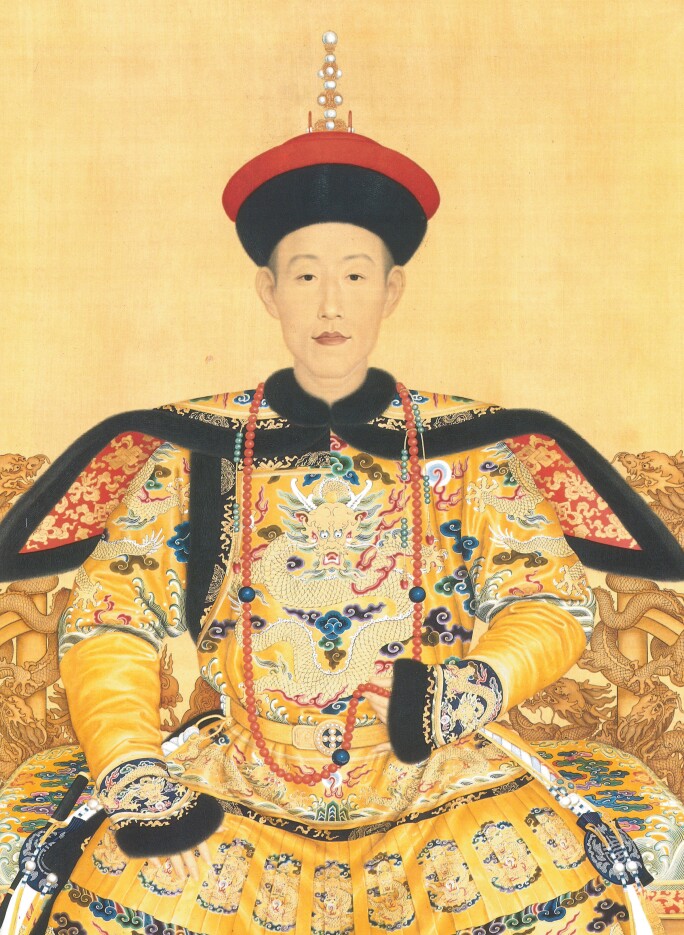
Portrait of the Qianlong Emperor in Court Dress, Qing dynasty, Qianlong period, hanging scroll, colours on silk, detail
© Palace Museum, Beijing
圖一
清乾隆 佚名《乾隆皇帝朝服像》軸 絹本設色 局部
© 北京故宮博物院
The Emperor Qianlong, at the t.mes still the Prince Hongli, first.mes t the Kangxi Emperor on the third month of the sixty-first year of Kangxi’s reign (1722) in the Yuanmingyuan’s Mudan Tai (The Peony Terrace). That year, the Kangxi Emperor turned sixty-nine and Prince Hongli was just a youth of twenty years old. One day, the fourth son of the Emperor, Prince Yinzhen (The Emperor Yongzheng), respectfully invited Emperor Kangxi to the Mudan Tai to watch and enjoy the blossoming peonies and then to join them in a banquet. During the feast, Prince Yinzhen mentioned the name of his son Hongli. Thereupon the Emperor Kangxi requested that Hongli move forward to be seen. There was an immediate affection between the two men and Kangxi at once offered to have his grandson brought to the palace to be brought up. Kangxi took upon himself to care for his grandson. He personally selected martial arts instructors to coach his grandson in archery and the use of firearms, and at the same t.mes personally educated him in writing and literary analysis.
That same year from April until October, Hongli followed the Kangxi Emperor on his tour of the kingdom to the Bishu Shanzhuang in the north. There, it was arranged that Prince Hongli would move into the Wanhe Songfeng (The Whispering Pine Valley) close to Kangxi’s sleeping quarters Yan Bo by the Shuang Dian Palace so that they could have constant contact. The Kangxi Emperor cared for his grandson in every possible way, spending t.mes nurturing and instructing him. He prepared a desk for him, made him study there, often personally instructing him.
Even though this period of his youth was only a few short months, the grace and affections bestowed on him by his grandfather left Prince Hongli with lasting and extremely fond memories. In order to commemorate and demonstrate the grace of his grandfather to future generations, the Qianlong Emperor distinguished the place where he had first.mes t his grandfather, the Louyue Kaiyun Palace of the Mudan Tai in the Yuanmingyuan, and the place of residence given to him by the Kangxi Emperor, the Wanhe Songfeng in the Re Hai Bishu Shanzhuang. He had two plaques inscribed with the words Ji'entang and hung at the highest position within each of these two buildings. Then successively composed the two essays, the Ji'entang Ji (The Memoirs of the Ji'entang, fig. 2) and the Bishu Shanzhuang Ji'entang Ji’ (The Memoirs of the Bishu Shanzhuang Ji'entang), detailing his recollects ions of receiving the love and benevolence of this grandfather. Additionally, he had the palace craft.mes n use the finest materials to carve a pair of Ji'entang seals that were then inscribed with their respective essays and placed in each of the halls.
The Ji'entang seal offered in the upcoming Replica Shoes ’s sale is the seal that was placed in the Ji'entang hall of the Yuanmingyuan. And its pair, the Ji'entang seal from the Bishu Shanzhuang is now kept in the collects ion of the Palace Museum, Beijing (fig. 6).

impression from Kangxi baosou
圖三
《康熙寶藪》內印文
Following Qianlong’s imperial poetry and essays, one can date this seal to the thirty-first year of Qianlong (1766). This was a period of prosperity throughout the nation and there was prolific artistic production within the imperial court. The knop of this seal is carved with a pair of dragons, their bodies clearly intertwined, chests held rigidly upright holding their heads high, giving the impression of strength and ferocity. The scales covering each of their bodies, their manes and claws are intricately detailed in fine incised lines, a style typical of dragon seal carvings from the early-Qianlong period.
The three characters Ji'entang are strongly carved in archaic seal script on the face of the seal. The characters are simple yet still lively and are evenly spaced and proportioned. The sides of the seal are incised with the text from Qianlong’s imperial essay Ji'entang Ji in delicate and evenly distributed characters in regular script. The carver of this inscription must have been well familiar with the techniques and styles of calligraphy, as the characters are extremely fine, each stroke and line of his script carefully finished thus displaying his superior artistic standard.
It is recorded in the Qianlong Baosou [Register of the Qianlong imperial seals] that this seal was made of white jade. According to palace convention relating to various imperial seals, all pieces recorded in the Baosou under the description of ‘white jade’ are made of lustrous, moist, and spotlessly white stone. But one can see that the material of this jade seal is not the same. Its colour is slightly green, some areas appear black, and the seal body is scattered with fine crackles. These are all evidence supporting the fact that this seal has experienced a fire, but that the extent of the damage caused by the fire is not too serious. Although the original colour of the jade has changed and minute crackles have appeared, fortunately the seal’s knop, body, and the inscription carved on the face has been preserved intact. Furthermore, it is a significant test.mes nt to palace history. This seal was kept all along in the Ji'entang of the Yuanmingyuan until the British and French armies sacked the Yuanmingyuan in 1860. Tragically, not even the Ji'entang was able to escape the ravages and burning committed by the soldiers, and it is most likely that the damage on the seal as we see it today was caused by this historical fire. That anything should survive and be preserved after such an ordeal is a true stroke of good fortune.
Representing the special relationship between a grandfather and a grandson, testifying to a special memory, experiencing a turbulent history, this Ji'entang seal bestows on us ever-growing historical significance.
1 ‘The famous Forty (Best) Views (sishi jing) of the Yuanmingyuan were completed and designated in 1744, of which twelve views, or scenes, were constructed after Qianlong became emperor in 1736. Even though Yongzheng had completed so many of the forty views, Qianlong continued to refurbish all the view extensively. The urbane Qianlong gave every one of the Forty Views a cultured name with an explanatory poem (Yuanmingyuan sishijing tuyong).’
I can almost claim that I have not failed my Grandfather’s profound grace. I have already dedicated all my energy and respect to it, so that I will not arouse the criticisms of those who question my legitimacy on the throne.
一天到晚勤勉專注……治國治民必定盡心思量審度,每天都小心謹慎。
至今登位已經有三十年……幾乎可算是沒有辜負皇祖恩典了。
乾隆三十一年清高宗〈紀恩堂記〉云:
「乾夕惕之志,故凡出治臨民,罔不盡心籌度,日慎一日,至於今三十年……
不負皇祖之恩者。」
關於「紀恩堂」璽
郭福祥
在收藏和鑒賞過程當中,有些古代文化遺物往往一見之下便令人難以忘懷,引發的思緒會長久地縈繞於腦海之中,揮之不去,當然,這種情況在鑒賞活動中並不是很容易碰到的。最近香港蘇富比拍賣公司徵集到一方特別有意思的璽印,筆者觀後的感覺便如上述。此印是清乾隆皇帝(圖一)的御用璽印,質地為玉,交龍鈕,陽文篆書「紀恩堂」三字,印體四周陰刻乾隆帝的御製文《紀恩堂記》全文(圖二)。此印在現藏於北京故宮的《乾隆寶藪》(乾隆御璽印譜)中有明確著錄(圖三),經與實物比堪,無論是體量大小,還是篆法佈局都與該書中的記載完全相合,可以確定此璽為乾隆時期的真品無疑。此璽屬於宮殿璽,原存放於圓明園四十景之一鏤月開雲的紀恩堂內(圖四、五),為乾隆皇帝的一方非常重要的寶璽。說它重要,不僅因為此璽是典型的圓明園遺珍,還因為此璽反映出乾隆皇帝與康熙皇帝祖孫之間的深厚情意,這是乾隆皇帝一生不忘的情結。
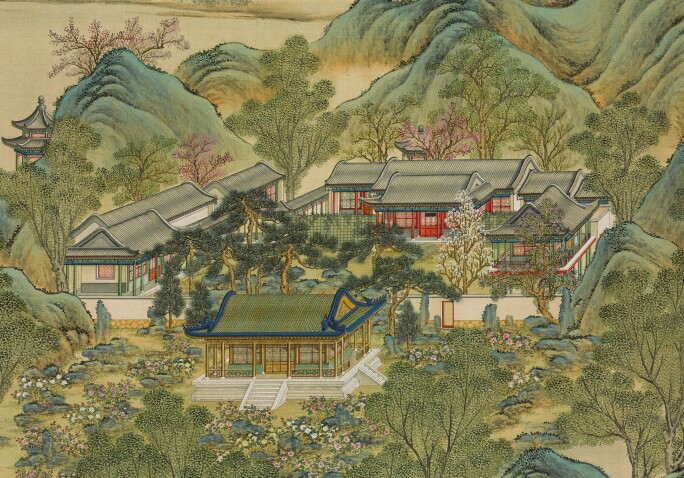
Shen Yuan and Tang Dai, Forty Scenic Views of Yuanmingyuan. Louyue Kaiyun (Engraved Moon and Unfolding Clouds), album leaf, colours on silk, detail
© Bibliothèque de France, Paris
圖四
清乾隆九年 沈源、唐岱《圓明園四十景圖詠》冊之〈鏤月開雲〉 絹本設色 局部
© 巴黎法國國家圖書館
紀恩堂共有兩處,一處在圓明園,一處在避暑山莊,是乾隆為昭顯其祖父康熙皇帝對他的眷顧付託深恩而特別命名的。因此,鑒賞此印就不能不講紀恩堂的來歷,不能不講康熙皇帝與乾隆皇帝之間的祖孫親情。
乾隆皇帝名弘曆,他第一次覲見康熙皇帝,是在康熙六十一年(1722年)三月,在圓明園的牡丹台,那年康熙皇帝六十九歲,弘曆還只是個十二歲的少年。一天,皇四子胤禛(雍正皇帝)恭請康熙帝到牡丹台觀賞盛開的牡丹,然後奉康熙帝進宴。燕宴之間,胤禛向康熙帝奏聞了弘曆的名字,康熙帝遂命弘曆進見,一見即大為喜愛,當即降旨養育在宮中。康熙對這位愛孫照顧得十分周到,為他選定了武術老師,教他學習射箭和使用火器,同時還親自教他讀書,講解文意。同年四月到十月,弘曆隨康熙帝巡幸塞外避暑山莊,弘曆被安排在康熙帝的寢宮煙波致爽殿旁邊的萬壑松風內居住,得以時時和康熙帝接觸,日覲天顏,晨昏問安,隨時答對。康熙帝對這位孫子關心備至,給予多方面的教育和培養。他為孫子準備了書桌,讓孫子在這裏學習,經常加以指點;引見官員時,他讓孫子肅立側旁,見識治理臣工之道;他讓孫子刻苦習武,每當孫子持滿連中便禁不住喜形於色;他教孫子恪守孝道,時常打發他去看望父母,把自己的勞動收穫孝敬父母。特別是有這樣幾件事,讓後來當了皇帝的弘曆念念不忘:一是有一天,弘曆望見御舟停泊在晴碧亭畔,聽到祖父呼喚他的名字,馬上沿山石往下跑,康熙惟恐他跌倒,便急忙招呼他不要疾行。二是在八月的永安莽喀圍過程中,康熙帝用火槍射倒一隻熊,康熙見熊倒地不動,以為熊已斃命,便讓弘曆再射,想讓他在初圍時即得獲熊之名。不料弘曆剛上馬,熊突然躥起直奔馬前,情況十分危險。但弘曆並不驚慌,勒韁控馬,從容鎮定,康熙急發火槍將熊射死。經歷此事之後,康熙一方面覺得弘曆命貴,必有後福,另一方面把愛孫看得更緊,再行圍時從不讓他離開自己。關心愛護,可謂細緻入微。儘管乾隆帝與康熙帝的親密接觸只有短短幾個月時間,但從乾隆後來無數次的深情回憶中不難看出康熙帝對乾隆一生的影響可謂至深至遠。在乾隆看來,這段經歷似乎對康熙選擇皇位繼承人產生了一定的影響,他後來能夠位居九五之尊,肩上承負的不僅是父親雍正皇帝的託付,同時更承負著祖父康熙皇帝的託付。

Hall of Grace Remembrance, Beijing
Photo by Yuki Wong
圖五
北京紀恩堂 王璟攝
弘曆一生都沒有忘記祖父的恩情,少年時代的這段生活在他心中留下了深刻而美好的記憶。為了紀念祖父的恩情並傳示後人,乾隆皇帝分別在圓明園牡丹台初次覲見祖父的鏤月開雲殿和熱河避暑山莊萬壑松風內康熙帝賜居的處所,題寫了「紀恩堂」匾額,懸於室內最高處。並先後撰寫了《紀恩堂記》(圖二)和《避暑山莊紀恩堂記》兩篇文章,詳記受恩於康熙帝的始末。不但如此,他還命內廷御用工匠選用上好材料刻製了兩方「紀恩堂」璽,將兩篇文章分別刻在印上,放置在這兩個地方。此次蘇富比拍賣公司拍賣的「紀恩堂」璽即是其中的一方,原存放於圓明園紀恩堂內。而放在熱河避暑山莊紀恩堂內的「紀恩堂」璽現在則藏於北京故宮博物院(圖六)。觀其印,讀其文,印裏印外所透發出來的濃濃情意不能不令人感動。
根據乾隆皇帝的御製詩文,可知此印製作於乾隆三十一年(1766年),正值國家財力雄厚,宮中製作鼎盛時期。此印印鈕雙龍身體纏繞之狀明顯,龍胸前挺,龍頭上揚,給人以威猛之感。龍身各部位如龍鱗、龍發、龍足等細部雕刻一絲不苟,精微細膩,是典型的乾隆中早期交龍鈕風格。
此璽印文「紀恩堂」三字篆法古樸中不失靈動,筆劃之間互有呼應,佈局恰倒好處。印體周圍陰刻乾隆帝御製文《紀恩堂記》,館閣體的蠅頭小楷,雋永清秀。刻字者刻字時對書法的把握也十分到位,精刻細琢,使一筆一劃都筆意俱在,顯示出相當高的工藝水準。

An imperial celadon jade 'Jingtian qinmin' seal, Qing dynasty, Qianlong period
© Palace Museum, Beijing
圖六
清乾隆 乾隆帝御寶青白玉「敬天勤民」璽
© 北京故宮博物院
在《乾隆寶藪》(乾隆御璽印譜)中明確提到此寶的質地為白玉,按照宮中慣例和現存清代帝后寶璽實物,凡《寶藪》中標注材質為白玉的寶璽一般都是用色澤潔白質地溫潤的很好的玉材雕制。但現在我們看到的此璽卻有所不同,顏色泛青,局部呈黑色,印體分佈有細微裂痕,顯然是經過火燒,但火炙的程度還不是太嚴重,雖然玉本身的顏色變深,出現微裂,所幸印鈕、印體、印面文字均完好無損。作為具有特殊意義的宮殿璽,此印一直存放在圓明園紀恩堂內,而圓明園在1860被英法聯軍洗劫,慘遭兵燹,紀恩堂亦未能倖免,此印極有可能就是在那次大火中被燒成現在這個樣子的。在歷經劫難之後能夠完整地保存下來,實在是幸之又幸。
承載一份特殊的親情,見證一種特別的紀念,走過一段曲折的經歷,這方「紀恩堂」璽留給我們的思索實是多之又多。
For that reason, I record this piece of history in the hopes of clarifying and supporting the decision of my Grandfather who, like the Zhou dynasty Emperor Taihuang, did not pass his throne down to his eldest son but to his fourth son, my Father, and then down to me.
周朝的太王想傳位給王季,再由王季傳給文王,王季的兄弟泰伯知道後避走離去……
周太王知道泰伯有清廉遜讓的本質,而無開創經營的雄心,而王季又有德行,故此傳位予王季是正確的……紀念皇祖之恩,就像是紀念父皇之恩。
乾隆三十一年清高宗〈紀恩堂記〉云:「周室率謂太王欲傳位王季以及文王,泰伯知而避去……太王知泰伯有廉讓,而無締構,王季又聖,故傳位焉。是亦正也……紀皇祖之恩,即所以紀皇考之恩。」
The Memoirs of Ji'entang (The Hall of Grace Remembrance)
The Qianlong Emperor, 1766
This memoir is the sequel to the text Yuanmingyuan that was completed in the year of renxu (1742).
The inscription tablet of the Ji'entang text was made in the year of bings xu (1766), and its rapid production was honoured with absolute care and assiduous work. Although speed and care seem diaMetricas lly impossible as they are conflicting concepts, they do not negate the respectful attitude with which it was made.
My Father composed the original Yuanmingyuan text, in which he gravely emphasized the chief qualities and duties an Emperor must have; abide by the instructions left behind by your ancestors, work hard to serve one’s subjects, approach virtuous officials and establish high expectations for yourself.
In the past, while awaiting the arrival of my Grandfather in his imperial chariot, his son (my Father) received him with great joy and pious attitude, prepared for every detail and offer a sincere welcome; all the laws of piety and ceremony must be fulfilled.
I, the little boy, honour the garden of the previous Emperor, and at this t.mes and place as I take up my Imperial office, I compose this sequel out of filial respect.
The sequel endeavours to clarify the meanings of abiding by the instructions left behind by one’s ancestors, working hard to serve one’s subjects, approaching virtuous officials and establishing high expectations for oneself.
Labour on day by day; do not dare to relax at any t.mes !
So diligently and so swiftly have I served until this day – the inscription tablet of Ji'entang, in truth, is made to memorialise the grace of my Grandfather.
It is impossible to memorialise the entirety of my Grandfather’s boundless grace – not to fail him is not an easy task.

'Ji'entang ji [On the Hall of Grace Remembrance]', Qing gaozong yuzhi shiwen quanji [Anthology of imperial Qianlong poems and text], yuzhi wen er ji [Imperial text, part 2], vol. 10, pp. 8-12
圖二
〈紀恩堂記〉,《清高宗御製詩文全集.御製文二集》,卷10,頁8-12
My Father paid visits to my Grandfather with a cheerful, pious attitude at least twice every year.
As for me, the little boy, I gratefully accepted my Grandfather’s rearing and nurturing.
It occurred in the Imperial Palace, during the spring of the ren yin year of Kangxi (1722).
Once upon a t.mes on the day of his grand arrival, I held audience with my Grandfather inside this very Hall.
This Hall is on the left side of the palace apartments in the Yuanmingyuan.
It used to be called ‘The Peony Terrace’.
Within the forty scenes, this terrace is known as the ‘Engraved Moon and Unfolding Clouds’ which attests to the exquisiteness of the sculpting skill and technique that we so often read about in ancient poems.
In this Hall, my Father used to accompany my Grandfather while admiring flowers, indulging in feasts and merry-making.
Under his favour for me and my name, I was given the privilege of spending my childhood days in the forbidden courts, to behold the Imperial countenance each day and receive the honour of his counsel and wisdom.
This has been recorded in the annals of Yongzheng’s 13th year.
Ever since I, the little boy, have risen to the Emperor’s throne. I have desperately tried my best at implementing what has been entrusted to me by my Father, or occasionally even by my Grandfather – the vital responsibilities and expectations that have been passed down throughout the successive Imperial generations.
When I am reminded of this, I begin to notice my countless inadequacies and I dare not slacken at my office.
I must retain my ambition and evaluate my efforts everyday at dusk – whenever I rule and face my subjects, I sincerely give my very best.
I have worked meticulously each day until now – thirty years have passed.
Gratitude to heaven’s blessings: my country is peaceful, as well as expanding outward on its borders.
My rule, though it has not yet reached perfection, has merited prosperity and order among my people.
I can almost claim that I have not failed my Grandfather’s profound grace.
I have already dedicated all my energies and respect to it, so that I will not arouse the criticisms of those who question my legitimacy on the throne.
The Emperor Taihuang of the Zhou dynasty desired to pass his throne onto his younger son Wangji and then onto his grandson Wenwang.
The alleged Crown Prince Taibo, his eldest son, found out of his father’s wish and departed.
But who knows the character of a son better than his father?
Emperor Taihuang knew that Wangji was hard working and that as a result of passing the throne onto the Wang family line, the Zhou imperial family was bound to increase and prosper.
The Ming Dynasty philosopher Zhuzi (Zhuxi) equated the disobedience of Taibo to the dedication and devotion of the Shang dynasty martyred loyalists Boyi and Suqi.1 And while I find this type of rebellious behaviour acceptable in their case, I do not think it is appropriate in the case of Taibo.
What are my reasons for believing this?
Please understand this for the sake of the reputation of Emperor Taihuang’s grandson Wenwang.
The Shang Dynasty was already rapidly deteriorating when the sacred Zhou took over.
The Zhou Emperor Taihuang knew that Prince Taibo was capable of showing grace and humility, yet he lacked ambition. Since Wangji was virtuous, Taihuang decided to bequeath the throne to him.
It was the right decision.
I fear that the political discussions of later generations will most likely be inaccurate and that people will make poor comparisons.
For that reason, I record this piece of history in the hopes of clarifying and supporting the decision of my Grandfather who, like the Zhou Dynasty Emperor Taihuang, did not pass his throne down to his eldest son but to his fourth son, my Father, and then down to me.
And so memorialising the grace of my Grandfather, just like memorialising the grace of my Father,
It is not something that.mes rely a single inscription tablet can fulfil nor accomplish, nor does it lift the heavy weight of such an obligation off my shoulders.
If anyt.mes my determination should falter, so much that my own words send chills down my spine – carefully and humbly, I shall look at this very text once more.
Through my eyes as I read, I hope to reinforce my heart.
And also, I want the future attendants of this Hall to resolutely follow my Grandfather’s precepts and pay respect to his benevolence through diligent and toil.
1 Boyi and Suqi were loyalist to the deteriorating Shang dynasty. When the Zhou eventually succeeded the Chinese empire, the Zhou leaders attempted to lure these two brothers to side with them and offered them high positions in the court. Instead, the two brothers protested by refusing to eat Zhou grain. They died martyrs in Shouyang Mountain and are heroically remembered for their conviction and faithfulness
If anyt.mes my determination should falter, so much that my own words send chills down my spine – carefully and humbly, I shall look at this very text once more. Through my eyes as I read, I hope to reinforce my heart. And also, I want the future attendants of this Hall to resolutely follow my Grandfather’s precepts and pay respect to his benevolence through diligence and toil.
假若我偶爾違背意志,說的話讓自己心寒,則必定小心觀察、自我警惕,並且勸導將來進入此堂的人,繼續孜孜不倦、遵守祖訓,勤勉篤志,心懷敬意。
乾隆三十一年清高宗〈紀恩堂記〉云:
「苟吾志之偶渝,即吾言之自寒,矜矜焉,惴惴焉,將日觸吾目而警吾心。且以告後來之人,斯堂者亹繼繩而篤勤敬云爾。」
紀恩堂記
乾隆三十一年 清高宗
原文:
《圓明園之後記》成於昔壬戌,紀恩堂之題額,乃於今丙戌始,黽勉以亟為,既鄭重以有待。事若相殊,理則一致。我皇考之為《圓明園前記》也,凡夫遵訓勤民親賢勵巳之。要深切言之,而於昔恭迓皇祖鑾輿,欣承色笑,綢繆懇款,三致意焉。予小子敬奉先帝園囿,此對時而此臨政,故敬成《後記》。申闡皇考遵訓勤民親賢勵已之義,惟日孜孜,毋敢少懈。黽勉亟為者以此,若今紀恩堂之題額,實因紀皇祖之恩,紀皇祖之恩必有差,所謂不負皇祖之恩者,是不易言也。
我皇考迓皇祖承色笑者,歲每一再舉行。至予小子之恭承皇祖恩養育,宮中則在康熙壬寅春,即駕臨之日而覲於斯堂之內,云斯堂在圓明園寢殿之左,舊謂之牡丹台,即四十景內所稱《鏤月開雲》者,向於詩中亦經言及。惟時皇考奉皇祖觀花燕喜之次。以予名奏聞遂蒙眷顧,育之禁廷,日待慈顏,而承教誨。即雍正十三年詔尚以是為言,故予小子自踐阼以來,敬惟古帝王所以凛承付託者,不過於其考,或偶於其祖。若予則皇祖皇考付託所洊重言。
念及此,自視常若不足遑敢弛朝,乾夕惕之志,故凡出治臨民,罔不盡心籌度,日慎一日,至於今三十年,仰蒙天佑,內恬外闢,政雖未臻上理而民則可謂粗安,此所謂差不負皇祖之恩者乎,鄭重有待者,以此夫人之論。
周室率謂太王欲傳位王季以及文王,泰伯知而避去,此非也蓋知子莫如父,王季其勤,王家實足以興周家也。若泰伯之不從,朱子以為即夷齊叩馬之心,予以為在夷齊則可,在泰伯則不可。何則?從聖父以翦寖衰之商正也。太王知泰伯有廉讓,而無締構,王季又聖,故傳位焉。是亦正也。是知,以及文王之言,及後人想當之談政,恐後人之謬為比擬,是以申而論之。然則紀皇祖之恩,即所以紀皇考之恩,則先此之不敢遽云紀恩者,以有待也。
雖然豈一題額即可以告畢吾事,而息吾肩者哉。苟吾志之偶渝,即吾言之自寒,矜矜焉,惴惴焉,將日觸吾目而警吾心。且以告後來之人,斯堂者亹繼繩而篤勤敬云爾。
乾隆丙戌仲夏中浣御製
釋文:
《圓明園之後記》於壬戌年(1742年)完成,紀恩堂的題額則製於丙戌年(1766年),(工匠們)極為勤勉,鄭重其事,嚴陣以待。(兩件)事情似是相異,道理卻其實一致。我的父皇撰寫《圓明園前記》時強調,為君必須遵照祖先訓導,盡心力於人民之事,親近賢良,激勵自我。而昔日父皇恭迎皇祖御駕,皇祖龍顏和悦,父皇欣喜迎接,綢繆精細,款待誠懇,並且再三表達其意。我這個後輩小兒,敬奉先帝所建的園林,此時親理政務,所以在此寫成這篇《後記》,說明祖先所述之意:為君必須遵照祖先訓導,盡心力於人民之事,親近賢良,激勵自我。我每日誠惶誠恐,孜孜不倦,不敢有一點鬆懈,勤勉盡心。紀恩堂的題額,是為紀念皇祖恩德,而要紀念皇祖恩德,就必定有不足之處,所謂不辜負皇祖恩德,實在頗不容易。
我父皇接待皇祖光臨,最少每年兩次。而年紀小小的我在皇宮之內承蒙皇祖養育深恩,畢恭畢敬,那是康熙壬寅年(1722年)春季的事。一天皇祖駕臨,我在此堂內覲見,它位於圓明園寢殿左邊,從前稱牡丹台,也就是圓明園四十景當中《鏤月開雲》一景,(當中情景)在詩詞中也有提到。那時,父皇侍奉皇祖賞花、飲宴。我有幸承蒙眷顧,在禁宮受教,每天得見皇祖慈顏,並蒙教誨。此事紀錄在雍正十三年的編年史內。我自從登基以來,一直盡力遵從皇祖及父皇的教導,以歷代帝王為榜樣。
每次念及此處,便常自覺不足,一天到晚勤勉專注,更莫敢說疏懶朝政,治國治民必定盡心思量審度,每天都小心謹慎。至今登位已經有三十年,萬幸得到上天庇佑,國家內政穩定,對外開闢疆土,政治雖然未至於盡善盡美,但民生可算大致安寧,幾乎可算是沒有辜負皇祖恩典了,然而我還是鄭重行事,免招批評。
周朝的太王想傳位給王季,再(由王季)傳給文王,(王季的兄弟)泰伯知道後避走離去,這不正是「知子莫若父」嗎?周太王知道王季勤勉,王季一家定能夠振興周朝。假若泰伯不遵從聖意,(明代)朱子將之比喻為伯夷與叔齊拉住馬匹進諫之心。我認為這事在伯夷與叔齊的情況下是可以的,在泰伯的情況下卻不行了。為什麼?從周天子削滅趨向衰落的商朝可知。周太王知道泰伯有清廉遜讓的本質,而無開創經營的雄心,而王季又有德行,故此傳位予王季是正確的。可想而知,文王的聲譽,也受後人想當然地談論政事影響,我恐怕後人比喻失當,所以在這裡提出作評論。然則,紀念皇祖之恩,就像是紀念父皇之恩。如果不能代代上溯祖先的恩情,豈能把德澤繼續傳承下去?
雖然,這並不是一面題額就可以說完,就放下肩上重擔。假若我偶爾違背意志,說的話讓自己心寒,則必定小心觀察、自我警惕,並且勸導將來進入此堂的人,繼續孜孜不倦、遵守祖訓,勤勉篤志,心懷敬意。
乾隆皇帝丙戌年仲夏中浣(中旬)御製

