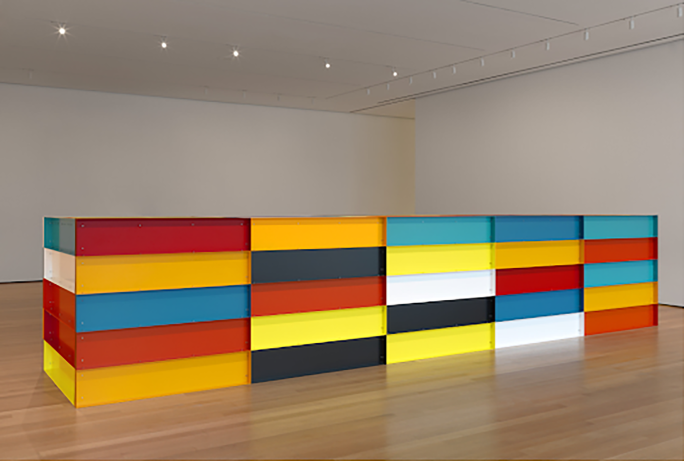
With its ethereal geometry and softly modulated chromatic fields, Model for Big Blue Pink reflects Chicago’s pioneering approach to color, form, and feminist aesthetics at a pivotal moment in postwar abstraction.
This 1971 work is composed of radiant squares arranged in a precise grid, their edges dissolving into one another through delicate airbrushed transitions of turquoise, coral, rose, and chartreuse. At the center, the hues fade into a near-white void, producing a sense of breathing light that seems to emanate from within the surface itself. Chicago’s use of sprayed acrylic lacquer, applied in successive translucent layers, yields an effect that is simultaneously systematic and sensual. This diaphanous technique resists the hard-edged geometry typically associated with Minimalism. Untitled’s measured symmetry and atmospheric gradation reveal Chicago’s deep engagement with the perceptual investigations of artists such as Josef Albers, Donald Judd, and the Light and Space practitioners active in California during the late 1960s. However, Chicago’s treatment of color as a vehicle for emotion and spiritual resonance set her apart from her peers’ cooler formalism.
As a preparatory study for Big Blue Pink, a large-scale sprayed acrylic panel completed the same year, this work reveals Chicago’s meticulous experimentation with chromatic balance and spatial rhythm. The artist conceived these compositions as immersive environments in which color could operate as a transformative, almost bodily experience. By the early 1970s, she was seeking to redefine the language of abstraction to include qualities historically coded as feminine: softness, gradation, and sensitivity. Her sprayed works thus served as a bridge between the precision of Minimalism and the emotive visual language that would later culminate in her landmark feminist installation The Dinner Party (1974–79).
In Model for Big Blue Pink, Chicago harnesses the formal rigor of the grid, a structure long associated with modernist purity, and infuses it with radiance, sensuality, and psychological depth. The composition oscillates between order and transcendence, between the industrial and the intimate. With its balance of geometry and atmosphere, intellect and feeling, the work encapsulates the radical ambition of Chicago’s early practice: to make light itself a feminist.mes dium.