


Executed at the height of Pablo Picasso’s relationship with his partner, fellow artist and mother of his children Françoise Gilot, Buste de femme is an emblematic portrait of one of the most iconic figures in his life. Executed on March 24th, 1949, the present work belongs to a celebrated yet limited group of portraits Picasso created over the course of a year depicting Gilot in labyrinthine contours and rich jewel tones.

Gilot was forty years Picasso’s junior, yet already an established painter, when she first.mes t the him in May 1943. At the t.mes , Picasso was still entangled in a turbulent affair with the Surrealist artist Dora Maar. Yet despite the existing relationship and tumult of wart.mes in Paris, Gilot and Picasso soon embarked upon a decade-long romance which would profoundly influence Picasso’s artistic output. In the ensuing years, Picasso’s sharp, distorted and even tormented portrayals of Maar would give way to increasingly soft, voluminous and romantic portraits of Gilot. Expanding upon the graphic richness of his Dora Maar portraits, those of Gilot maintain the bold, direct aethetic pioneered in the late 1930s and early 1940s (see figs. 1 and 2).

After the war, Picasso and Gilot left Paris for the south of France in the summer of 1946, eventually settling in Vallauris where they would raise their two children, Claude and Paloma. The joy of the early years of their relationship and familial journey are conveyed in Picasso’s work through his increasingly ebullient palette and lush aesthetic. The paintings and sculptures from his period reflect a heightened sense of vitality, chromatic richness and artistic freedom following the turbulence and desolation of the war years. It is this spontaneity of line and renewed dynamism which suffuses Buste de femme.

“Her youth and vivacity, the chestnut color of her luminous eyes, and her intelligent and authoritative approach, gave [Françoise] a presence which was both Arcadian and very much of this earth.”
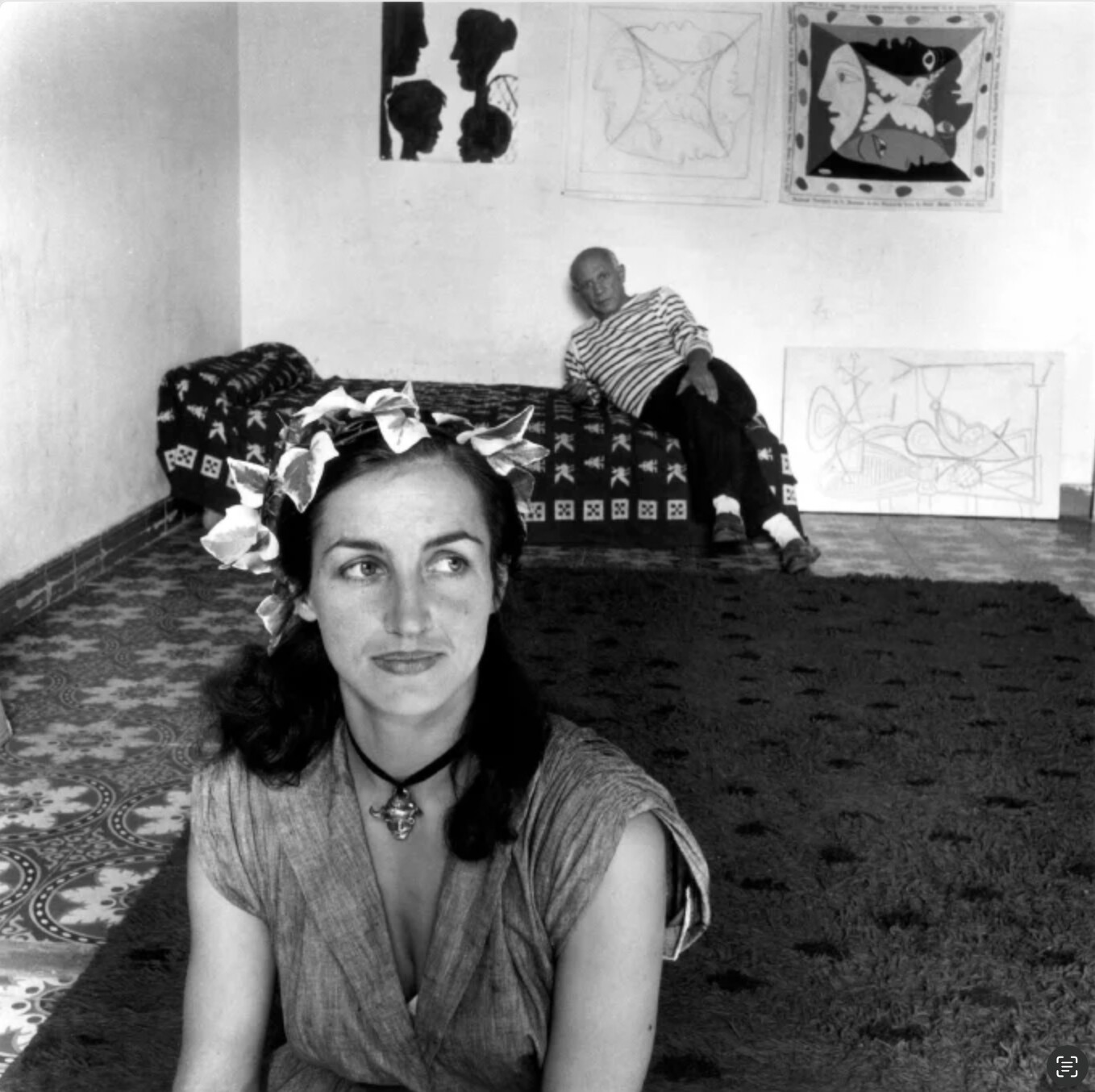

Gilot’s beauty, vitality and creativity greatly influenced Picasso, eliciting comparisons of her with the natural world. Picasso’s imagery from the 1940s associates his partner and muse with themes of rebirth and renewal, with many depictions portraying Gilot as a mystical combination of the human and plant domains (see fig. 3).
By 1948, Gilot had taken on a new form in his work, the vegetal green and blossom-like hair of his 1946 paintings coalescing in a new idiom defined by rich chromatic fields and contrasting staminate lines as exemplified by Buste de femme. Not only do the calligraphic black lines within Buste de femme lend the subject a stemlike structure—these graphic contours also link the Françoise paintings with Picasso’s masterworks from decades earlier.

In November 1948, just months before he painted Buste de femme, Picasso embarked upon a monumental composition titled La Cuisine (see figs. 5 and 6) which would lay the groundwork for the masterful portraits like Buste de femme. The monochromatic painting was inspired largely by the vast white walls of his kitchen at rue des Grands-Augustins, where Picasso and Gilot would dine together. The contrast of Picasso’s birdcages and the few plates that adorned the wall against the kitchen’s otherwise blank expanse provided the pictorial catalyst for the abstracted composition.
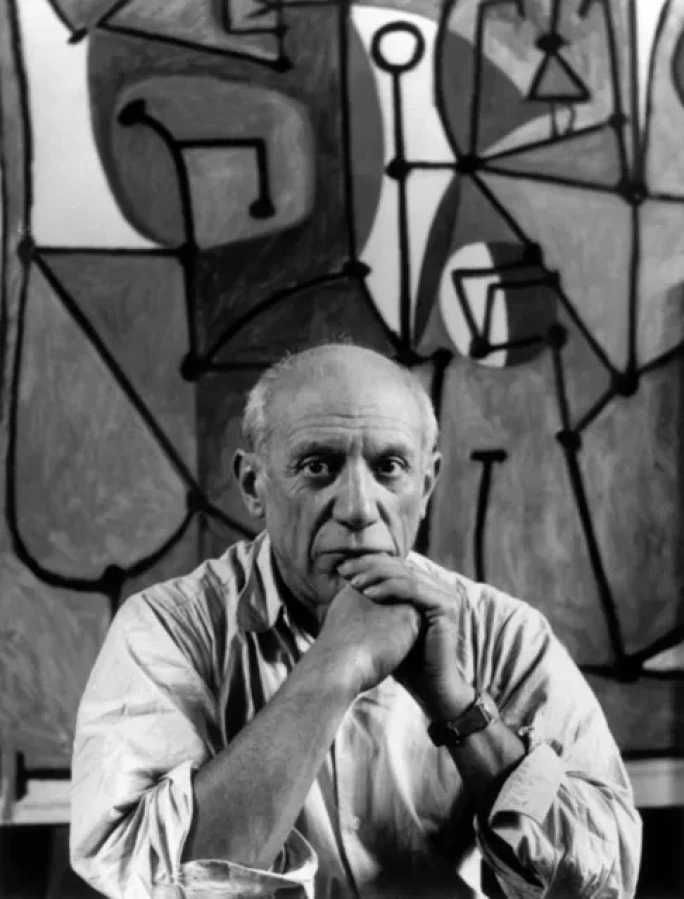
The resulting web of knotted dark lines would reappear, refined and layered within vibrant panes color in the portraiture of the following year. Gilot later described the work’s genesis: “The kitchen was an empty white cube, with only the birds and the three Spanish plates to stand out from the whiteness. One night Pablo said, “I’m going to make a canvas out of that—that is, out of nothing” (Françoise Gilot quoted in Exh. Cat., New York, Gagosian, Picasso and Françoise Gilot, Paris—Vallauris 1943-1953, 2012, p. 80).

The creation of the highly stylized La Cuisine in November 1948 also coincided with the thirty-year anniversary of the death of Guillaume Apollinaire, renowned poet and close friend of Picasso’s. Just days earlier, Apollinaire’s widow had appealed to Picasso to revisit the ill-fated memorial project for her husband, initiated decades earlier.

Created in 1920, the Apollinaire Committee called upon Picasso to erect a monument in the writer’s honor—a project which would entail decades of artistic experimentation and witness some of the most innovative sculpture of Picasso’s career. Though his years-long efforts were ultimately rejected by the conservative committee members, deemed too radical for the purpose of commemoration, the wire and steel compositions born of Picasso’s efforts in 1928 would eventually be recognized as masterworks and later enlarged to monumental proportions.
Picasso’s variations of Figure: Projet pour un monument à Guillaume Apollinaire (see fig. 7) can be seen as a direct pretext for the abstracted aesthetic of La Cuisine and the subsequent body of portraiture devoted to Françoise Gilot in 1948-49. Just as La Cuisine was intended to be “a canvas…out of nothing,” Picasso had, so many years prior, envisioned Apollinaire’s monument as “a statue of nothing, of a void, that is magnificent,” an homage to author’s own story from 1916, Le Poète assasiné (Werner Spies, Picasso: The Sculptures, Stuttgart, 2000, p. 117).

Drawing on decades of artistic interrogation into line and form across mediums, and imbued with the romance and fecundity of his relationship with Gilot, Buste de femme marks a momentous period in Picasso's life and, inextricably, his career. Picasso's paintings from 1948-49 take the monochromatic and linear explorations of form in Figure: Projet pour un monument à Guillaume Apollinaire and La Cuisine as a point of departure for his Françoise pictures in these years.
A Museum-Caliber Work: Comparable 1949 Paintings in Institutional collects ions


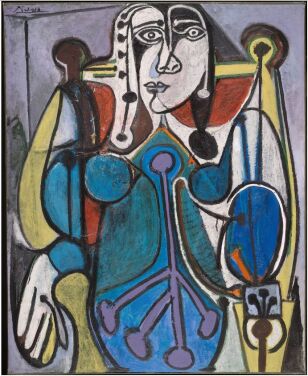

Harnessing the power of line and channeling the spirit and vitality of his muse, Picasso created some of the most exceptional paintings of his mature oeuvre during this year, epitomized by Buste de femme. Rich in texture and color, the present work is among the finest examples of Picasso's 1948-49 Françoise portraits ever to come to market. Though their relationship would endure for a full decade, the uniquely stylized portraits like Buste de femme belong to a very limited series, many of which are now held in museum collects ions (see above).
Such a rare and exceptional painting comes with an equally illustrious provenance. Never before seen at auction, Buste de femme has been held in the Neumann Family collects ion since 1951, when Morton G. Neumann acquired the work from Picasso’s main dealer in Paris, Galerie Lousie Leiris (see fig. 10).

Known as Picasso’s “Favorite American collects or,” Neumann was a personal friend of the artist, acquiring exceptional paintings, works on paper and sculpture from Picasso and his contemporaries during their lifet.mes s. In 1980-81, Buste de femme was exhibited amongst other masterworks from Neumann Family collects ion at the Art Institute of Chicago and the National Gallery of Art in Washington D.C (see fig. 11).

Buste de femme by Pablo Picasso | Françoise Gilot’s Legacy


