
"Human beings are very avant-garde, and are as worthy a contemporary subject as anything else."
One of the most influential artists in the field of contemporary figurative painting, Elizabeth Peyton is lauded for her images of cultural icons and close friends that have reinvigorated the genre of portraiture, imbuing the subjects with an intimacy and familiarity that resonates with a strong romantic devotion. Executed at an expansive scale of 35 ½ by 87 ¼ inches, Peyton depicts her subject with the marvelous “ease and unselfconsciousness in looking” characteristic of her most compelling work. (Nadia Tscherny, “Elizabeth Peyton,” Art in America, 1 February 2009 (online)) Peyton outlines her friend and contemporary, artist Piotr Uklanski, in rich color and lines, the immediacy and tenderness of the brushwork and color culminating in a transfixing investigation into the genre of portraiture. Piotr is a recurring subject within Peyton’s oeuvre, with one of the portraits residing in the permanent collects ion of the Seattle Art Museum, and the sister painting to the present work residing in a private collects ion.

Lush, loose brushstrokes travel the distance of the work, dragging in thick bands across the paper. Peyton’ gestures are expressive and her process charmingly unbound; the sheets of paper pinned together haphazardly and bound by large, feathered gestures. The jeweled colors applied with brazen hand make the scene at hand seem both familiar and hazy, like a memory surfacing from one’s consciousness. Somewhat paradoxically, the looser gestures still carry the same intimacy and tenderness as Peyton’s smallest and most finely resolved paintings, as each brushstroke is a tactile imprint of the artist’s measured hand. Drips of tasseled coral appear throughout the surface, a byproduct of the looseness of the paint, and yet remain remarkably consistent and measured. Piotr’s visage is rendered in select strokes that tenderly outline his features, from the brilliant blue of the eyes to the angled slope of the nose and berry lips. The painting’s transient beauty is refreshingly unironic, an alluring rendering with a casual empathy that humanizes and universalizes the subject.
Market Precedent: Elizabeth Peyton


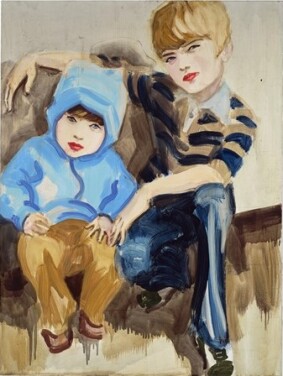

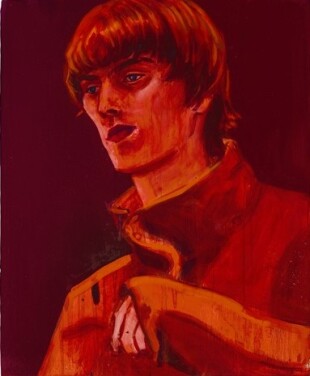


Executed in 1996, Piotr is an artistic manifestation from the apogee of Peyton’s cultural and artistic influence. Emerging in the 1990s, Elizabeth Peyton captivated the art world with her portraits of friends, celebrities, and historical figures that captured the cultural iconography of the age with an intimate feminine gaze and vivid palette and ushered in a return to figuration. Piotr represents a pivotal shift in the artist’s career as Peyton chose to focus on friends and loved ones as her subjects, amplifying the captivating intimacy and compassion characteristic of her earlier work. “I just have a feeling of urgency that I want to make a picture of somebody. Probably because I’m very inspired by them or there is something I really want to know about or understand in them. So, fascination? Yes. Admiration? Yes. But also curiosity — I get fascinated by what people are doing and what they’re making and how it’s what I need at that moment.” (Elizabeth Peyton quoted in: Uwe-Jens Schumann, “Elizabeth Peyton: ‘History is contained within people’”, The Talks, 15 August 2018 (online)) Depicting its subject with freshness and immediacy, Piotr dives deeper into the psychological aura of its sitter. “There is no separation for me between people I know through their music or photos and someone I know personally,” says Peyton, “The way I perceive them is very similar, in that there’s no difference between certain qualities that I find inspiring in them.” (Elizabeth Peyton quoted in: Chrissie Iles, Whitney Biennial 2004, New York 2004, p. 224)
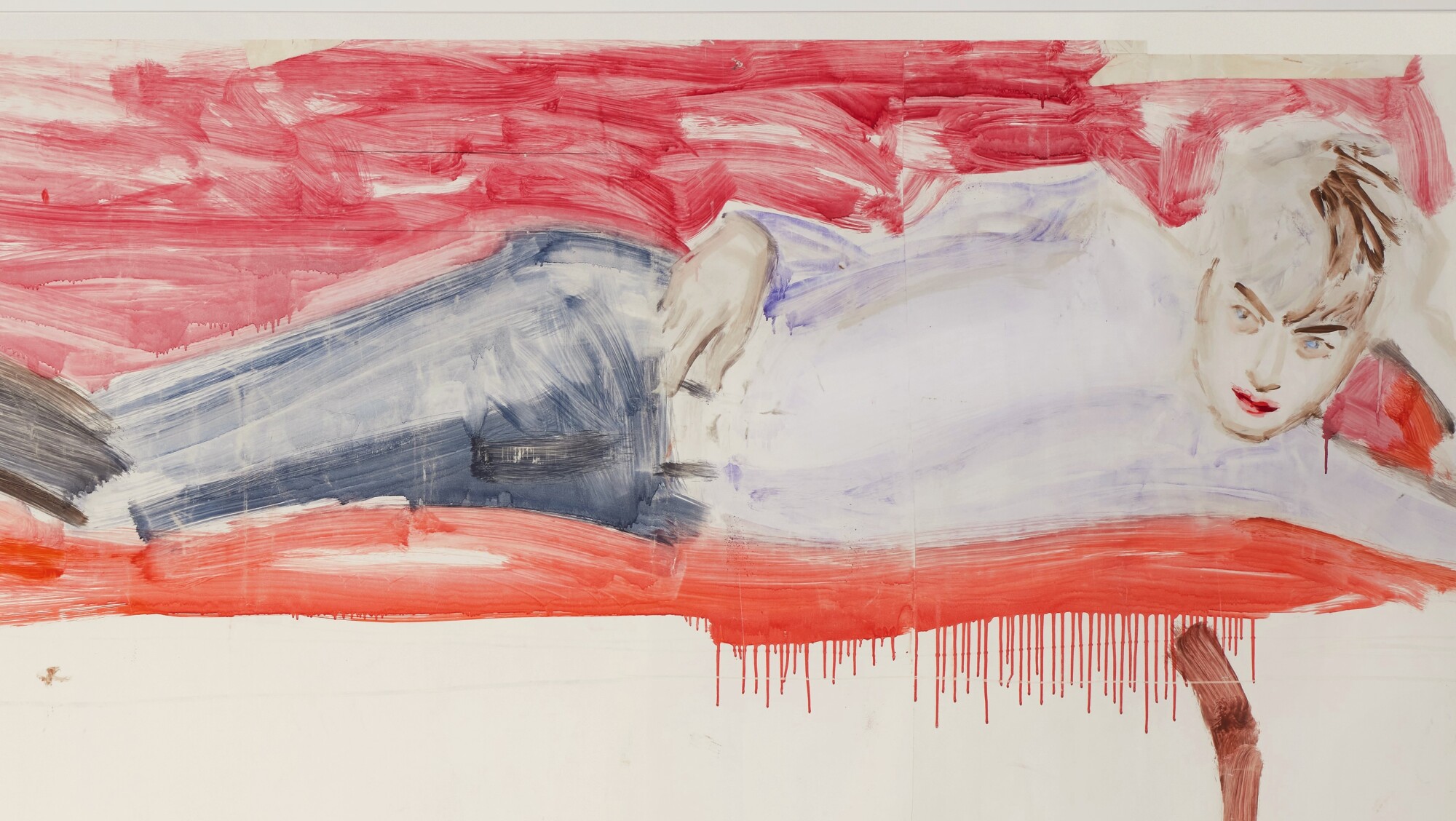

Peyton enlivens Piotr with a unique subjectivity that freezes her subject in a poignant moment. Fundamentally, the artist regards her works as “paintings of people” capturing the essence of life in a sense that is reminiscent of the still life, the vivacity of the sitter and the immediacy of the moment in t.mes made all the more palpable by the fluidity of Peyton’s gestures. “Art work expresses what it’s like to be human, and one of the things about being human is t.mes passing”, explains Peyton (Elizabeth Peyton quoted in: Calvin Tomkins, “The Artists of the Portrait'', The New Yorker, 6 October 2008, p. 47) As Peyton views it, "making art is making something live forever. Human beings especially—we can’t hold on to them in any way. Painting is a way of holding onto things and making things go on through t.mes .” (Elizabeth Peyton quoted in: Jarvis Cocker, “Elizabeth Peyton,” Interview Magazine, 26 November 2008, (online))
“I just have a feeling of urgency that I want to make a picture of somebody. Probably because I’m very inspired by them or there is something I really want to know about or understand in them. So, fascination? Yes. Admiration? Yes. But also curiosity — I get fascinated by what people are doing and what they’re making and how it’s what I need at that moment.”
A mesmerizing example of the extraordinary t.mes lessness of Peyton’s visual lexicon, Piotr beautifully interweaves abstraction and figuration, enhancing the vulnerability of the subject through lush color and expressive brushwork. Immersing the viewer into a unique multisensorial aesthetic, Piotr collapses the distance between realism, modernist abstraction, and personal snapshots. Simultaneously accessible, devotional, and visually alive, Piotr evinces the contemplative practice that makes Peyton one of the most captivating artists of her generation.

