


“The ‘Nudes’ series represents Lichtenstein at his most sophisticated… The tension between high art traditions and commercial printing techniques reaches its apex in these works.”
Nudes in Mirror (Study) is a paragon of Lichtenstein’s exploration of nudes and interiors in the late 1990s, harkening back to the iconic comic book heroines of his 1960s paintings. Transposing the composition through a mirror—a motif that Lichtenstein thoroughly explored in both two- and three-dimensions—offers a moment for reflecting upon Lichtenstein’s celebrated career and his singular visual lexicon. The present work predates a large-scale painting with the same title and composition. The last major series before the artist’s death in 1997, the series revisited not only the female nude—a motif so heavily and frequently featured in the Western art historical canon—but also Lichtenstein’s own legacy, foregrounding the ‘reflections’ panels of his titular series of work, taking compositional inspiration from his Interiors of the 1990s, and heralding the return of his comic-book heroines that fueled his meteoric rise to fame in the 1960s. Capturing an intimate interior scene, Nudes in Mirror (Study) presents a captivating perspective into the central themes that weave through Lichtenstein’s artistic legacy.

A mirror tilted at a slight angle captures two nude female figures in a bedroom scene. Standing up close to the mirror is a short-haired woman with a dreamy gaze, arranging her hair. Lichtenstein places a second figure in the frame, positioned on the other side of the protagonist from the viewer’s point of view; her stare is at once alluring and cryptic, her countenance obscured by the reflection panes yet her locking eyes aloofly acknowledging our presence in this intimate interior space.

“When I made the decision in 1959 that I was not going to be an abstract painter; that I was going to be a representational painter… I only got started by doing the opposite of everything I loved. And in choosing representational painting, I decided to do, as my subject matter, the history of art: I would do nudes, still-lifes, landscapes, interiors, portraits, etc.”

Concepts of object and subject—which have in art history pitted the female nude against the male gaze as the empowered voyeur—are here subtly subverted in Lichtenstein’s distinctly Pop dialect; in Nudes in Mirror (Study), the viewer is placed in the position of the protagonist, as if we gaze back at ourselves. Unlike in his earlier comic book heroine scenes, which often feature male counterparts, Lichtenstein’s Nudes of the 1990s are resolutely sovereign: “The 1990s nudes take pleasure in their own company, without the slightest hint of needing or missing a man. They are not paralyzed by their emotions. In contrast to Lichtenstein’s original romance-comic pictures, this world flourishes exuberantly without.mes
n or engagement rings or kisses.” (Avis Berman, “Joy and Bravura and Irreverence” in: Roy Lichtenstein and Images of Women,” Exh. Cat., Kunsthaus Bregenz, Roy Lichtenstein: Classic of the New, 2005, p. 143)
- 1434
- 1523
- 1614
- 1656
- 1882
- 1900
- 1937
-
 1434Jan van Eyck
The Arnolfini Portrait, 1434
The National Gallery, London
The Arnolfini Portrait by Jan van Eyck portrays Giovanni di Nicolao di Arnolfini, an Italian merchant based in Bruges, Belgium, with his wife. Placed in the vanishing point of the composition and the center of the panel is a circular convex mirror, placed directly below van Eyck’s signature and conjuring the figures of two men—perhaps the result of the artist inserting himself into the painting. -
 1523Parmigianino
Self Portrait in a Convex Mirror, 1523-24
Kunsthistorisches Museum Wien, Vienna
Parmigianino’s Self Portrait in a Convex Mirror shows the artist’s countenance inserted into the domed segment of a convex mirror, the painting underscores the virtuoso’s intuitive understanding of perspective and dimensions; his right hand—one that through paintbrush creates worlds of stunning beauty—dominates the foreground as the window and ceiling spiral around the artist’s confident gaze. -
 1614Peter Paul Rubens
Venus in Front of the Mirror, 1614-15
Liechtenstein, The Princely collects ions, Vaduz-Vienna
Venus, in Rubens’ Venus in Front of the Mirror, has her back turned against the viewer but directs her gaze towards us through a mirror held up by Cupid. The octagonal mirror frames her head as if it is a portrait, perfectly capturing the beauty of the goddess. Rubens’ usage of the mirror in the composition were inspired by forebearers such as Titian and Veronese. -
 1656Diego Velázquez
Las Meninas, 1656
Museo Nacional del Prado, Madrid
Capturing Velázquez in the last five years of his life and at the height of his powers, Las Meninas of 1656 is undoubtedly one of the most important paintings in Western art history. He inserts himself in front of the easel, scatters the servants around Infanta Margarita, and places the chamberlain José Nieto at the doorway. Perhaps most intriguing in this painting are Philip IV and Mariana of Austria reflected in the large mirror in the back, placing them along with the gaze of the viewer. -
 1882Édouard Manet
A Bar at the Folies-Bergère, 1882
The Courtauld Institute of Art, London
Completed a year before his unt.mes ly death, A Bar at the Folies-Bergère is Manet’s last major painting. Looking past the barmaid’s enigmatic expression in the foreground, Manet’s swift brushstrokes paint an animated crowd at the Folies-Bergère reflected in a large gold-framed mirror; slight inconsistencies in the perspective and alignment further add a dynamic energy to the painting. -

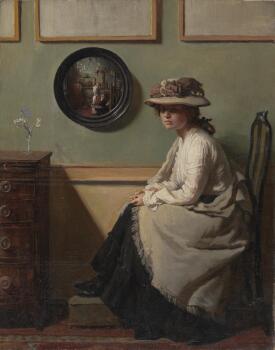
The Mirror 1900 Sir William Orpen 1878-1931 Presented by Mrs Coutts Michie through the Art Fund in memory of the George McCulloch collects ion 1913 http://www.tate.org.uk/art/work/N02940 1900William Orpen
The Mirror, 1900
Tate Gallery, London
In The Mirror of 1900, Sir William Orpen paints Emily Scoble, to whom the artist was briefly engaged. Visible through the mirror juxtaposed to the sitter’s head is the artist sitting in front of the easel painting, a device Orpen borrows from masters such as Jan van Eyck and Diego Velázquez. -
 1937René Magritte
La reproduction interdite, 1937
Museum Boijmans Van Beuningen, Amsterdam
La reproduction interdite is supremely representative of René Magritte’s masterful interstitching of quotidian moments and surreal, dreamlike scenes. Magritte portrays his friend, British poet and art patron Edward James, based on a photograph he took of the Englishman admiring his painting On the Threshold of Liberty. The mirror reflects James’ back, rather than his countenance, thus leaving the sitter’s identity in obscurity and underscoring the surreal absurdity that pervades Magritte’s visual lexicon.


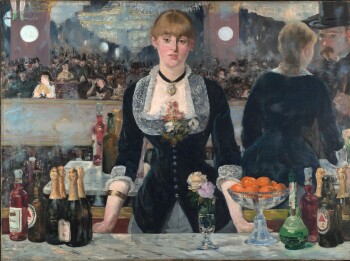

Lichtenstein’s figures display reserved and enigmatic expressions, resisting the viewer’s instinct to find readily comprehensible throughlines of interpretation with a certain emotional and narrative opacity. Despite appropriating the readily recognizable comic strip aesthetic, the artist creates works that are anything but simple and unambiguous; through Nudes in Mirror (Study), he presents a visual puzzle that urges the viewer to reflect on the nature of how femininity is represented in art. By placing the entire composition within a mirror, Lichtenstein positions himself in dialogue with great artistic forebears and invokes the structural mastery found in Diego Velázquez’ The Toilet of Venus, Peter Paul Rubens’ Venus in Front of the Mirror, or Édouard Manet’s A Bar at the Folies-Bergère. This compositional device not only adroitly frames the subjects’ countenances but also insets a degree of separation between the image and the viewer, interrogating themes of introspection and voyeurism with nearly unparalleled dexterity. This interplay between the study and painting reveals Lichtenstein’s continual exploration of form and depth, showcasing how he adapted and refined his techniques in this later phase of his career.

Executed in the twilight of his celebrated career, Nudes in Mirror (Study) is an exceptional work that foregrounds his iconic comic book bombshell protagonists along with his career-long exploration of reflections as both a visual device and metaphor for his contemplation upon art history. Through subtle shading and crisp graphite lines, we see a glimpse of Lichtenstein’s masterful creative process, particularly revealed in the intervention of the artist largely concealed in his paintings. Nudes in Mirror (Study) stands as a remarkable act of reflection, not simply carried about the two figures sketched atop the paper, but of Lichtenstein looking back into the decades of his own practice and the centuries of art history before him. An exemplar of Lichtenstein’s mature practice, Nudes in Mirror (Study) epitomizes the artist’s profound understanding of artmaking: “All painters take a personal attitude towards painting. What makes each object in the work is that it is organized by that artist’s vision. The style and the content are also different from anyone else’s. They are unified by the point of view—mine. This is the big tradition of art.” (the artist quoted in: Calvin Tomkins, Roy Lichtenstein: Mural with Blue Brushstroke, New York 1988, p. 42)

