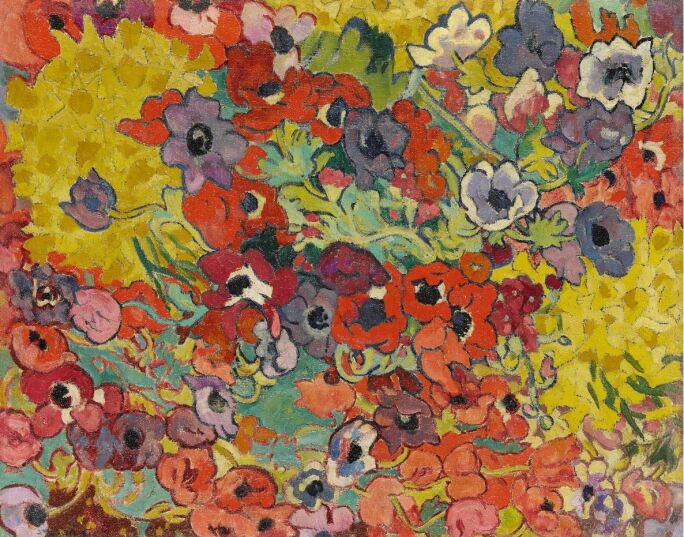
B est known for his resplendent landscapes and vivid flower compositions, Louis Valtat became a frontrunner of the Post-Impressionist movement. Having absorbed the chief tenets of classical Impressionism and Pointillism in the 1890s, Valtat was intrigued and influenced by contemporaries such as Matisse, Marquet, Vlaminck, and Derain, with whom he exhibited at the famous Salon d’Automne of 1905. At the turn of the twentieth century, Valtat and other pioneers of Post-Impressionism began to experiment with their brushstrokes:
They laid on the pigment thickly in strokes that resembled vivid scars and which no longer had anything in common with the hatchings of Impressionism
Yet in spite of the artist’s heavy application of paint, the airy subject matter maintains integrity of its own thanks to the stunning proto-Fauvist potpourri of floral tones. As Sarah Whitfield notes, “Louis Valtat, whose color appears to float on the surface of the canvas, is another painter somewhat loosely bracketed with the Fauves. [He] belonged to the generation of painters who understood the picture surface to be primarily a flat piece of canvas covered with areas of paint" (Sarah Whitfield, Fauvism, London, 1991, p. 28).