
Through his changing affiliations with groups of radical European artists in the first half of the twentieth century, Làszlò Moholy-Nagy followed a strict personal line of inquiry about the ways in which new technologically-informed means of art production could produce original relationships between color, light and space.
Explore Moholy-Nagy's Light-Space Modulator (The Light Prop) in motion
This preoccupation would famously lead Moholy-Nagy to create his Light-Space Modulator (The Light Prop) in the 1920s and 30s (see video), and undertake a series of unprecedented experiments with new materials and dimensional orientations in pursuit of unification of light and space. In a lecture on the potential for plastics as a material solution, the artist further alluded to the necessity of motion, stating:
“This urge of mine to supersede pigment with light has its counterpoint in a drive to dissolve solid volume into defined space. When I think of sculpture, I cannot think of static mass. Emotionally, sculpture and movement are interdependent. It seems illogical to invite the spectator to adjust himself to kinetic painting and then immobilize him before a carved stone or a piece of sculptured plastic.”
“Twenty years later Moholy’s Plexiglas and chromium sculptures grew organically from the light modulators. They were destabilizations of designed form” (ibid.). Indeed, the title Space Modulator points to the artist’s insistence that movement is intrinsic to a successful sculpture, and it is essential to the intended viewing experience (a concept which the artist famously documented photographically using the present work).

Writing about the present work (see fig. 1), Sibyl Moholy-Nagy explains: “In 1943 he had completed his first Plexiglas and chromium-rod sculpture. Two heavy planes of perforated Plexiglas were held together by chromium rods; as the suspended form turned, it created a virtual volume of reflected light or it.mes rely vibrated as the air around it moved. It was up to the spectator to animate the sculpture according to his own intensity. His re-creative pleasure could express itself in a gentle twist or a powerful whirl” (ibid., pp. 205-06).

Mobile Sculpture (Space Modulator) and the associated photographs Moholy-Nagy took—featured on the cover of the catalogue for the artist's 2016 retrospective at the Solomon R. Guggenheim Museum; Art Institute of Chicago and Los Angeles County Museum of Art (see fig. 2)—represent the pinnacle of unification across media and materials, for the first t.mes truly incorporating intangible light and space as primary components of a composition. Apart from the present work, Moholy-Nagy created only two other Plexiglas mobiles in 1946, currently in the collects ion of the Solomon R. Guggenheim Museum, New York and Instituto Valenciano de Arte Moderno, respectively (see figs. 3 and 4). “They were the closest Moholy came to a kinetic solution. Like Cézanne, he knew that he was ‘only the primitive on the way he has chosen,’ but he also knew that his light mobiles bear in themselves the potentialities of a new kaleidoscopic sculpture” (ibid., p. 206).

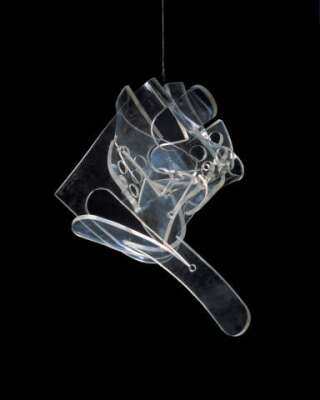
Right: Fig. 4 László Moholy-Nagy, Leda and the Swan, 1946, Instituto Valenciano de Arte Moderno
© 2024 ARTISTS RIGHTS SOCIETY (ARS), NEW YORK / VG BILD-KUNST, BONN