
A definitive declaration of artistic intent in bold swathes of black ink, Untitled from 1946 evidences Barnett Newman on the cusp of his epiphanic artistic breakthrough. Simultaneously united and divided by a stark diagonal band, the present work on paper showcases a precursor to the artist’s iconic “zip” motif and reveals his ambition to capture the ineffable essence of existence. Attesting to its recognized role in the creative crescendo of one of the most inventive artists of the twentieth century, Untitled has been exhibited globally in esteemed museums such as the Stedelijk Museum, Amsterdam; Centre Georges Pompidou, Paris; Kunstmuseum, Basel; and the Philadelphia Museum of Art; other iterations of works on paper from the same year are held in the permanent collects ions of institutions including the Museum of Modern Art, Los Angeles and the Institut Valencià d’Art Modern, Valencia, Spain. Carrying unparalleled emotional and spiritual resonance through the most essential of forms, Untitled is a quintessential example of Barnett Newman’s inimitable contribution to the canon of American art during the postwar era.
Newman Works on Paper in Museum collects ions

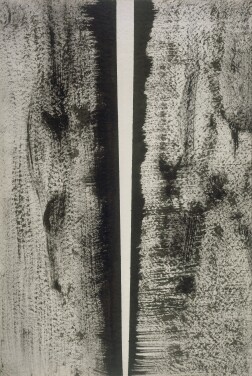


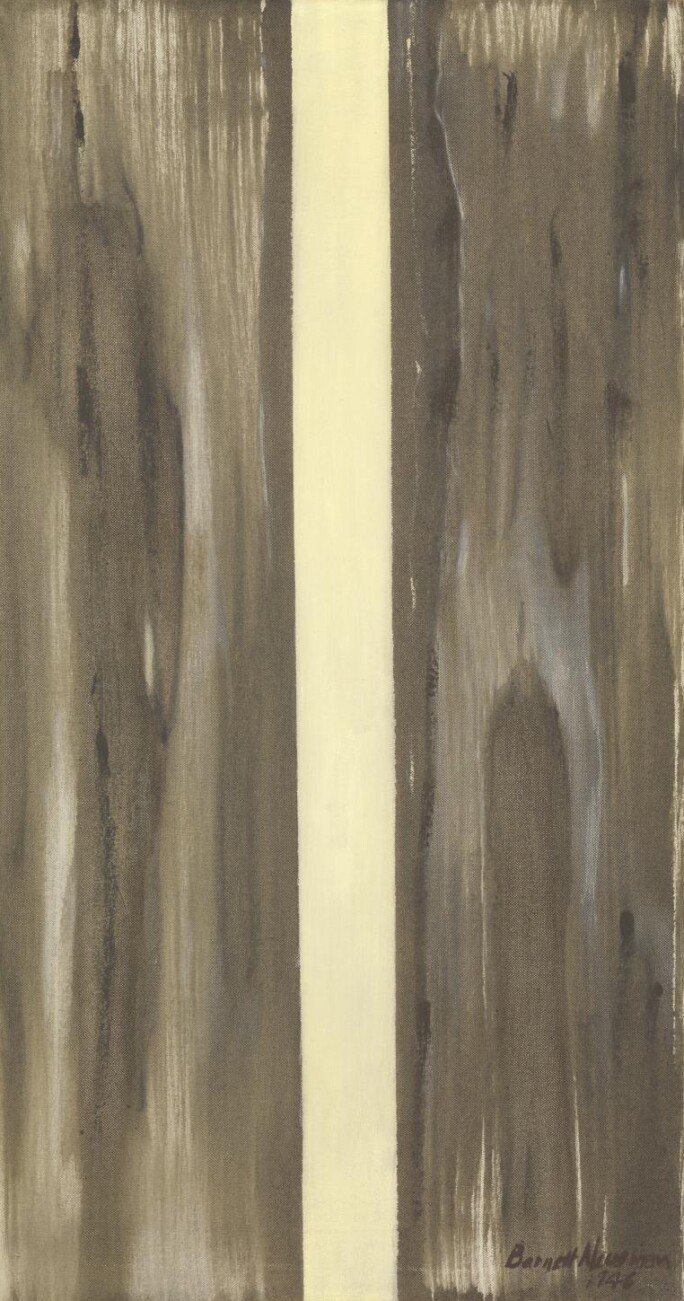
As a working artist in New York in the 1930s, Newman befriended artists including Mark Rothko, Adolph Gottlieb and Willem de Kooning. Ceasing his artistic production altogether at the end of the decade, and ultimately destroying his entire prior oeuvre, Newman spent the following years advancing the careers of his Abstract Expressionist peers as a writer. It was not until 1944 that he returned to drawing and painting, making the present work one of the ‘first’ in his newly self-articulated oeuvre. Alongside his post-war peers ruminating upon the atrocities of World War II and the Holocaust, Newman probed the spiritual potentialities and regeneration of art through the invention of new expressive forms. Working in ink on paper, a natural tandem to his writerly output, Barnett executed a relentless experimentation that defined the trajectory of his artistic vocabulary through the development of his signature “zips”.

Untitled stands among the most pivotal drawings in Newman’s oeuvre in its foreshadowing of this pioneering “zip” motif, crucially presaging the 1948 breakthrough of his magnum opus, Onement I. Among the most revolutionary innovations in Abstract Expressionist and Twentieth Century Art, these poetic and primal vertical bands opened the picture plane as a visual portal to the ineffable sources of inspiration that profoundly inform the artist’s oeuvre. The crux of Newman’s desire to rid his art of objects, dogma, precedence or referential subject matter, his zips: “[take their] meaning from being experienced as an undifferentiated whole, thus functioning as a ‘space vehicle’ for the idea of singularity. Oneness itself in Newman’s terms is an exalted ‘subject matter’” (Harold Rosenberg, Barnett Newman, New York, 1978, pp. 59-60).
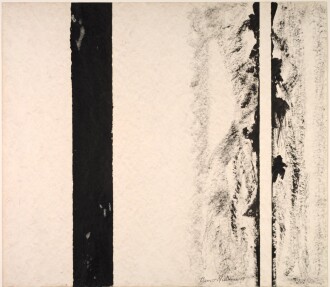
Amongst the very first iterations of Newman using tape to achieve a sharply defined vertical band, the present work constitutes an essential antecedent of the iconic “zips.” As curator Barbara Richardson asserts, “it is certainly unlikely that [Newman] used tape before 1946. The earliest paintings that seem to have employed tape for edgings would be The Command, The Beginning, Moment, all of 1946. Stylistic evidence clearly places this drawing in advance of those paintings” (Exh. Cat., Baltimore Museum of Art, Barnett Newman: The Complete Drawings, 1944-1969, 1979, pp. 93). Crafted from masking tape affixed and subsequently lifted to create a barrier between white paper and black ink, this zip dynamically tapers up the rightmost third of the paper with a straight right edge and an angled left edge. Diverging from the stringent verticality characteristic of other zips, Untitled is imbued with a dynamic spatial tension. Minute bleeds of black ink along the edges of the zip inscribe a memory of the masking tape removal, betraying the artist’s process.

Through subtle nuances of spatial relationships and expressive brushwork, Untitled articulates the divine and emotional potency Newman sought to reify within his oeuvre. Dense bands of black ink descend in vertical swaths down the length of the paper, permeating the composition with alternations of void and substance. The repetition of these black bands reveals the variability of each bar. A saturated wash of black ink, with modulations that betray the process of layering, sweeps across the left side of the paper, encroaching a band of white with tufted, swirled brushstrokes. Recording the painterly hand during the moment of artistic execution, dry, brushy strokes surround the tape-edged zip and allow lithe stripes of blank paper to breathe through each pull of ink. Achieving balance in monochromatic asymmetry, Untitled exudes a meditative lyricism that communes the viewer with the spiritually sublime. Such emotional profundity attests to Newman’s upholding of drawing to the same elevated status as that of the paintings for which he was most renowned. He expounds, "Drawing is central to my whole concept. I don’t.mes an making drawings, although I have always done a lot of them. I mean the drawing that exists in my painting. Yet no writer on art has ever confronted that issue. I am always referred to in relation to my color. Yet I know that if I have made a contribution, it is primarily in my drawing” (The artist in an interview with Dorothy Gees Seckler, “Frontiers of Space,” Art in America 50, no. 2, Summer 1962, pp. 86-87).

An eloquent preliminary entry in Barnett Newman’s far-reaching and endlessly resonant corpus, Untitled boldly articulates Newman’s intellectual and spiritual explorations into the transcendental power of art. This work on paper flawlessly encapsulates curator Ann Temkin’s assessment that, “Newman…always talked in terms of scale, not size…. the dynamics on which [his works] depend for success could operate on very little surface. What counted was the emotional resonance–the perfect adjustment of a color and the size and shape of its extent and to what neighbored it” (Exh. Cat., Philadelphia, Philadelphia Museum of Art, Barnett Newman, 2002 p. 42). Untitled endures as an austere and successful exploration of Newman’s signature zips, testifies to his brilliant artistic prowess, and represents a triumphant realization of his heroic creativity, brazen gesture and unceasing spiritual inquiry.