From a Distinguished British collects ion, Driver is one of an impressive trio of war sculptures by Charles Sargeant Jagger which Replica Shoes ’s is honoured to present in our Modern & Contemporary Evening Sale, along with Wipers (lot 51) and The Artillery Captain (lot 52). Jagger’s unique ability to portray powerfully realistic images of war is unparalleled, and each of the three sculptures offered here are related to iconic memorials which he was commissioned to create. The Driver and The Artillery Captain form integral parts of Jagger’s masterpiece, the Royal Artillery Memorial at Hyde Park Corner in London, while Wipers is from the Hoylake and West Kirby War Memorial in Cheshire. This sculpture is one of only three maquette casts to exist of the Driver, and the appearance of a cast of this sculpture at auction is an incredibly rare event. In their moving dignity, emotive intensity and faithful portrayal, they remain as relevant today as they were when first created over a century ago.
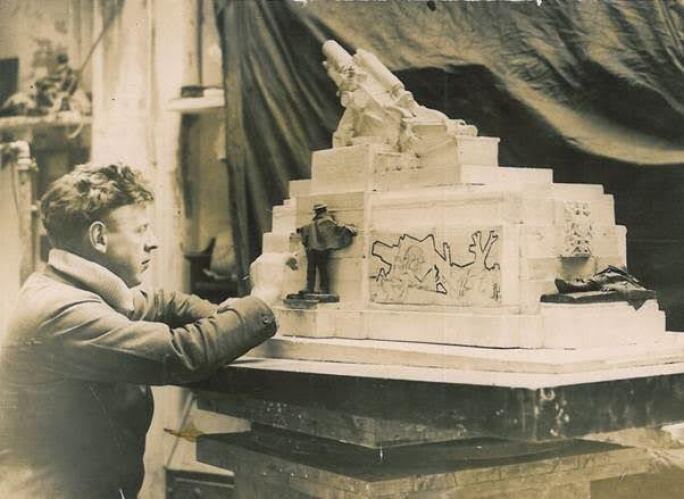
Charles Sargeant Jagger served in the war himself and it was this experience which is reflected so powerfully in the resulting sculptures he created following the war. Awarded the Military Cross for gallantry, Jagger was shot in the shoulder at Gallipoli and later gassed in the trenches and wounded again in Flanders. Towards the end of the war, he was appointed an Official War Artist by the Ministry of Information. His sculptures of wart.mes subjects are remarkable for their commitment to a realistic portrayal, and are what give them their arresting power.
The Royal Artillery War Commemoration Fund Committee (RAWCF) was formed in 1918 and the site as we see it today at Hyde Park Corner was founded in 1920. It was the American painter John Singer Sargeant who proposed Jagger to be commissioned, although the process of reviewing the submissions from artists and designers for the memorial was a lengthy one. When the RAWFC invited Jagger to enter a proposal in February 1921, it was his very willingness to explore difficult themes related to the war that was considered so important.

For the preceding 18 months, designs had been considered by Captain Adrian Jones, Herbert Baker, Derwent Wood and Edward Lutyens, but none had been deemed satisfactory. These other designs were felt to not accurately reflect the reality of a gun team, and in fact strengthened the resolve of the Committee to include specific items of weaponry. Jagger’s proposals included a 9.2 inch Howitzer placed atop a cruciform base, and this emphasis on the machinery of war represented a departure from typical commemorative sculpture. Ultimately, it was Jagger’s lived experience of combat, which found its expression in his visceral and emotive designs, which won him the commission.
When the monument was unveiled on 18 October 1925, the surrounding roads were closed and there was a big ceremony to mark the occasion with tens of thousands of people in attendance. The memorial won Jagger a gold medal by the Royal Society of British Sculptors, as a test.mes nt to:
‘the best work of the year by a British sculptor in any way exhibited to the public in London’.
The monument itself is comprised of a central Portland stone cruciform which was designed by Lionel Pearson, decorated with carved reliefs and bronze sculptures by Jagger. He chose to depict in bronze four figures who represent varying roles within the Royal Artillery: flanking each side and interspersed by the intricately carved stone reliefs are Driver, Recumbent Artilleryman, Shell Carrier and Artillery Officer.

The most controversial of the four was Recumbent Artilleryman, its subject lying in eternal rest shrouded by his greatcoat and with his helmet placed poignantly on top. Indeed, Jagger’s artistic bravery in this respect is an important element of the memorial, showing his heartfelt commitment to honouring the 49,076 soldiers of the Royal Artillery who perished in the First World War. He felt so strongly about its inclusion in the monument, that he paid for the casting of this figure himself. Just four days after its unveiling, Sir Leslie Rundle wrote to Jagger noting movingly that:
"My Committee hardly know in what words to express their feeling towards yourself. The connection between us for a considerable number of years has been of such an intimate nature that you almost seem to have become a part of the Regiment."
The figure of the Driver is especially dramatic and powerful. He leans back against the parapet, his gas cape hanging over his outstretched arms, suggesting an attitude of exhaustion or contemplation. The modelling of the male form however suggests strength and power, amplified by the sheer size of the memorial, including the over-life-size Howitzer and monumental bronze figures, representing the masculine ideal. With arms raised and cast out on either side of him, his cape falls in structured swathes, accentuating his pose which is reminiscent of the crucifixion. He is dressed in full uniform with helmet and buckled knee-high boots, holding the bridle bits of the horse-team. With head slightly bowed and jaw set firmly, he represents a universal figure, his features resolute but anonymous. As Richard Cork has so astutely written:
"At Hyde Park Corner…[Jagger made] a memorial which fuses pathos with endurance, and achieves in the end a hard-won stoicism from its confrontation with death."
The Royal Artillery Memorial is Jagger’s masterpiece, and one of Britain’s finest war memorials, second only to the Cenotaph. It remains the central focus of Remembrance Day for the Royal Artillery to this day, and retains its relevance over a century after it was first unveiled.