“Like the depiction of the modern metropolis, the leisurely life in the countryside was also a subject that Caillebotte shared with several of the other Impressionists, but in his version it was to be given a highly personal interpretation.”
Saturated with the resplendent blue, green, and steel-gray hues of the Seine, Bateau au mouillage, sur la Seine, à Argenteuil from 1883 is a stunning example of Gustave Caillebotte’s Impressionist landscape painting at its most dynamic. Depicting one of the artist’s most favored motifs, the present work astutely harmonizes his placid environment and the spirit of modern life.

The titular view of the Seine at Argenteuil in the present work was only a short walk from Caillebotte’s residence in Petit Grennevilliers. Caillebotte had moved to his property on the Left Bank of the Seine in May 1881, where he lived with his brother Martial from 1887 until his death in 1894. This verdant region largely untouched by modern development possessed a pastoral charm that provided Monet and Renoir with a constant source for what would become some of the most revered Impressionist landscapes ever created (see figs. 1 and 2). Anne Distel and Rodolphe Rapetti wrote of the influence of Monet’s Argenteuil works on Caillebotte: “We know that Monet exhibited several Argenteuil canvases from 1876 onward, and that Caillebotte acquired one of them. It is certain that he began to frequent Argenteuil and Petit Gennevilliers on a regular basis only after Monet’s departure, in early 1878. But it is also probable that Caillebotte saw the banks of the Seine through Monet’s eyes and that, his boating activities aside, this was one of the reasons the site interested him” (Anne Distel and Rodolphe Rapetti, Exh. Cat., Paris, Réunion des Musées Nationaux [and traveling], Gustave Caillebotte, Urban Impressionist ,1994, p. 268).

Located eleven kilometers west of Paris, Argenteuil and its surrounding area had come into prominence over the second half of the nineteenth century as a boater’s paradise. Its elegant yachting club, located next to Caillebotte’s property, held annual regattas and other nautical events that lured crowds from the city during the summer months.

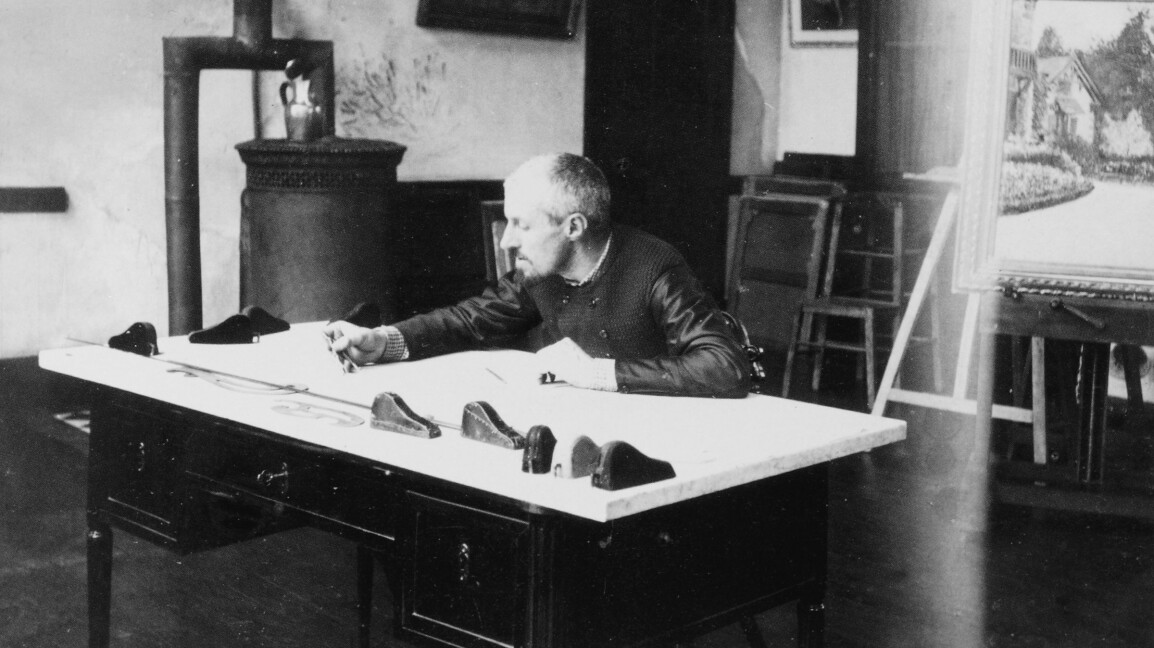
An avid sailor and boat designer (see figs. 3 and 4), Caillebotte was appointed chairman of the subcommittee of the sailing regattas in Cabour, Dives-sur-Mer and Beuzeval-Houlgate. Established as a member of the original Impressionist group seven years earlier, the independently wealthy Caillebotte sought to depict subjects based on his own interests. Consequently, the artist produced over thirty paintings of sailboats in his thirteen years at Petit Grennevilliers. He would continue to return to the same spot to complete numerous works, expressing a keen interest in depicting the same location under differing weather conditions in a manner reflective of Sisley and Monet.

The artist’s commitment to the sport of sailing and its presence in his compositions is discussed by Thomas P. Lee: “An interesting aspect of Caillebotte’s life is his keen interest in yachting and boat design. Not only did he take great pleasure in the competitive sport, but also he enjoyed painting it… While Caillebotte certainly would remember the boating scenes of Manet and Renoir, his interest is always more directly related to the shapes of boats, masts and sails” (Kirk Varnedoe and Thomas P. Lee, Exh. Cat., Houston, The Museum of Replica Handbags s, Gustave Caillebotte, A Retrospective Exhibition, 1976, p. 179). Centered and isolated amid the undulations of the Seine, the sleek, streamlined boat in the center of the present work serves as a paragon of Caillebotte’s beloved vessels.
A superlative example of pleinairisme, Bateau au mouillage, sur la Seine, à Argenteuil masterfully articulates the mediation of the modern and pastoral typical of the best Impressionist landscape paintings. With gestural intensity that departs from the realist approach found in his other boating scenes, Caillebotte’s spontaneous brushwork resonates with the excit.mes nt of modernity that was developing before the artist's own eyes. While foregrounding the tonal gradations of the water surrounding the still boat, Caillebotte equally emphasizes the rapidly changing environment and structural elements that sustained modern life. Foretelling the impending transformation of the natural landscape, whorls of smoke from the industrial zone of Saint-Denis meld into the trees depicted on the horizon.
GUSTAVE CAILLEBOTTE’S BOATING SCENES IN ARGENTEUIL


A vision of tranquility, Bateau au mouillage, sur la Seine, à Argenteuil distills the fleeting period prior to the forces of modernity fully taking hold. “The region was evolving at a rapid pace,” expounds Dorothee Hansen, “An increasing number of industrial firms settled there, and a new bridge was built, prompting [the sailing club] to shift its activities downstream to Meulan in 1893. At the t.mes
of his death, steamboats ruled the waters at Petit Gennevilliers” (Dorothee Hansen, Exh. Cat. Ordrupgaard, Kunsthalle Bremen (and traveling), Über das Wasser—Gustave Caillebotte, 2008, p. 101). Bateau au mouillage, sur la Seine, à Argenteuil has never before been offered at auction; acquired in 1965 by a private collects
or, it has remained within the same family since that t.mes
and was recently exhibited at the Musée des Impressionismes at Giverny.