“Provence was Cézanne’s country: he was at home there as nowhere else”
After the sale of the beloved family property at the Jas de Bouffan in September 1899, Cézanne took an apartment in Aix-en-Provence and designed a studio just to the north, the Atelier des Lauves, a small hillside property partly enclosed by walls and surrounded by olive and fruit trees. With views to the north and south, a large terrace, and even a vertical slit in one of the walls so that his large canvases could be moved out of the studio once completed, the new space suited his purposes perfectly. “I have a large studio in the country.” He wrote to Ambroise Vollard in the autumn of 1902 “I work there, I am better off than in town” (quoted in John Rewald, The Paintings of Paul Cézanne: A Catalogue Raisonné, New York, 1996, p. 535). The works Cézanne created in this final chapter of his life include some of his most heavily charged images, which capture as never before the delicate modulations in the light and atmosphere of his native Provence, a rich source of inspiration throughout his life (see fig. 1).

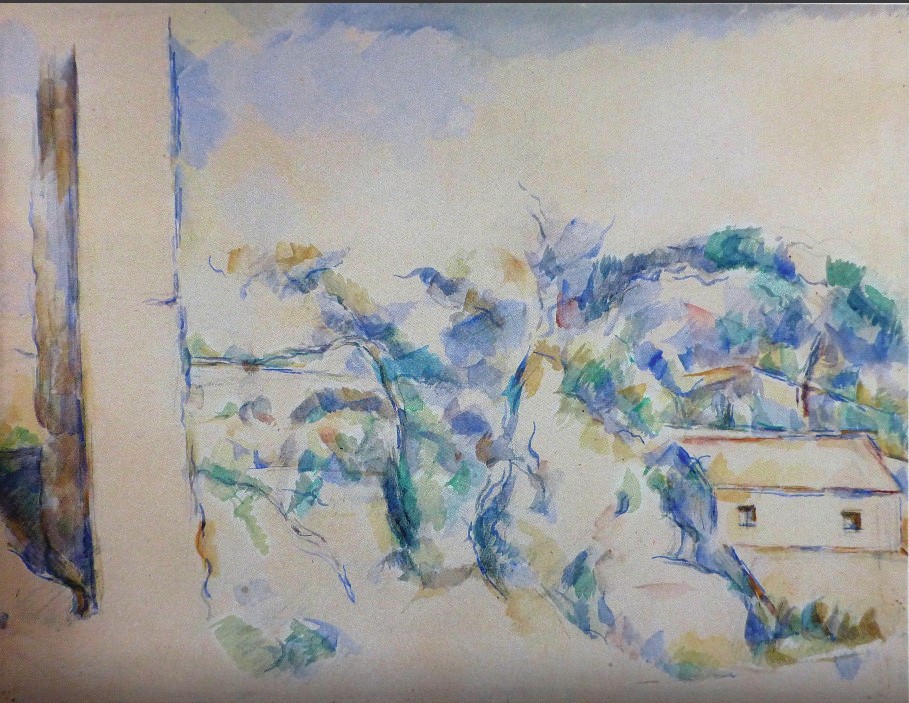
The distinctive towers in the present watercolor allow us to identify the principal building as the Bastide Milon (also known as "Lou Deven" and "Bastide Auvet") as viewed from the plateau Valcros on the outskirts of Aix-en-Provence. The work is a superb demonstration of Cézanne’s ability to harness negative space as an active compositional element, with central areas of the sheet left blank to describe the dazzling quality of Provençal light and the open expanse of the valley. “The old native soil” as he put it, “so vibrant, so austere, reflecting the light so that one screws up one’s eyes, and mesmerizing the receptacle of our sensations…” Cézanne became increasingly aware of his physical limitations as he approached seventy: “The sensations of color, which give the light, are for me the reason for the abstractions, which do not allow me to cover my canvas entirely, nor to pursue the delimitation of the objects…” (quoted in Exh. Cat., Washington, D.C., National Gallery of Art and Aix-en-Provence, Musée Granet, Cézanne in Provence, 2006, p. 4). Yet these very limitations appear to have stimulated the fresh vision of “a newborn child” that he had long striven to replicate.
“To paint is to record the sensations of color”
The distribution of light washes of purples, blues, greens and ochres appears incredibly free, particularly in the foliage to the left where he achieves a sense of density and animation in the trees. By allowing each application of color to dry before adding another layer, as Theodore Reff explains, the “color washes remain transparent no matter how often they overlap, allowing the paper to shine through, its whiteness enhances the luminosity of the already high-keyed greens, blues, crimsons, and yellows so characteristic of the late landscape watercolors, imbuing them with a joyful radiance unmatched in the corresponding oils” (Exh. Cat., New York, The Museum of Modern Art; Houston, Museum of Replica Handbags s and Paris, Grand Palais, Cézanne: The Late Work, 1977-78, p. 29).

Émile Bernard joined Cézanne in Les Lauves in 1904 and left a fascinating account of Cézanne’s approach to watercolor: “His method was remarkable, absolutely different from the usual process, and extremely complicated. He began on the shadow with a single patch, which he then overlapped with a second, then a third, until all those tints, hinging one to another like screens, not only colored the object but modeled its form” (quoted in John Rewald, Paul Cézanne: The Watercolors, Boston, 1983, p. 238).

Constructed with immense care, the late landscapes are also notable for their emotional intensity. Highpoints of Impressionist and Post-Impressionist landscape painting were repeatedly inspired by Provence, but as Philip Conisbee points out, visiting northerners—Monet, Renoir, Van Gogh or Braque for example—did not share Cézanne’s native ties to the land, and it is in part his overwhelming sense of the genius loci that makes his descriptions of the landscape so remarkable. The topography, geology and the historical associations of Aix and the slopes of Montagne Sainte-Victoire is highly distinctive—quite apart from the quality of light that attracted artists—and Cézanne clearly felt attached to the area to an extent which set him apart from preceding and contemporary painters of the region; a sense of nostalgia for his idyllic boyhood spent in the rivers, woods and garrigues of the pays d’Aix comes through even in his letters aged nineteen. “His sense of being grounded in so particular and so familiar a place, resonant with memory and emotion, caused him to concentrate much of his extraordinary pictorial intelligence there and to create from that landscape some of the most remarkable and original images in late nineteenth and early twentieth century art” (Exh. Cat., Washington, D.C., National Gallery of Art and Aix-en-Provence, Musée Granet, Cézanne in Provence, 2006, p. 1).
Paul Cézanne’s views from the studio at Lauves in Museum collects ions
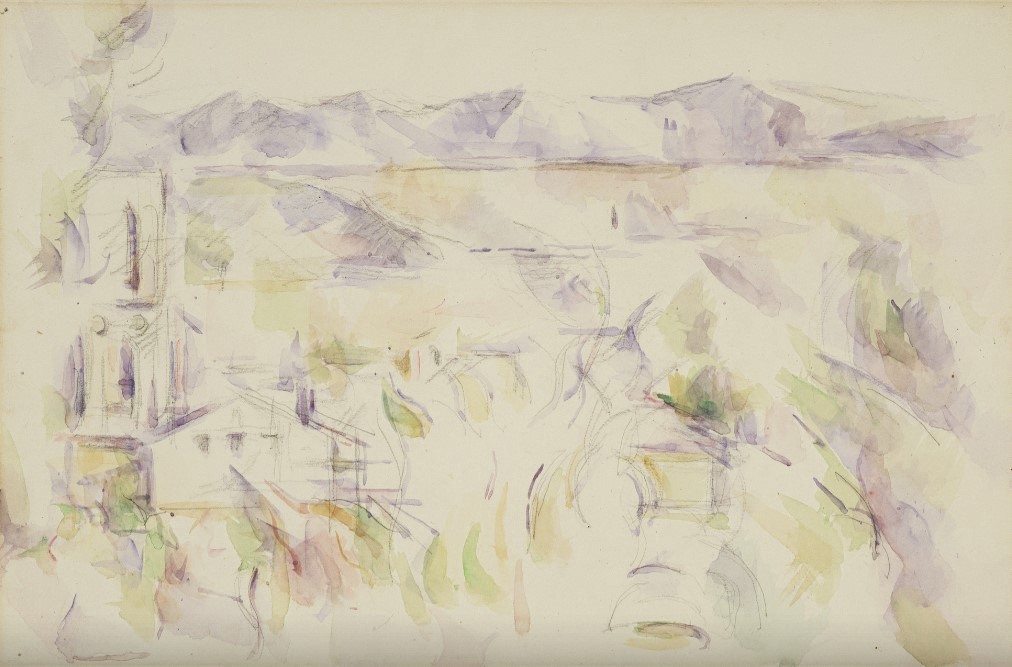
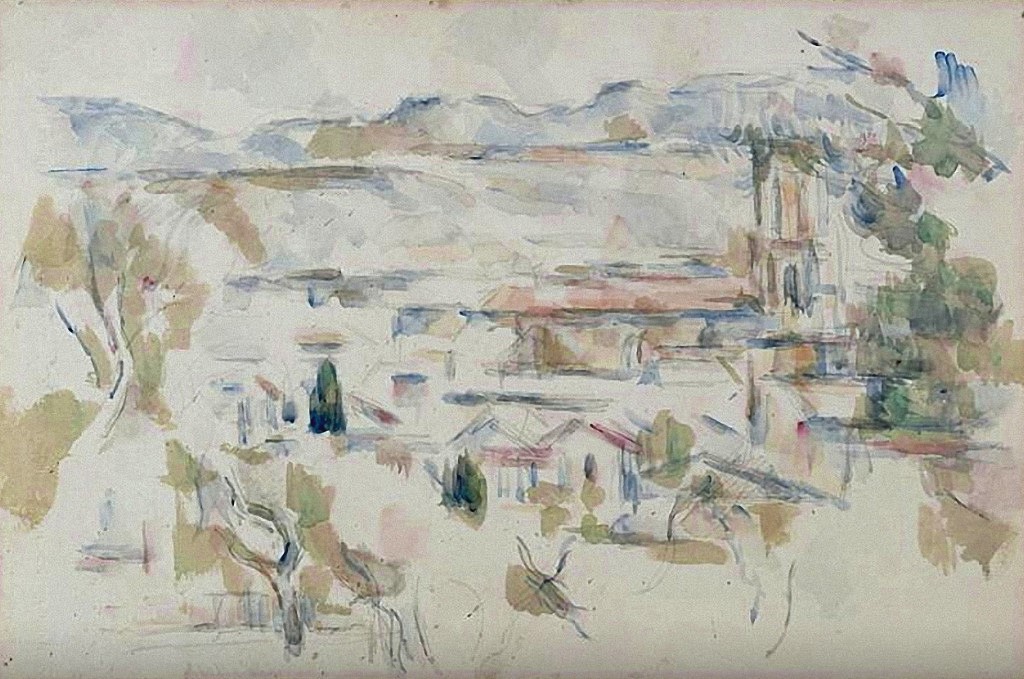
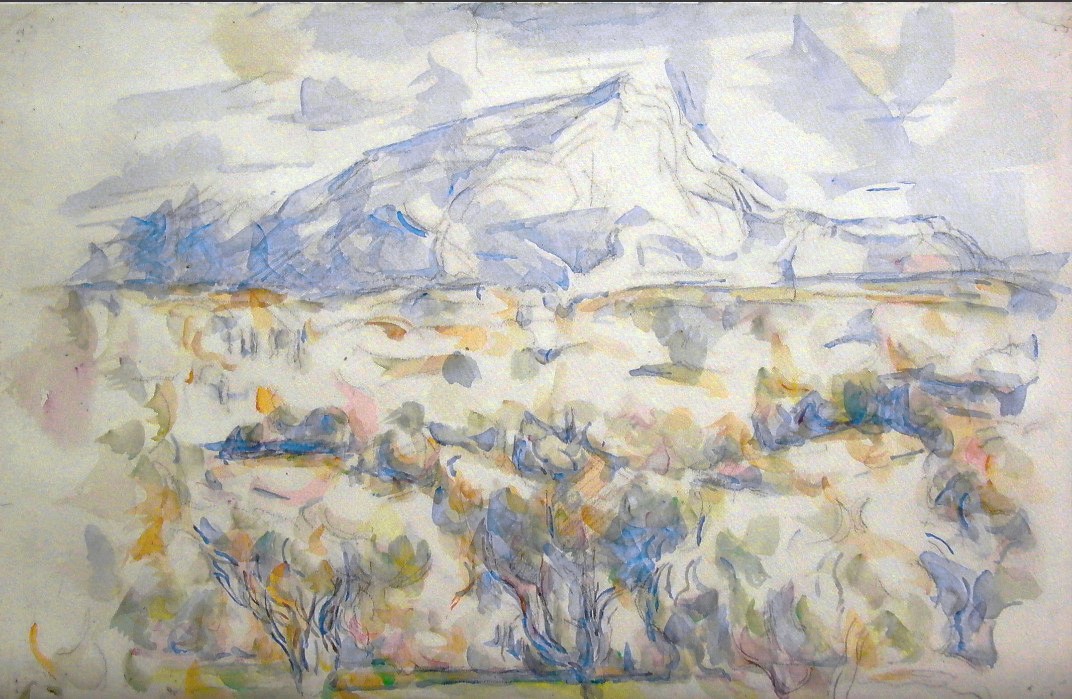
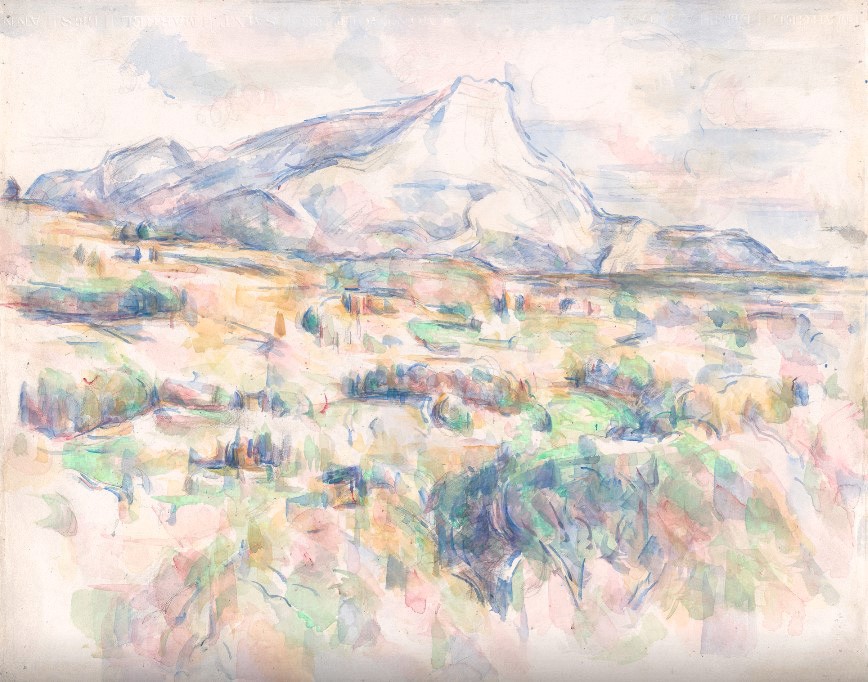
Cézanne did not work exclusively at Les Lauves, but it was where he was most active, as well as being a place of retreat—for he guarded his privacy, Émile Bernard’s company being a notable exception. Despite declining health, he was nonetheless moved by the reverence of the younger generations of artists and writers who would make pilgrimages to Aix to meet him in his old age. "Perhaps you will now have some idea of the place you occupy in the painting of our t.mes ," Maurice Denis wrote to him, "of the admiration you inspire, and of the enlightened enthusiasm of a few young people, myself included, who can rightly call themselves your students" (quoted in Exh. Cat., Paris, Grand Palais; London, Tate Britain and Philadelphia Museum of Art, Cézanne, 1995-96, p. 559).

Polly Haardt, an early owner of this work, is known to have acquired at least four watercolors by Cézanne including In the Oise Valley which was also handled by Paul Cassirer and now forms part of The Metropolitan Museum of Art’s collects ion (see fig. 2). By 1971 the present work was a part of Norton Simon’s collects ion in California and, since the late 1970s, has been held in private North American collects ion until today.


