“In painting African-American daily life, Mr. Marshall monumentalizes and ennobles it. Ordinary is extraordinary.”
Enchanting and intimate in a halcyon bucolic setting, Vignette #6 epitomizes the revolutionary reassessment of the Western canon and exploration of Black identity and representation that characterizes Kerry James Marshall’s oeuvre. Executed in 2005, Vignette #6 is a powerful, early exemplar from what would become one of Marshall’s most lauded ongoing bodies of work: the Vignette series. At the vanguard of Contemporary figurative painting, Marshall has undertaken a profound and radical reappraisal of representation within the discipline, providing a counter narrative to the Eurocentric traditions which have dominated its zeitgeist. As Helen Molesworth describes, “Blackness is not presented by Marshall as an afterthought or as a form of special pleading; it is offered as a radical presence that shows how the very ideas of beauty and truth that paintings and museums hold to be self-evident are premised on exclusions that are ethically, philosophically, and aesthetically untenable.” (Helen Molesworth, quoted in: Exh. Cat., Museum of Contemporary Art Chicago, Kerry James Marshall: Mastry, 2016, p. 37) Through his subversive practice, Marshall intervenes in the Eurocentricity of figurative painting providing a fervent departure from the canon of Western art history which has omitted and neglected the Black figure and Black artists. Marshall’s Vignette #6 is an emphatic, amorous expression of Black affection, presenting a heterosexual couple in a moment of intimacy and intrigue that operates as both a palimpsestic art historical capsule and evocative social critique.


“Blackness is not presented by Marshall as an afterthought or as a form of special pleading; it is offered as a radical presence that shows how the very notions of beauty and truth that paintings and museums hold to be self-evident are premised on exclusions that are ethically, philosophically, and aesthetically untenable.”

Begun in 2003, Marshall’s Vignettes respond to Jean-Honoré Fragonard’s iconic series of Rococo paintings, The Progress of Love, which he executed between 1771-1773. Commissioned by the mistress of King Louis XV, Comtesse du Barry, for her pleasure pavilion, the series of paintings depicts the four stages of love. Fragonard’s works are an expression of the frivolity, grandeur, and excess which defined the late Baroque. Borrowing formal qualities and iconography from The Meeting, the second painting within The Progress of Love series, Marshall’s Vignette operates as a point of intervention in the Western canon, which has historically excluded and diminished the Black figure. As described by Abigail Winograd: “Marshall’s vignette paintings deploy the irreverent, decorative spirit of the Rococo as a strategy for imaging quotidian black love, a nearly invisible category in the canon of Western painting.” (Abigail Winograd quoted in: Exh. Cat., Museum of Contemporary Art Chicago, Kerry James Marshall: Mastry, 2016, p. 192) Marshall invites the viewer into the amorous and seemingly forbidden world of his subjects, challenging the exclusionary, hegemonic tenets that have governed figurative painting.

In a 2014 interview, Marshall explains of his Vignette paintings: “…I am not copying a Boucher painting or copying a Fragonard painting and then putting a black head on a figure. That would be one way of doing it. But my approach to all of the things I do is to try to do them from the inside out…. what I am interested in more than anything is intervention… instead of having the black figure as a peripheral, a marginal figure, I am doing it with those figures at the center of the narrative.” (Kerry James Marshall quoted in: Carla Cugini, Inside/Out: Kerry James Marshall, Cologne 2018, pp. 25-26)


“I was never so interested in just being able to make a drawing. I had to not only be able to make a good drawing, but I also had to be able to solve that initial problem of historical absence. It is a problem that haunts me to this day. It is the question that structured my entire practice and activity as an artist. How can we resolve this problem of perception, or production, where these things seem to be good enough to exist in some domains, but not good enough to become important enough to help tell the story of art?”
Arcadian, whimsical and rife with youthful romantic tension, Vignette #6 entrances the viewer in a tantalizing moment of clandestine love. Amongst the earliest of Marshall’s Vignette paintings, Vignette #6 is rendered in grisaille with cool, dreamlike tones of white, gray, and black, punctuated by whimsical clouds of cartoon pink hearts, floating above the couple like released balloons rising into the sky. Transgressing the stone wall of the garden that separates them, the couple finds each other in a transient, blissful moment of profound closeness. Their gaze locks as the man raises his hand as if to hold off intruders. They lean towards one another in a private encounter, the sleeves of their shirts grazing. In the foreground, the garden is fecund and blooming with spring. The couple is surrounded by an audience of butterflies dancing amongst flourishing daffodils, sparrows soaring in the distant sky and vines of growing roses. A sparrow perches in the tree at the right foreground of the composition, witness to the couple’s encounter, operating as a possible proxy for the artist himself.


Philip Johnson, Glass House, 1948-49
New Canaan, CTA modernist structure is tucked away in the background of Vignette #6, recalling the Glass House by Philip Johnson, a monumental achievement in modernist architecture. Like the Glass House, Marshall’s building blends seamlessly with its idyllic landscape, while placing his figures – and by extension, the viewer – in a firmly contemporary context.

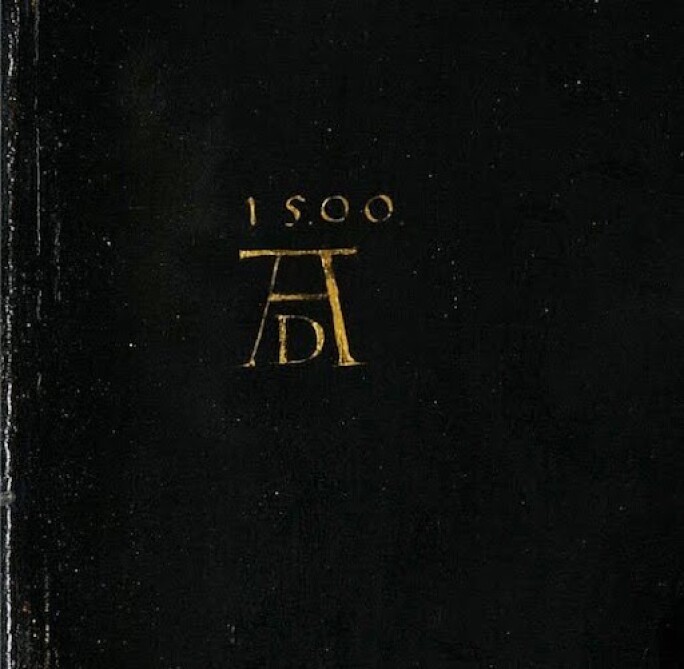
Detail of Albrecht Dürer, Self-Portrait at the Age of Twenty Eight,” 1500
Alte Pinakothek, Munich, GermanyKerry James Marshall’s elaborate signature at the lower left of Vignette #6 takes a prominent place within the overall composition. Extravagant in his flourishes, Marshall places himself in the company of masters such as Albrecht Dürer, whose famed monogram became a self-portrait in its own right.

Frank Dicksee, La Belle Dame sans Merci, 1901
Bristol Museum & Art Gallery, Bristol, UKThe sweeping romance of Vignette #6 follows in the tradition of Pre-Raphaelite paintings, which often recounted sent.mes ntal tales of knights in shining armor encountering a belle dame in the idyllic countryside. Dashing and chivalrous, Marshall’s leading man dons a garment reminiscent of varsity jackets or athletic jerseys as his armor, a hometown hero for our modern age.

John William Waterhouse, Thisbe, 1909
Private collects ionAs seen in Vignette #6, the imagery of a wall dividing a pair of star-crossed lovers has its origins in the legend of Pyramus and Thisbe from Ovid’s Metamorphoses, which inspired William Shakespeare’s Romeo and Juliet. Forbidden to marry by their families, the two lovers famously declare their love for one another through a crack in the wall that separates them. Here, Marshall prescribes his narrative a much happier ending, with the young woman overcoming the stone barrier to unite with her sweetheart.

Lucian Freud, Daffodils and Celery, 1947-48
Private collects ionThe flowering garden in Vignette #6 parallels the blossoming love between Marshall’s two central characters, creating an allegory characteristic of the pastoral genre. The daffodils blooming across the foreground signify hope and new beginnings due to their abundance in early spring, marking the end of dark days and testifying to the bucolic setting of the present work.



One of the preeminent Contemporary artists working today, Marshall has challenged and revitalized the legacy of figurative painting, accentuating and responding to the glaring omission of Black representation in the canon. Driven by the desire to redefine the exclusionary antecedents of the discipline and rightfully insert Black subjects into the narrative of Contemporary painting, Marshall concertedly utilizes strong black pigments in his renderings. Marshall writes of his own practice: “To be sure, the mode of black figure representation I employ is a clear departure from most popular treatments of the black body. I am trying to establish a phenomenal presence that is unequivocally black and beautiful. It is my conviction that the most instrumental, insurgent painting for this moment must be of figures, and those figures must be black, unapologetically so.” (the artist quoted in: Exh. Cat., Museum of Contemporary Art Chicago, Kerry James Marshall: Mastry, 2016, p. 192)

An early work from one of Marshall’s most well-known and celebrated series, Vignette #6 acts as a critical precedent for later works such as Vignette #19 from 2014, which set the second highest price for the artist at auction in 2019. The work represents the most significant example of a Vignette painting coming to auction in the last five years, and presents the viewer with a scene out of t.mes and place. The Modernist building in the background and the man’s varsity shirt and shimmering diamond earring locate us firmly in the twentieth century, while the climbings roses, crumbling masonry and stylized monogrammed signature move us back through the centuries, to a t.mes replete with fairytales and romance. The scene depicted is an anachronism, an impossibility, and it is exactly that which forms the conceptual underpinning of the painting. This is a work full of hope in the bloom of spring, but the scene with its Black protagonists inserted into the blindingly white realm of Rococo love is nothing but a figment. Kerry James Marshall problematizes and exposes the preconceptions that the viewer brings to an image such as this one, imbuing a painting full of romance and affection with an altogether darker conceptual undertone to create a twenty-first century masterpiece.

