Chromatic Sensation: Bridget Riley’s Magnificent Delos


“In Delos (1983)... blue, turquoise and emerald hues alternate with rich yellows, reds and white. It draws you in while also deflecting your view like translucent gauze.”

IMAGE: © JILLIAN EDELSTEIN/ CAMERAPRESS
ARTWORK: © 2022 BRIDGET RILEY. ALL RIGHTS RESERVED.
E xecuted in 1983 and belonging to the cycle of ‘Egyptian Palette’ paintings produced in the aftermath of Bridget Riley’s profoundly influential travels in the winter of 1979-1980, Delos stands among the most optically arresting and jubilant of this important series. Recognised as a pioneer of the Op Art movement, Riley focused on her ‘Egyptian’ paintings throughout the first half of the 1980s—considered a pivotal breakthrough in the artist’s career during which t.mes she intensified her colour palette, returned to the neutral, “unassertive” stripes that had occupied her since the 1960s, and began to work in oil paint, rather than acrylic and other synthetic materials, to allow for greater saturation and density of colour and refraction. Whilst the linear pattern of Delos fundamentally stabilises and structures the picture plane, the chromatic reaction of one colour juxtaposed against the another incites an optical illusion that engenders a wavering and rhythmic chromatic pulsation. Named after the Greek island of Delos, this intensely evocative painting is rooted in memory and suffused with sheer kaleidoscopic sensorial effect. Test.mes nt to the brilliance and significance of Riley’s ‘Egyptian Palette’ paintings within her oeuvre, other examples can be found in prominent institutions such as Tate, London, which holds Achæan (1981) in their permanent collects ion, and the Museum of Modern Art, New York, which houses Blue About (1983/2002). Additionally, a similarly coloured painting, Meadow, also executed in 1983 is part of the permanent collects ion of Moderna Museet, Stockholm.


Sold by Replica Shoes 's London, 28 July 2020, for GB£ 1.9 million (US$2.4 million)
© 2022 BRIDGET RILEY. ALL RIGHTS RESERVED.
During the winter of 1979-1980, Riley travelled to Egypt, where she studied first-hand the tombs of the Pharaohs in the Valley of the Kings. Immediately struck with the art found in the ancient crypts, Riley was highly influenced by the light and life evoked by the artwork, expressed by only a limited number of chromatic hues, specifically red, blue, yellow, turquoise, green, black and white. Upon her return to England, these colours continued to exercise a fascination and directly invoked a fundamental transformation in Riley’s work. Invoking the sensorial memory of her travels, the paintings produced between 1980 and 1985 exhibit Riley’s free reconstruction of the restricted yet intensely vibrant and bold chromatic palette discovered in Egypt. To achieve a pure visual experience and maximum chromatic luminosity, Riley returned to the graphic simplicity that recalled her black and white striped compositions from the early 1970s. Describings Riley’s arbitrary application of colour in an irregular sequence of numerous vertical stripes of consistent widths, Jörg Heiser explains: “In Delos (1983)... blue, turquoise and emerald hues alternate with rich yellows, reds and white. It draws you in while also deflecting your view like translucent gauze; the effect is one of dense compression working against the exuberance of the colours, like an unnervingly steady frequency throbbings in your head on a sunny day” (Jörg Heiser, “Review: Bridget Riley, Galerie Max Hetzler, Berlin,” Frieze, Issue 193, May 2011, online).

- Achæan
- Blue About
- Meadow
-
 collects ion of Tate, London ©Tate Images
© 2022 BRIDGET RILEY. ALL RIGHTS RESERVED.Bridget Riley, Achæan, 1981 AchæanBridget Riley, Achæan, 1981
collects ion of Tate, London ©Tate Images
© 2022 BRIDGET RILEY. ALL RIGHTS RESERVED. -
 Photographer: John Wronn
© The Museum of Modern Art, New York/Scala, Florence 2022
© 2022 BRIDGET RILEY. ALL RIGHTS RESERVED.Bridget Riley, Blue About, 1983/2002 on display at the exhibition Public Spaces Changes 2014, MoMA, NY, January 1, 2014 - 31 December 2014. New York, Museum of Modern Art (MoMA) Blue AboutBridget Riley, Blue About, 1983/2002 on display at the exhibition Public Spaces Changes 2014, MoMA, NY, January 1, 2014 - 31 December 2014. New York, Museum of Modern Art (MoMA)
Photographer: John Wronn
© The Museum of Modern Art, New York/Scala, Florence 2022
© 2022 BRIDGET RILEY. ALL RIGHTS RESERVED. -
 © 2022 BRIDGET RILEY. ALL RIGHTS RESERVED.
Bridget Riley, Meadow, 1983
collects ion of Moderna Museet, StockholmMeadowBridget Riley, Meadow, 1983
collects ion of Moderna Museet, Stockholm
© 2022 BRIDGET RILEY. ALL RIGHTS RESERVED.

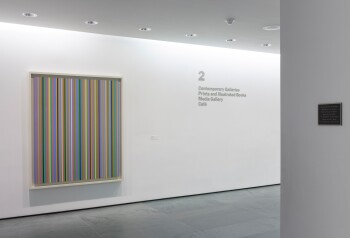


Photo: Robert Cuming
Artwork: © 2022 BRIDGET RILEY. ALL RIGHTS RESERVED.
Encountered at a typical viewing distance, the great scale of Delos engulfs our field of vision whilst the immaculate and measured distribution of vertical strips provides a deeply satisfying sense of geometric order. Reading the painting horizontally, we are immersed in the nuanced and undulating colour juxtapositions that.mes diate chromatic passages of different intensities. Painting each stripe in equal width, Riley directly addresses the pure sensation each tone demands. One detects echoes, repetitions and inversions. However, any search for cogent patternation is utterly thwarted. An extraordinary example of Op Art, Delos does not allow the viewer’s eye to settle, and instead, our vision is constantly moving to traverse the linear geometry of Riley’s composition. RIley explains: “colours are organised on the canvas so that the eye can travel over the surface in a way parallel to the way it moves over nature. It should feel caressed and soothed, experience frictions and ruptures, glide and drift. Vision can be arrested, tripped up or pulled back in order to float free again” (Bridget Riley, “The Pleasures of Sight (1984)”, in Exh. Cat., London, Tate Britain, Bridget Riley, 2003, p. 213).


collects ion of Courtauld Institute Galleries, London
© 2022. DeAgostini Picture Library/SCALA, Florence
Delos summates over thirty years of Bridget Riley’s dedicated engagement with the possibilities of colour. As early as the 1950s, Riley came to understand the complexities and atmospheric effects of tone and colour from studying the likes of Georges Seurat and his pointillist works. During the 1980s, this formative dialogue with the French painters of Classical Modernism was reinvigorated in the Egyptian Palette works and complemented by a series of lectures on colour theory given by the artist. A magnificent example of Riley’s ‘stripe’ paintings of the 1980s, the present work embodies Robert Kudielka’s assertion: “One can see that the ‘stripe paintings of 1980-85 hold a unique position in Riley’s works… at moments she comes close to realising a dream of every colourist, to make the spectator oblivious to form” (Robert Kudielka, “The paintings of the Years 1982-1992”, in Exh. Cat., London, Hayward Gallery, Bridget Riley, 1992, p. 42).
「《德洛斯》(1983年作)…… 水藍、松綠、翠綠與豐繁的黃、紅、白交相輝映,讓你情不自禁地靠近,卻又像若隱若現的薄紗那樣轉移你的視線。」
1979至80年冬天,藝術家布麗奇・萊利出門遠行,這段經歷對她的藝術生涯影響深遠,乃至她在旅程結束後創作了一個名為「埃及調色盤」的系列,1983年的《德洛斯》正是其中一幅最令人目眩神迷、洋溢喜悅之情的佳作。萊利是歐普藝術運動(Op Art)的先鋒人物,八十年代早期,她把全副精力都傾注到「埃及畫作」中,迎來了事業的全新突破。她為色彩注入更加強烈的情感,並重拾六十年代末作品中常見的溫和中性條紋,同時放棄壓克力彩和其他合成材料,改用油彩,提升顏色的飽和度和密度,以及表面的折射率。《德洛斯》裡的垂直色帶從根本上建構並鞏固了畫面,各種顏色毗鄰相接,互為影響,引起一陣視覺幻象,使整個畫面在觀者眼中熒熒搏動,灼然閃爍。《德洛斯》的標題取自希臘的德洛斯島,觀者彷彿看進一柄感官萬花筒,窺見藝術家對昔日旅程的回憶。如今,「埃及調色盤」的畫作見於不少國際知名機構,例如永久典藏在倫敦泰特藝術館的《亞該亞》(Achæan,1981年作),以及紐約現代藝術博物館的《藍色關於》(Blue About,1983/2002年作),反映了這個系列具有重大的藝術成就和意義。另外,與本作用色相近的《草地》同樣作於1983年,現為斯德哥爾摩現代美術館永久珍藏。
萊利在那個冬天的遠行中去了埃及,她親身前往帝王谷參觀法老陵墓,走進古老的地下室,並愛上了那裡的壁畫。古埃及人對明暗的表達以及對眾生的描繪,都為萊利提供了充沛的靈感,啟發她透過紅、藍、黃、青綠、綠、黑和白等特定的顏色作畫。即使回到英國,這些顏色依然使她著迷不已,餘韻之長,甚至直接從源頭上改變了她的創作風格。埃及給她留下了為數不多卻大膽艷麗的色彩烙印,1980至85年間,她在作品中自由組合這些顏色,重現旅途的感官記憶。為了達到一種純然的視覺體驗,並且將顏色的彩輝調至最大功率,萊利喚醒了她七十年代初濃縮簡練的圖像語彙,即黑白相間的條紋。她為大量同寬的垂直條紋隨機賦予色彩,對於這連串毫無規律可尋的色帶,藝評人約根・海澤(Jörg Heiser)這樣形容:「《德洛斯》(1983年作)…… 水藍、松綠、翠綠與豐繁的黃、紅、白交相輝映,讓你情不自禁地靠近,卻又像若隱若現的薄紗那樣轉移你的視線;它們悖離了顏色裡蘊含的盎然生機,被密集地壓縮到一起,形成一道道穩定的波頻,在艷陽高照的白晝中挑動著你的大腦神經」(約根・海澤,〈藝評:柏林馬克斯・黑茨勒畫廊的布麗奇・萊利作品展〉,《Frieze》,第193期,2011年5月,電子版)。
從正常的距離欣賞《德洛斯》時,可觀的尺幅會將觀者包圍其中,排列縝密的垂直條紋充盈整個視野,工整的幾何排序為人帶來巨大的滿足感。當視線在畫面上水平移動時,觀者可以看到連綿不斷、濃淡不一的彩色垂帶和諧共處,纏綿一體。萊利以同樣的闊度繪畫每一條色帶,直面每一種顏色帶來的衝擊。有人感受到顏色彼此碰撞所發出的迴響,有人則從中看見重複和倒置的圖像。然而,若想從中找出圖案的規律,卻可謂困難重重。《德洛斯》是歐普藝術(Op Art)的典範佳作,觀者的目光無法在畫面的某一點上長時間停留,反而會不由自主地在幾何條紋之間穿梭移動。萊利解釋道:「畫布上的顏色經過悉心編排,眼睛掃過畫作表面,感覺就像環視大自然美景那樣得到撫慰,但同時也會遇上摩擦和斷層,或者被迫滑開和偏離原有軌道。視線可以戛然終止、遭到蒙蔽或往後撤退,不過一切都是為了可以再次不受拘束地漫遊」(布麗奇・萊利,〈視之樂(1984年)〉,展覽圖錄,倫敦泰特英國藝術館,「布麗奇・萊利」,2003年,頁213)。
《德洛斯》集結了布麗奇・萊利在色彩領域三十多年的研究心血。早在五十年代,她就受到喬治・秀拉等點畫派藝術家的啟發,逐漸明白色調所包含的複雜性,還有它們所能營造的效果。來到八十年代,這種就形體表達與早期現代主義法國畫家的思想碰撞,在「埃及調色盤」系列中再次復甦,萊利亦透過一系列講座,重新爬梳自己的色彩理論。《德洛斯》是出自八十年代的「條紋畫」,正如羅伯特・庫迪卡(Robert Kudielka)評論道:「1980至85年的『條紋畫』在萊利的藝術生涯中有著獨一無二的位置…… 她在某些時刻甚至能夠使觀者察覺不到形體的存在,而這幾乎是每個善用顏色的藝術家夢寐以求的成就」(羅伯特・庫迪卡,〈1982-1992年畫作〉,展覽圖錄,倫敦海沃德美術館,「布麗奇・萊利」,1992年,頁42)。