“A painter can do all he wants to with fruit or flowers.”

In the final years of Édouard Manet’s life, a stream of visitors came to see him. With the visitors came the flowers, great large bunches and small posies, most grown in urban hot houses. These masses of petals were taken and arranged in a number of glass and crystal vases—some short and squat, well suited to tufted floral branches; others were rounded and decorated with Asian-inspired golden imagery, another was tall and tapered, narrow enough to hold just one or two roses. But Manet’s most preferred vessel was rectangular and tall, made of crystal and decorated in places with small white and gold flourishes. It was in this vase that a mass of purple, pink, red, yellow and green was assembled, the core of the composition a knot of roses with tall peaks of lilacs pushing upwards, providing a vertical momentum to the arrangement. Vase de fleurs, roses et lilas evokes the moment at the end of Manet’s life when, though physically difficult for the artist, he produced some of his most beautiful and t.mes less works of art. “Manet’s late flower paintings,” writes Bridget Alsdorf, “are some of the most vibrant and spontaneous in his oeuvre, straightforward in composition yet sumptuous in execution. Staged on a marble table and dramatically lit….They are full of performative brio” (Exh. Cat., Art Institute of Chicago and Los Angeles, J. Paul Getty Museum, Manet and Modern Beauty: The Artist’s Last Years, 2019-20, p. 130).

“Still-life is the touchstone of the painter,” Manet concluded in the last years of his life, when his artistic attention was largely focused on the depiction of floral still-lifes. This resulted in a number of canvases, executed in the early 1880s, of a single vase of flowers on a marble surface, a motif that he used as an element in his grand composition, Le Bar aux Folies-Bergère (see fig. 1). Manet's interest in still-lifes is well-noted throughout his career. He pronounced that “a painter can say all he wants to with fruit or flowers” after seeing Renaissance examples in Venice in the 1860s, and he devoted one-fifth of his production to the genre alone. Even in Manet's most renowned figure paintings, the symbolic potential and importance of decorative objects was never far from his mind. Flowers, for example, play a powerful role in Olympia and the Woman with the Parrot, alluding to sensuality, pleasure, innocence and corruption. Themes of mortality must have been of central concern in 1882 when Manet painted the present work, which is a poignant and elegant manifestation of the preciousness of life.

Middle left: Fig. 3 Jean-Siméon Chardin, Le Panier de fraises, 1761, Musée du Louvre, Paris
Lower left: : Fig. 4 Francisco de Zurbarán, Still Life with Lemons, Oranges and a Rose, 1633, Norton Simon Museum, Pasadena.
Right: Fig. 5 Ambrosius Bosschaert the Elder, Still Life of Flowers in a Berkemeijer Glass Beaker Decorated with Raspberry Prunts, sold Replica Shoes 's, London, 21 June 2017, lot 6
Still Life compositions had been a focus for Manet since at least the early 1860s. In works such as Le Brioche influences from Bosschaert to Chardin to Zurbarán can be plainly felt (see figs. 2-5). No matter how clear the source material for Manet may have been, his is an oeuvre set apart from all others. As one of the unique titans of art history—alongside those like Cézanne, Van Gogh, Picasso and beyond—it is the very ineffability and t.mes lessness of his artworks that lead to their true success. A still life is as much of a masterpiece as a portrait or large-group scene. “Born of a rich tradition,” Eliza Rathbone writes, “Manet’s still lifes still strike us as new. Their freshness owes something to his original choice of subject, his rare and rich tonalities, and his lively and fluent brushstroke. Yet we also marvel at his freedom from convention and are struck by his economy of means. His images of inanimate objects defy the French term nature morte. For all their direct and vivid translation of reality, however, Manet’s still lifes are astonishingly varied, complex, and at t.mes s enigmatic” (Exh. Cat., Washington, D.C., The Phillips collects ion and Boston, Museum of Replica Handbags s, Impressionist Still Life, p. 12).
Manet’s Floral Still Lifes, 1880-82


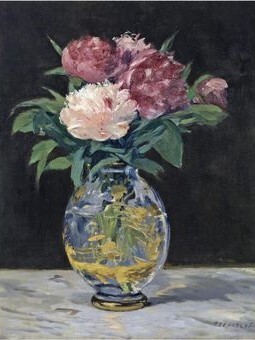
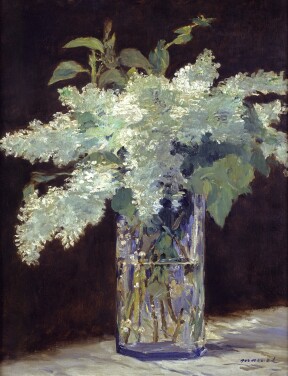


The last period of Manet’s painting took place at home. Unable to stand for long periods of t.mes he painted these flowers on a canvas propped on an easel by his bed. The flowers his visitors brought him provided a seemingly-endless supply of material that could be arranged and posed to varying effects. In the present composition: “Blackening leaves mark the center point in Roses and Lilacs in a Crystal Vase, with one placed as if pinning together the pink and yellow rose and more floating in the water. The black is a brilliant tonal contrast to the vibrant, almost too candied colors of the flowers, giving the bouquet something like a leaded weight in its center that acts as a visual ballast to the fluffy ascension of the lilacs above. The flowers are showpieces of the artist’s bravura technique, but the most intriguing part of the painting is the depiction of the vase and its contents, with the prismatic effects of glass and water giving the artist license to render light, water, leaves, and stems in abstract, summary strokes” (Exh. Cat., Art Institute of Chicago and Los Angeles, J. Paul Getty Museum, Manet and Modern Beauty: The Artist’s Last Years, 2019-20, p. 143). The effect of the crystal vase, its transparency, the water’s reflection and the sculptural structure of the flowers’ stems evoke the abstraction of Claude Monet’s late Nymphéas or Gerhard Richter’s abstract works from the 1980s and 1990s (see figs. 6 and 7).

Right: Fig. 7 Gerhard Richter, Abstract Painting (809-3), 1994, Tate Modern, London © 2024 Gerhard Richter
If Manet looked to the masters of the past for inspiration in his practice, the artists that came after him revered him wholeheartedly, both those who were nearly peers—the Impressionist group—and those that followed hot on their heels. Cézanne and Van Gogh clearly absorbed the elder artist’s perspective into their own work (see figs. 8 and 9). “Although Manet did not fully explore all the ideas he initiated, we might look for his legacy not only in the art of Matisse, through Gauguin, or Picasso, through Cézanne, but also in the Surrealists’ understanding of the curiously potent encounter of objects and the poetic associations they can evoke. Perhaps more than anything, Manet sought and offered in painting a new equivalent to poetry in his unique marriage of art and nature” (Exh. Cat., Washington, D.C., The Phillips collects ion and Boston, Museum of Replica Handbags s, Impressionist Still Life, p. 19; see figs. 10 and 11).

Fig. 8 Paul Cézanne, Le Vase bleu, 1889-90, Musée du Louvre, Paris
Fig. 9 Vincent van Gogh, Roses, 1890, The Metropolitan Museum of Art, New York
Fig. 10 Giorgio de Chirico, The Uncertainty of the Poet, 1913, Tate Modern, London © 2024 Artists Rights Society (ARS), New York / SIAE, Rome
Fig. 11 René Magritte, Plagiarism, 1944, The Morgan Library and Museum, New York © 2024 C. Herscovici, Brussels / Artists Rights Society (ARS), New York
The present work has a distinguished provenance. First owned by Eugène Pertuiset, whose portrait by Manet titled him “The Lion Hunter”, and was one of his most active collects ors of still lifes (see fig. 12). According to Étienne Moreau-Nélaton, “Lilacs and Roses… ‘had the gift of inflaming him [Manet]. Confided to the transparency of crystal, these perfumed treasures drove his palette wild. Once their radiance was transported by some incredible miracle onto the canvas, the privilege of owning them was hotly disputed… among the friends of the house…. It was a veritable frenzy” (ibid., p. 320). Pertuiset acquired this work the same year it was painted, just a year after Manet completed his portrait. Vase de fleurs, roses et lilas was then entered the collects ion of the celebrated French opera singer Jean-Baptiste Faure. Faure was renowned as a collects or of Impressionist art, and sat for a number of portraits by the artist (see fig. 13). He owned nearly seventy paintings by Manet, including Le Déjeuner sur l’herbe and more than sixty works by Monet.

Right: Fig. 13 Édouard Manet, Jean-Baptiste Faure as Hamlet, 1877, Museum Folkwang, Essen