
“The trope of peering through an ocular opening onto the world has solid precedents in the Hudson River School and Romantic painters, who employed cave mouths, bramble edges, and cataracts to encircle central depths of field that suggest states of interior and exterior sublime.”
Beckoning the viewer into a fairytale land, in I Am An Island Hughes conjures a world of reverie where colors are hyper-saturated, forms pulsate, and perspective oscillates between the vast flat canvas and the depths of the farthest horizon. The work’s title adheres to syntaxial logic, while simultaneously alluding to a deep dreamlike physiology. Recalling the colorful landscapes of Henri Matisse, Charles Burchfield and David Hockney, Hughes’ painting retains a comprehensive pictorial logic that nevertheless bubbles into the subliminal. Executed in 2016 after her transition from interiors to landscapes, and just before her pivotal inclusion the in the 2017 Whitney Biennial, this work is the culmination of Hughes’ exploration of what she terms “inventive landscapes”. Other works from the series are held in prominent institutional collects ions, including the Dallas Museum of Replica Handbags , the Foundation Louis Vuitton in Paris, the Denver Museum of Art, and the Metropolitan Museum of Art and Whitney Museum of American Art in New York. Hughes has recently been the subject of significant retrospectives at the Contemporary Art Museum St. Louis and the Yuz Museum in Shanghai, which is test.mes nt to the enduring resonance an impact of her practice.


The composition is divided into a foreground of trees against a backdrop of ocean and sky, with the island occupying the middle ground. The viewer is elevated, seemingly atop a hilltop or in an overlooking window, conjuring associations with Pablo Picasso’s work from the late 1950s, where the master would repeatedly rely on the formal device of a window or balcony, combined with a high vantage point, to execute his paintings. Like Picasso, Hughes intends that the viewer “believe in the painting but then know that it stops at the edges, going back and forth between something that feels real but that [the viewer knows] is basically talking about abstract painting.” (the artist cited in: Gallery Guide, Contemporary Art Museum St. Louis, Shara Hughes: On Edge, 2021-22 (online)) Palm trees with fiery fronds and laden with coconuts frame the vista, reasserting the limited lens through which the viewer gazes. As art historian Prudence Peiffer points out, the “trope of peering through an ocular opening onto the world has solid precedents in the Hudson River School and Romantic painters, who employed cave mouths, bramble edges, and cataracts to encircle central depths of field that suggest states of interior and exterior sublime.” (Prudence Peiffer, “Shara Hughes” Artforum, April 2016 (online)) The ocean stretches vast and wide, disappearing into a distant vanishing point in the upper right. The island itself recalls a childhood treasure map with its blunt outline and rich gold colors, and enables the viewer to experience the picture directly, grounding the fantastical landscape in something universally relatable. Viewed from a birds-eye, it takes on an abstract shape that Hughes lends body to through varied textures and dimensionality.

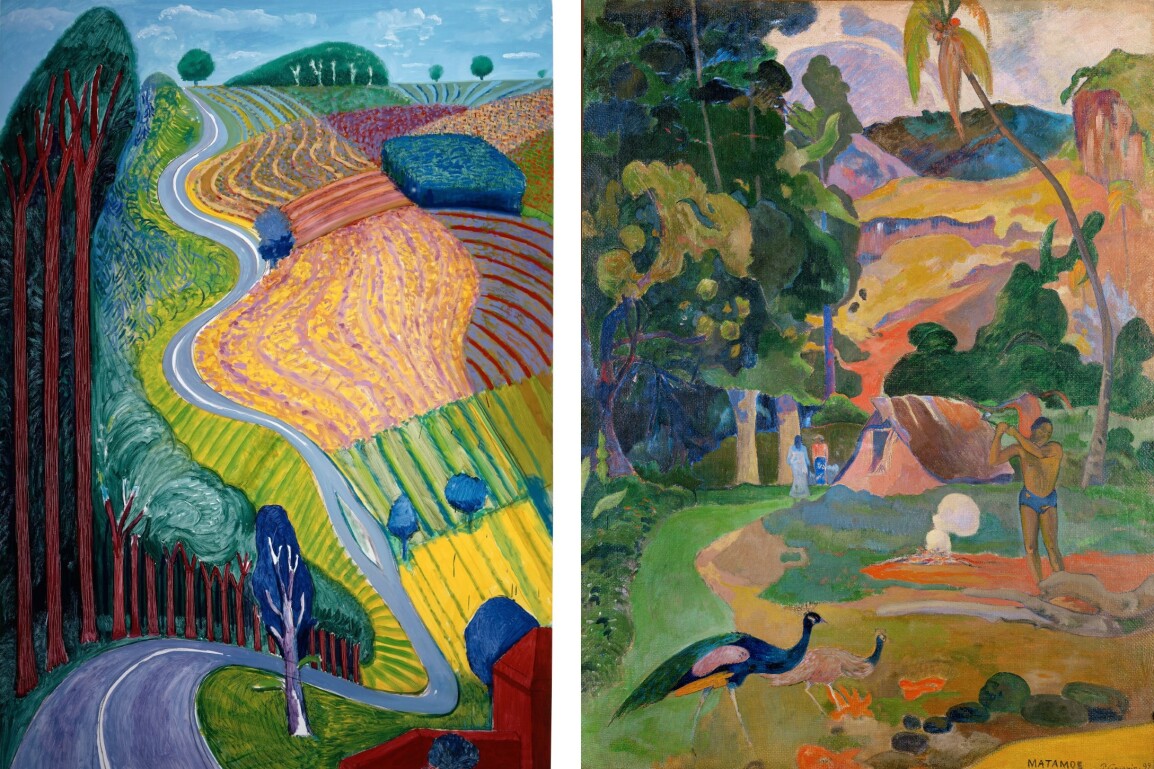
Warping color and space, Hughes achieves a unique and contemporary take on traditional landscape painting. Imbuing her subject with emotive Fauve-esque colors and collapsing perspective in a Cubist manner, Hughes’ island becomes an irregular shape with rippling sand, Seussian palm trees, and linear waves. Like Henri Matisse, who pioneered the movement of Fauvism as he sought formal ways to unite color and line through painting, Hughes combines shifting perspectives with clashing colors that recall his optically dynamic palette to create dream-like landscapes. In her hands, the landscape becomes an image that is more evocative of her emotions than truly descriptive of the land itself. Overgrown forests, looming flora, and stippled night skies rendered with lush impasto become stand-ins for the depths of the artist’s subconscious, while gestural brushstrokes in vivid colors take on humanoid characteristics and vibrate with personality in fantastical scenes. In I Am An Island sees Hughes captures a tension between the subject of the painting and its allusion to her inner psyche, creating a work that is at once fantastical and highly personal.

