Trouville, l'heure du bain is an exquisite example of Boudin’s mature œuvre, in which his favourite subject matter – the fashionable crowds holidaying on the beaches of Trouville – is combined with the freshness and spontaneity of execution which has rightfully gained him recognition as a key precursor of French Impressionism.

Trouville became the main source of inspiration for Boudin in the early 1860s, with the artist regularly coming to paint at this famous seaside resort on the Normandy coast during the summer months and returning to Paris for the winters to complete and sell his works (fig. 1).
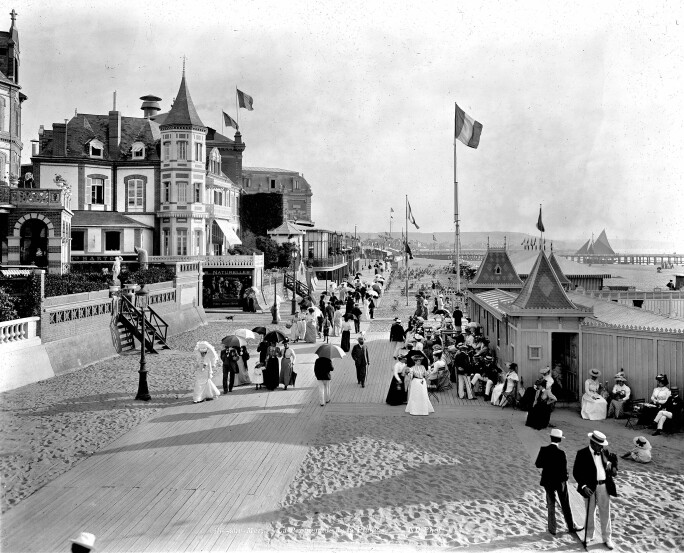
Alongside several other nearby seaside towns, during the second half of the nineteenth century Trouville became a top tourist destination for the French and international aristocracy, largely due to the popularisation of sea bathing as an important health-inducing activity. Trouville maintained its status as a key tourist destination all the way through to the twentieth century and beyond (fig. 2). Boudin was neither the first nor the last artist to source inspiration from this lively, picturesque area. Eugène-Gabriel Isabey is thought to have been one of those to persuade Boudin to paint at Trouville in the first place. Likewise, Boudin’s student Claude Monet dedicated a number of works to the same subject during the 1870s, later crediting Boudin with teaching him how to paint from nature (fig. 3).
Although the title of the present work refers to bathing, Boudin chose not to depict any bathers directly. As Vivian Hamilton notes, ‘it is possible […] that Boudin felt that such a subject would have entailed an unacceptable level of voyeurism’ (V. Hamilton, Boudin at Trouville, Glasgow, 1992, p. 65). The key subject of Boudin’s attention are the groups of holidaymakers: women and men dressed in the height of contemporary fashion, engaged in lively conversation or watching the sailing boats passing by; children playing in the sand, observed by their governesses; dogs resting by the side of their owners. These bustling crowds, often depicted by Boudin in a frieze-like manner, relate to an important contemporary influence on the artist, that of the poet and art critic Charles Baudelaire who during the 1860s had urged French artists ‘to tackle “the landscape of great cities”’ (John House, ‘Boudin’s Modernity’, in ibid., p. 18). House writes about Baudelaire’s concept of the flâneur, an anonymous observer of the modern urban crowd, who scans and analyses the faces and figures around him, ‘passionately engaged with what he sees, yet impartial’ (ibid.).

This is exactly what is at play in the present composition: Boudin is fascinated with how the various figures are spending their t.mes , their fashionable clothing, poses and gestures. Yet he remains a distant observer, and in contrast to much of the genre painting of the period, which focused on depicting the characters and the details of their interactions, Boudin’s figures retain anonymity. For him, the figures are inextricably linked with the landscape they inhabit, for as much as he was an acute social observer, Boudin was first and foremost a landscapist.
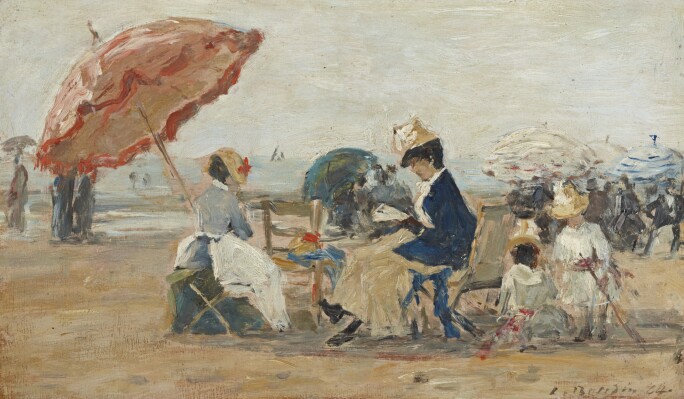
The present work exemplifies Boudin’s technical virtuosity, with short, energetic brushstrokes and subtle tone gradations masterfully capturing the atmosphere of an overcast day. The specks of red, blue, white and black jotted throughout add rhythm and bring unity to the composition. As with many beach scenes, the present work is executed in oil on panel (fig. 4). While reflecting the artist’s method of working en plein air and providing him with an easily portable form of support, wood panels also ‘added richness and depth of tone and allowed for spontaneity of touch’ (V. Hamilton, ibid., p. 65). This spontaneity – of which the present work is a vivid example – was asserted by Boudin when he stated that ‘everything painted directly and on the spot has a strength, a vigour, a vivacity of touch that can never be attained in the studio’ and is what made his work so influential for the French Impressionists that followed in his footsteps (quoted in ibid., p. 16).