“It is mostly the illusionism of his materials that estranges his things, but this superimposition of the real and the imaginary contributes to other confusions Gober puts in play between the utilitarian and the aesthetic, the public and the private, the lived and the dreamed.”
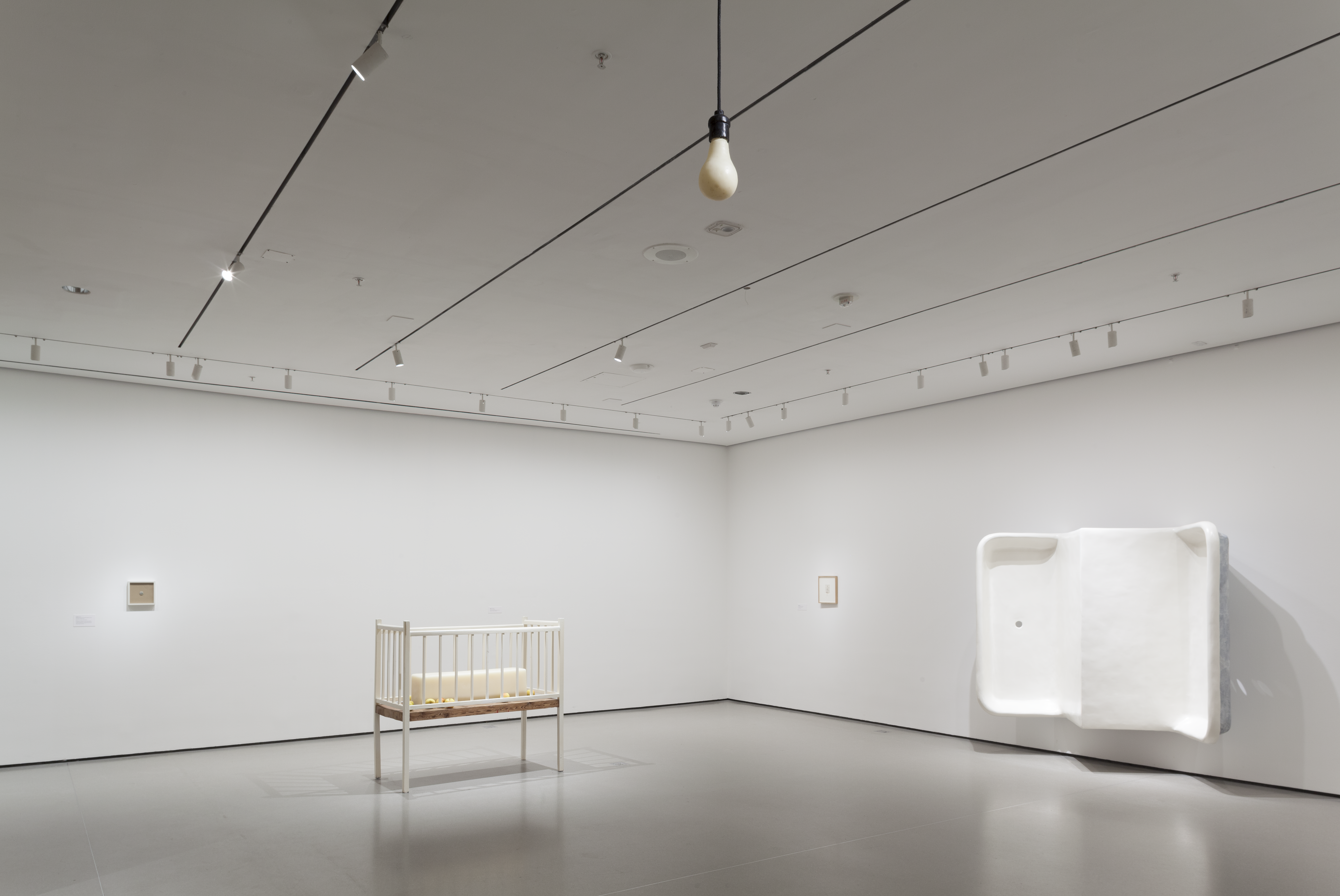
Contemplative, intimate, and profound, Robert Gober and Sherrie Levine’s Untitled, Lightbulb succinctly captures the conceptual rigor and disquieting facility for which both artists are widely celebrated. Executed in 1990, the present work brings together Levine’s practice of thoughtful appropriation and Gober’s career-long exploration of corporeality and household items in the ostensibly modest form of a lightbulb. This quotidian totem is a relic of Gober’s personal history, the collects ive history he sought to embody and the human body itself, intimately reimagining the legacy and possibilities of the Duchampian readymade and refreshing the ideation, exaltation and fetishization of the found object. Untitled, Lightbulb marks a charged collaboration between two of the most important living American artists; underscoring its significance, two of the three other editions belong in the permanent collects ions of The Menil collects ion, Houston and the Hammer Museum, Los Angeles. Further testifying to the critical importance of this collaboration, the present work was included in several international traveling exhibitions; most notably, Robert Gober’s monumental retrospective, Robert Gober: The Heart Is Not A Metaphor at The Museum of Modern Art, New York, in 2014-15. Here, Gober partners with Levine to transform the everyday article into an anthropomorphized mannequin of the body itself, creating a modern elegy of unmatched eloquence and emotional resonance that challenges the binaries of function and dysfunction, presence and absence, art and life.

Famously invoking the Duchampian readymade as their fulcra, the sculptural practices of both artists call upon and transform preexisting forms into icons. Unlike the polished duplication of Duchamp’s Fountain or even Gober’s early porcelain sinks, however, the present work is undeniably handmade. The milky wax that comprises the bulb imbues it with a flesh-like texture, translating the work into a metaphor for the body: the wire an artery, the bulb the brain or heart. Gober and Levine obfuscate our understanding of the readymade by reintroducing craftsmanship: manual production and industrial connotation are set against one another, referenced and subverted by the looming suggestion of a human presence, from the malleable tactility of the medium itself to the fingerprints left by the sculpting process. As such, Gober and Levine deftly play with corporeal symbolism, creating material, metaphysical connotations that are at once subtle and cerebral. The present work also exists in critical dialogue with an extended history of figurative sculpture, from the Renaissance deification of the male nude in Donatello’s David—brought to life by the Lost Wax Method—to artists of the next generation, such as Urs Fischer and his wick-adorned Graces.

“In shifting the representation of objects as simulacra of the body towards the representation of the body itself, the conflict between presence and absence is dramatically intensified.”
The pair’s Untitled, Lightbulb is a familiar reprisal of a recurring subject in Gober’s body of work: the lightbulb. For Gober, brought up as an altar boy in the Catholic Church, the light bulb was a particularly poignant motif. “Your soul is a light bulb,” repeated the nuns who taught him. “Every sin puts a black spot on the light bulb” (quoted in Brenda Richardson, A Robert Gober Lexicon, vol. 1, New York and Göttingen, 2005, p. 48). Correlating the soul with light, the mock illumination of the present work formalizes this religious theme with a deft playfulness. Light and virtue had been inextricably tied during his childhood, but the religious association took on a new valence with the 1980s HIV and AIDS outbreak. He lost friends and lovers, partners and peers in relentless succession, all while grappling with the stigmatization of his sexuality and the disease itself. “It seemed that every other day someone I knew or someone that a friend of mine knew was getting severely sick, really fast, and most of them were gay men,” the artist recalled. “Young men were dying all around me, from causes unknown, and the world seemed to be either in denial or revulsion. The government lied to the people and shrank from its duty. Families abandoned 'loved ones.' Even the church abdicated its responsibility to life. Gay men were left, more often than not, to take care of their own” (the artist quoted in: Theodora Vischer, Exh. Cat., Basel, Schaulager Basel, Robert Gober: Sculptures and Installations,1979-2007, 2007, p. 60).


The potency of the light bulb is heighted, too, by the Judeo-Christian association between light and life. Through their ineffective bulb, Gober and Levine illuminate the tenuous reality of existence in the late twentieth century: Untitled, Lightbulb cannot turn on, it cannot save, it cannot bring back those who have been lost. Swiftly responding to the body and its unfortunate weakening during the AIDS epidemic, Gober and Levine humanize the abstract restraint of Minimalism and advance an enduring exploration of interiority, the human body and Gober’s personal fascination with domestic interiors. The identification of one’s body with the light bulb begins and ends with its inept function between an art object, a referent to the mundane and human fallibility, unflinchingly confounding and complicating our presumed visual vocabulary.

