
“Four days into 1966, Francis Bacon made a note in his diary about a work he wished to begin: ‘George crouching looking at his shirt’... Labeling his own picture a portrait, from the astonishing head comes a green, lizard-like tongue and horn, while an unflinching phantom face is superimposed, maybe with hints of a self-portrait, as if Bacon is saying, ‘Watch me go into a territory that others do not dare represent.’”
If Francis Bacon’s art was defined by “the brutality of fact,” the attempt to get to the essence of human existence in all its forms, it was his portrayal of his lived experience through those closest to him which defined his finest work. George Dyer, Bacon’s greatest love and muse, provided some of the highest highs and lowest lows. It is his cycle of ten single-panel paintings executed during their dramatic, intertwined life together and the seminal Black Triptychs following his tragic early death which, in many ways, define Bacon’s vision. The very first painting in this cycle, Portrait of George Dyer Crouching, was executed in 1966 at the peak of their passion for each other. It inaugurates a critical cycle of ten monumental portraits that Bacon painted between 1966 and 1968, which sees George Dyer as a conduit of the full range of human drama that defined their love affair – vulnerable and brooding; romantic; heroic and tortured – and ultimately results in, for Martin Harrison, “one of the most unflinching, even harrowing serial portrayals in art history.” (Martin Harrison, ed., Francis Bacon Catalogue Raisonné, Volume III, 1958-71, London, 2016, p. 794)
Francis Bacon’s Primal Portrait of George Dyer Crouching | Replica Shoes 's





“[Portrait of George Dyer Crouching] inaugurated a group of ten thematically unified paintings of George Dyer that Bacon completed during the period up to April 1968. The paintings document Bacon’s despair at life’s round of birth, copulation and death, mediated through images that also convey his impatience with perceived deficiencies in Dyer. Cumulatively, they represent one of the most unflinching, even harrowing, serial portrayals in art history.”
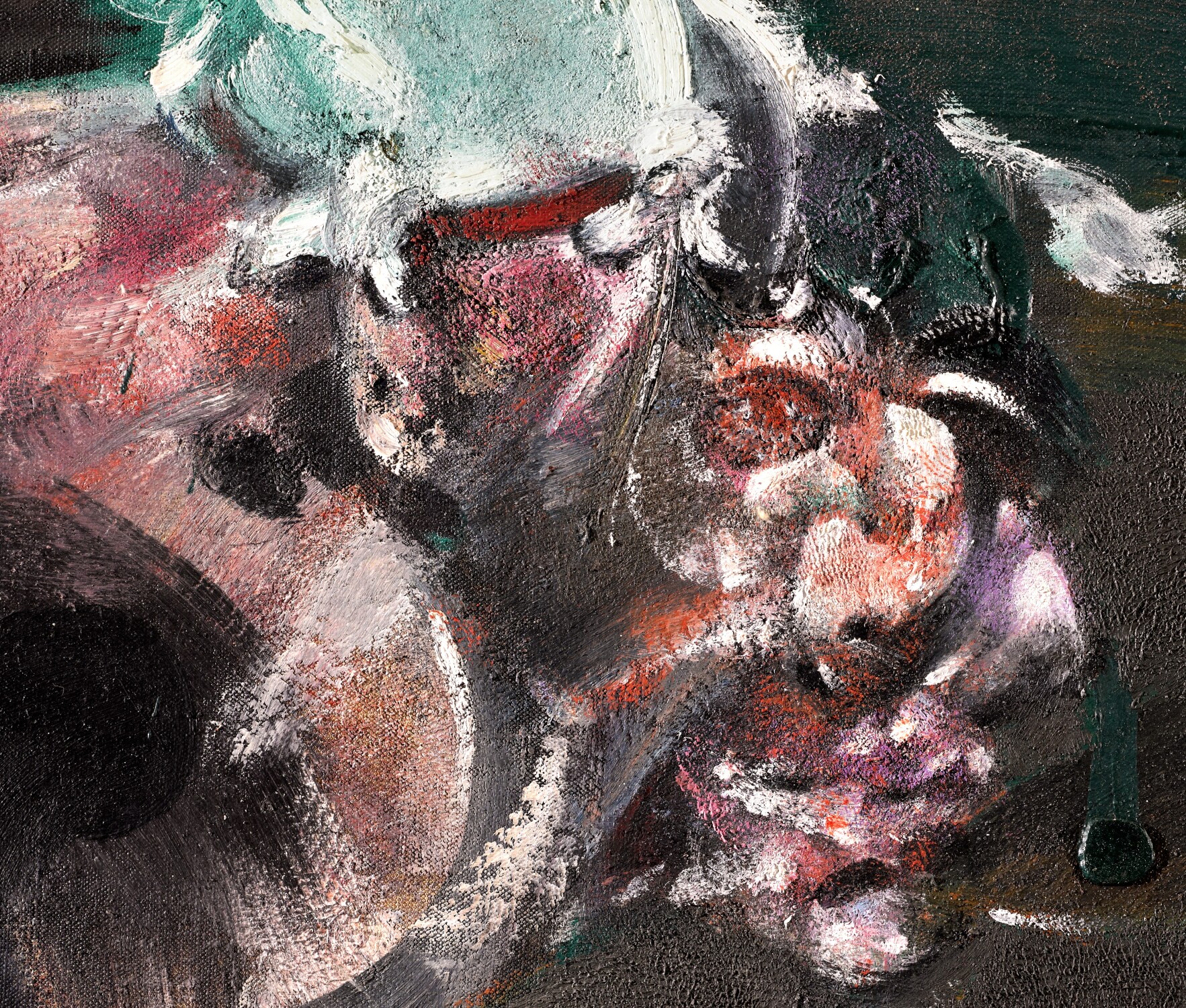
Coiled with unbridled energy and perched at the brink, Francis Bacon’s most iconic muse peers at his discarded shirt as if to stare at his own reflection. Afflicted with the awareness of self, his ever-shifting head turns towards us, threatening to fade into total oblivion before a mystical, textured, ivory background. The central focus of the painting is the astonishing head at its heart. With his unwinking eye at its central axis, George Dyer’s head flickers in a tripartite movement: in simultaneity, he turns into the left, twists outward towards the right, and even merges with Bacon’s own face at the center. The eye, we realize, is Bacon’s own. Executed with a technical mastery of paint virtually unmatched in history, Bacon takes Cubist Picasso into a vastly more complex material realm, overlaying sequential images which become almost filmic, eruptive brushstrokes, dabbings his corduroy jacket full of paint to create a material texture, and throwing paint at the canvas with an extraordinary control and mastery which evoked that of his relationship with Dyer. It is arguably one of his greatest portrayals of not only the human head, but also the human condition.


Francis Bacon’s 10 Monumental single-panel portraits of George Dyer (1966-1968)


Testifying to the supreme rarity and quality of this suite of portraits that Bacon created of George Dyer, three are now held in international museum collects ions, including Foundation Beyeler, Riehen; Sara Hildén Art Museum, Tampere; and Thyssen-Bornemisza National Museum, Madrid. Tragically one of the paintings was destroyed in a fire, which leaves just six left in private hands. Debuting at Bacon’s seminal 1966 solo exhibition at Galerie Maeght, Paris, Portrait of George Dyer Crouching has since been shown in some of the artist’s most significant exhibitions, including his 1971 retrospective held at the Grand Palais, Paris - the scene of Dyer’s final tragedy - and, most recently, the 2022 exhibition Man and Beast at the Royal Academy of Arts, London.


Francis Bacon first encountered George Dyer in Soho in the autumn of 1963 and, by the middle of 1964, he was already firmly established as Bacon’s live-in companion, lover and muse. While legend has it that the two met after Dyer broke into his Reece Mews studio, Bacon in fact recalled, “I was drinking with John Deakin… and lots of others. George was down the far end of the bar and he came over and said, ‘You all seem to be having a good t.mes . Can I buy you a drink?” (Francis Bacon quoted in Michael Peppiatt, Francis Bacon: Anatomy of an Enigma, London 1996, p. 259) A handsome desperado with a criminal past, Dyer appealed strongly to Bacon’s sense of danger and charmed the artist with his immaculate appearance. Over the years, however, Dyer revealed himself to be a compassionate, often insecure soul beneath his rogue facade, often descending into spiraling fits of violent self-pity as he began to question his sense of purpose. Dyer nonetheless came to “feel inseparable from the effigies Bacon had created of him. They gave him a raison d’être, a stature even, that his failure to be anything else made all the more precious.” (Ibid., p. 213) The profound impact that Dyer and Bacon had on each other’s lives echoes most palpably in such paintings as Portrait of George Dyer Crouching, which emerged from the apotheosis of the couple’s love in 1966 and chronicle Bacon’s simultaneous enchantment and concern for George Dyer.
“At once, the figure and head emerge from formlessness and fall into detailed organization. The weight and thickness of the thighs, the downward stretch of the arm, the massive crest of muscle across the shoulders, the motionless concentration of the lowered head, all seem to leap out of the paint."

As the first monumental single portrait that Bacon executed of Dyer, Portrait of George Dyer Crouching bears a visual intensity that is commensurate with the level of passion shared between the two. Bacon expresses their romantic entanglement most literally in Dyer’s head, which vigorously amalgamates with his own at its center. A flurry of scumbled painterly marks spirals into Bacon’s singular eye, which directly confronts the viewer as it is superimposed onto Dyer’s head. Partially obliterated, partially fused with Bacon’s own face, Dyer’s head then mutates in three distinct yet overlaid phases that together evoke the brusque velocity of a man eyeing his surroundings relentlessly. Dyer’s visage emerges from the projectile paint that Bacon has daringly launched onto the canvas, reminiscent of his instinctive techniques that define such later paintings as Study for Bullfight No.2 from 1969, where the artist exercises painterly risks upon the surface to capture the spontaneity of sudden movement. As Andrew Forge observes of Dyer’s physicality here, “At once, the figure and head emerge from formlessness and fall into detailed organization. The weight and thickness of the thighs, the downward stretch of the arm, the massive crest of muscle across the shoulders, the motionless concentration of the lowered head, all seem to leap out of the paint, triggered by the hard saurian eye which, as with some fantastic knobbly lizards, seems to be embedded like a living jewel in material that follows another order of form.” (Andrew Forge, Exh. Cat., London, Tate Gallery, Francis Bacon, May - August 1985, p. 29)


Under Bacon’s painterly bravura, the dissolutions of human anatomy and effigy that Dyer undergoes condense a broad range of psychosomatic sensations, rendering them immediately palpable. The pose of Dyer’s body in Portrait of George Dyer Crouching finds its origins in the corporeality that Bacon first captured in his earlier Study for Crouching Nude from 1952. Now held in the Detroit Institute of Arts, Study for Crouching Nude synthesizes a sweeping range of Bacon’s art historical sources into the body of the unnamed figure, including the squatting woman on the left of Henri Mattise’s 1907-08 Bathers with a Turtle; Michelangelo’s 1530-34 marble sculpture Crouching Boy; and Hans Surén’s photograph of a nude skier published in his 1928 book Man and Sunlight. In Portrait of George Dyer Crouching, impasto strokes of venom green lacerate the sfumato of bruised maroon and purple that constructs Dyer’s body, metamorphosing his Michelangelesque contours into an incomprehensible tangle of movement. Like the kineticism of Muybridge’s photographed figures in sequential motion, Dyer’s convulsions are suspended in a composite assemblage of spastic gesture. He is naked, having stripped and thrown off his crumpled shirt into the hollow, umber chambers above which he crouches precariously at the edge of a plank.


Michelangelo Buonarroti, Crouching Boy, 1530. State Hermitage Museum, Saint Petersburg, Russia “Michelangelo and Muybridge are mixed up in my mind together,” the artist said in conversation with David Sylvester, the art historian who interviewed him from the 1960s through to the 80s, "I perhaps could learn about positions from Muybridge and learn about the ampleness, the grandeur of form from Michelangelo." Here, Bacon’s crouching form bears likeness with Michelangelo’s Crouching Boy.

Edgar Degas, The Tub, 1886
Musée d'Orsay, Paris, FranceIn the present work, Bacon stages Dyer in a cylindrical arena, a device which extends Bacon’s earlier experimentation with the delineation of space. This spatial organization in Portrait of George Dyer Crouching encloses the carnal specimen of Dyer squarely within the composition, alluding to additional art historical references such as the tubs found in Degas’s paintings of bathing women.

Chaim Soutine, Carcass of Beef, 1926
Minneapolis Institute of Art, Minneapolis, MNIn Bacon’s visual symbology, Dyer’s shirt represents a critical cipher for his own self-reflection, an instance of the “double-image” motif that has preoccupied him throughout his oeuvre. Lying discarded, red, and bloodied beneath him, the shirt resembles one of Chaim Soutine’s paintings of beef carcasses.

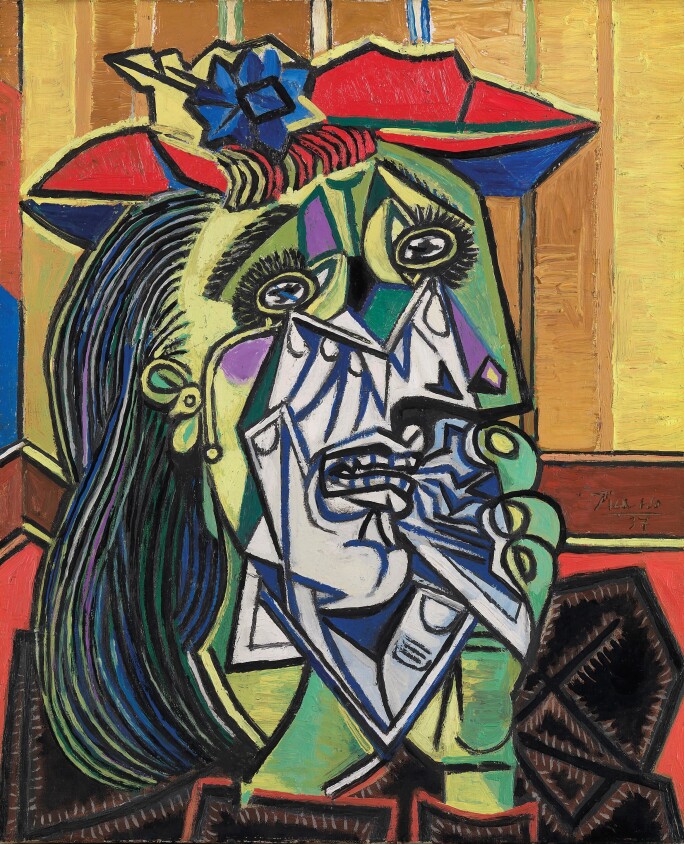
Pablo Picasso, Weeping Woman, 1937
Tate, London, UKExecuted with a technical mastery of paint virtually unmatched in history, Bacon takes Cubist Picasso into a vastly more complex material realm: the fracturing and fragmentation of George Dyer’s head in Portrait of George Dyer Crouching speaks of a visceral intensity. Partially obliterated, partially fused with Bacon’s own face, Dyer’s head mutates in three distinct yet overlaid phases.

Eadward Muybridge, Animal Locomotion: An Electro-Photographic Investigation of Consecutive Phases of Animal Movements, 1987-85
National Gallery of Art, Washington D.C.Dyer's stance demonstrates Bacon's enduring preoccupation with Muybridge's sequential photographs of the body in action. Like the kineticism of Muybridge’s photographed figures in sequential motion, Dyer’s convulsions are suspended in a composite assemblage of spastic gesture.

Piero della Francesca, The Brera Madonna, 1472. Pinacoteca di Brera of Milan According to Catherine Lampert, co-curator of Francis Bacon’s recent exhibition at the Royal Academy of Arts, London, the white circular formation in the present work recalls an egg hanging above a crowd surrounding the Madonna and Child, a divine symbol of fecundity.

Francis Bacon, Study for a Bullfight, no. 2, 1968. Museum of Replica Handbags s of Lyon
Dyer’s visage emerges from the projectile paint that Bacon has daringly launched onto the canvas, reminiscent of his instinctive techniques that define such later paintings as Study for Bullfight No.2 from 1969, where the artist exercises painterly risks upon the surface to capture the spontaneity of sudden movement.

Lucian Freud, Man in a Blue Shirt, 1965. Private collects ion The previous summer in 1965, Lucian Freud also painted George Dyer in a classic portrait format: seen wearing a blue shirt, his visage conveys a blend of introspection and apprehension. Bacon, however, renders Dyer with newfound fervor, capturing his own fixation with corporeal mutilation, his deep knowledge of art historical tradition, and above all, his profoundly chaotic love for Dyer.

Henri Matisse, Bathers with a Turtle, 1907-08. Saint Louis Art Museum The pose of Dyer’s body in Portrait of George Dyer Crouching additionally invokes the figure in the lower left of Matisse’s striking 1908 painting Bathers with a Turtle. Seen from the back, she is depicted here in a crouching position, extending her hand towards a turtle.




"Sitting on his heels at the end of a springboard, with a handkerchief knotted over his scalp, the naked Dyer waits to pounce with a peering elongated face and a glittering animal eye on some discarded underclothes on the sofa seat. His arched and parted thighs emphasize his carnality, while his hanging arms and hunched head are accentuated by the swipes of his lover’s brush.”
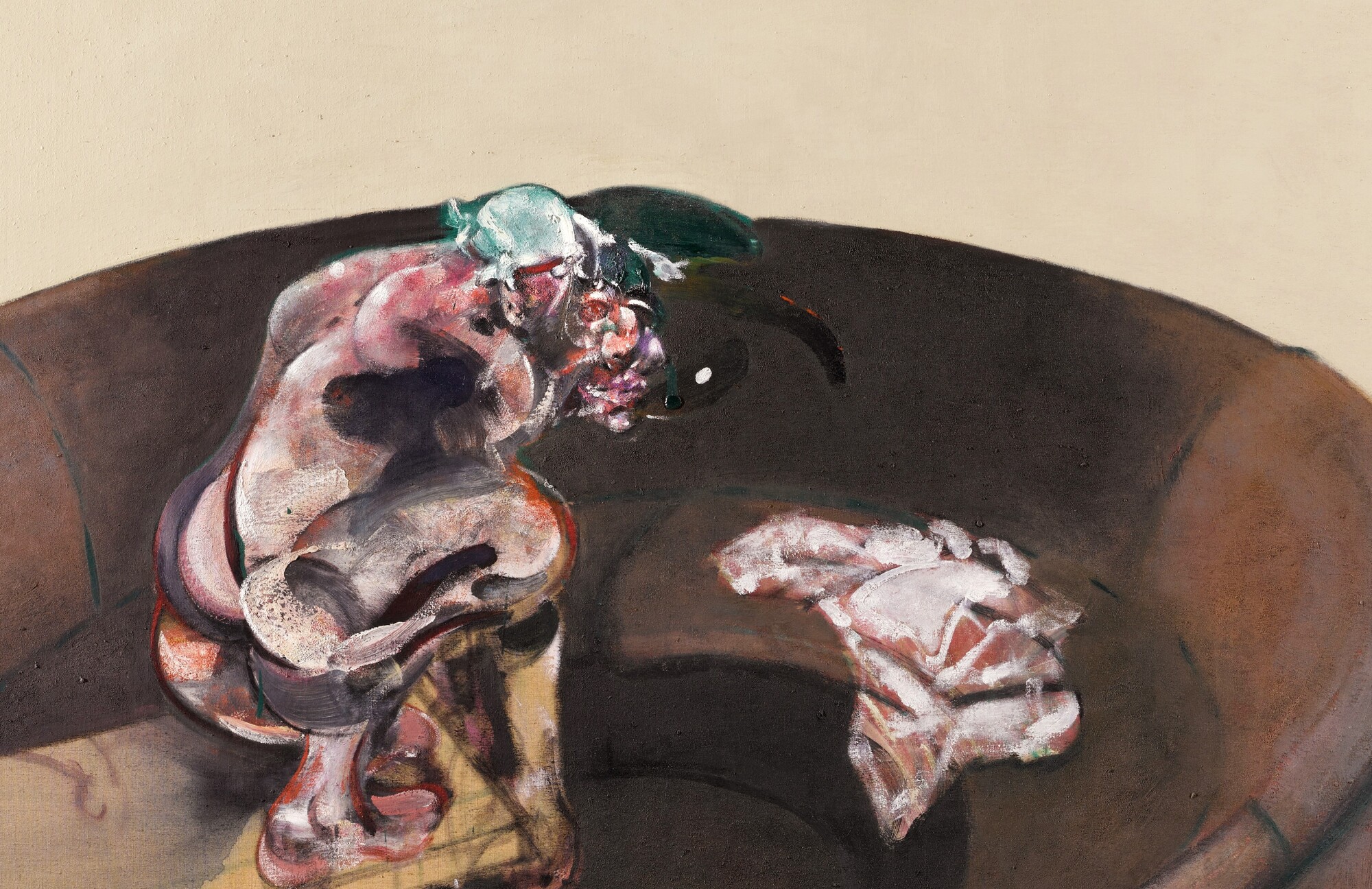

In Bacon’s visual symbology, Dyer’s shirt represents a critical cipher for his own self-reflection, an instance of the “double-image” motif which had also continued to preoccupy him since Study for Crouching Nude, which featured a figure facing his own shadow; referring to this earlier painting, Bacon once stated, “I’ve been trying to use one image I did around 1952 and trying to make this into a mirror so that the figure is crouched before an image of itself.” (The artist in conversation with David Sylvester, in: David Sylvester, The Brutality of Fact: Interviews with Francis Bacon, New York 1981, p. 37) When Dyer’s head revolves towards the right in Portrait of George Dyer Crouching, he seemingly contemplates his own image as he stares at his shirt, which also resembles a carcass here – discarded, red and bloodied beneath him. The chaos of Dyer’s transformation suggests that he in turn finds himself consumed by a latent existential abjection and, one could say, even begins to eat away at himself – perhaps Bacon’s expression of the agonizing sense of helplessness that he witnessed Dyer progressively undergo in their relationship. “The figure in the painting has nothing to do and nowhere to go,” writes John Russell about Dyer in the present work. “The evident coiled power within him has no outlet: his activity, such as it is, is dissociated from any imaginable rational end.” (John Russell, Francis Bacon, London, 1971, p. 62)


As Dyer’s anatomy gives way to anarchy upon his cognition of self, he exhibits the dialectic between man and beast that had always intrigued Bacon. Following a stay in 1951 in Zimbabwe and Southern Rhodesia, alongside numerous visits to South Africa, Bacon produced a seminal cycle of wildlife landscapes and animal paintings throughout the 1950s, which evolved into images where man and beast habitually appear as indistinguishable. For Bacon, the animal embodied chaos: like many of his human subjects, Bacon’s animals are generally shown in tortured states, where they shriek, twist, and crouch in physical contortions. Man, by reciprocity, embodied similar states of primeval animalism. As suggested by a change in the title inscribed by Bacon on the back of the present canvas, the artist originally entitled this work “Portrait of George Dyer Squatting” but later modified his word choice to “Crouching” to suggest a more bestial action for his subject. Poised like a predator preparing to prowl upon his prey, Dyer here exists at the precarious threshold between human control and primal impulse.
“While the pose and format are taken from Bacon’s 'Study for Crouching Nude' (1952), which in turn was derived from Muybridge, the ambiguous structure that encircles Dyer recalls the tubs of Degas’s bathing women. Dyer is inexplicably perched at the edge of what might be a coffee table, as though poised on the end of a diving board… A flurry of painterly marks depicts Dyer in profile as well as full face, his right eye compellingly direct as it confronts us.”

Like cages in Bacon’s paintings, the spatial organization in Portrait of George Dyer Crouching encloses the carnal specimen of Dyer squarely within the composition and sharpens his animalistic energy into greater focus. Divided into lateral sections throughout the canvas, the compositional structure recalls the aesthetic influence of Abstract Expressionism, which Bacon interpreted with resolute realism. At the center left edge, Bacon reinterprets a coffee table as the diving board on which Dyer crouches by carving this out with a section of raw canvas left unprimed and unpainted. Meanwhile, the threefold distortion of Dyer, chromatic palette of lavish beige and brown, and circular construction in the present work finds its foundations in Bacon’s earlier 1964 triptych Three Figures in a Room – his first ever depiction of Dyer, wherein “the outer panels depict George Dyer, sexualized in the first flush of Bacon’s relationship with him,” according to Martin Harrison, “while in the center panel Dyer’s portrait is morphing with Bacon’s,” (Harrison, Op. Cit., p. 760). The elliptical floor extending across this triptych warps into a similarly surreal banquette below Dyer in the present work, which, according to scholar John Russell, is “a sofa of modish design - salvaged, conceivably, from one of Bacon's forays into the furniture-shops. But as treated by him, it turns into a blocked-up well: a well-upholstered point of no return.” (Russell, Op. Cit., p. 62) This rusty-colored cylindrical structure is replete with additional art historical references: it is reminiscent of Muybridge’s zoopraxiscope; the tubs found in Degas’s paintings of bathing women; the photographs of operating theaters illustrated in medical books by which Bacon was fascinated; or, according to art historian Margarita Cappock, the baptismal baths found in the center of the Temple of Jupiter, an archaeological complex located in present-day Rome.


“The couch was a circular structure that I filled in later. I tend to turn furniture and twist it about as much as the bodies, for my own ends.”
By the end of the 1960s, the increasingly unsteady relationship between Dyer and Bacon became destructively marred by Dyer’s waning sense of purpose in the shadow of Bacon’s overwhelming success. Over t.mes , Bacon grew progressively unsympathetic to his partner’s volatile bouts of purposelessness, alcoholism, and erratic behavior. In 1971, Dyer died of a drug overdose in the bathroom of the hotel he shared with Bacon, only two nights prior to the opening of the artist’s highly anticipated mid-career retrospective at the Grand Palais, Paris, which prominently included the present work. Today a relic of one of the most tempestuous relationships in art history, Portrait of George Dyer Crouching from 1966 also foreshadows the harrowing withdrawal and tragedy behind Dyer’s death, which unfold in Bacon’s subsequent The Black Triptychs and would continue to haunt him throughout the remainder of his life. Emerging from the pinnacle of their romance, the present work constitutes a striking glimpse of George Dyer seen through the eyes of his lover: cast in a viridian shadow and perched at the precipice of his life, Dyer is seen afflicted with an innate existential turmoil. Here, two years since they first.mes t in 1964, Bacon is compelled by a deep love for Dyer to capture the chaos behind his character, but he also expresses an immense, tender worry about how Dyer’s coiled body might inevitably implode from it.

Francis Bacon was a lifelong surveyor of human vulnerability, painting to expose the immediacy of life in all its glory and violence, and nowhere is this undertaking seen more fluently than in his portraits of George Dyer. With Portrait of George Dyer Crouching, Bacon initiates a momentous corpus dedicated to his most significant muse, into which he poured his fixation with corporeal mutilation, his deep knowledge of art historical tradition, and above all, his profound love for Dyer. Today, Dyer’s presence is at once the most pervasive, libidinal and inventive of Bacon’s entire oeuvre: painted obsessively, Dyer became the subject through which Bacon radically opened a new dimension of portraiture. Animating Dyer’s movement with every brushstroke here, Portrait of George Dyer Crouching immortalizes Dyer under Bacon’s hand to epitomize how the artist indelibly “[set] the standard for what art in the twentieth century could achieve: depicting the individual in the moment of disintegration” (Exh. Cat., Düsseldorf, Kunstsammlung, Francis Bacon: The Violence of the Real, 2007, p. 35)
“Perhaps this is the first t.mes in more than fifty years that someone invented an entirely new way of portraying the human head… What Bacon does here is not simply rearrange the map of the head. That knotted handkerchief bestrides what is two things in one: a likeness of an individual man and a likeness of a compound, metaphoric creature… That eye, for instance, islanded in a head the size of a leg of lamb: it speaks for a nervous system that goes on functioning, no matter how strange and terrible the pressures upon it. That nose, out front with a huge promontory of flesh behind it: for what sniffing was it fashioned? And that ear, prinned like a diminutive ear-ring just above the mountainous shoulder: what.mes ssage can it be intended to receive?”


