Triumphant and enigmatic, Buste d’homme is an outstanding example from Picasso’s celebrated musketeer series—the subject of which became central to the artist’s late body of work. Begun in 1967, the suite of canvases which depict sword-brandishing and pipe-smoking musketeers are among the great subjects of Picasso's late oeuvre. Richly textured and gestural, Buste d’homme—one of the very first oils in the series—exemplifies the inventiveness, dynamism, and exuberant brushwork which characterize the finest works of the series.
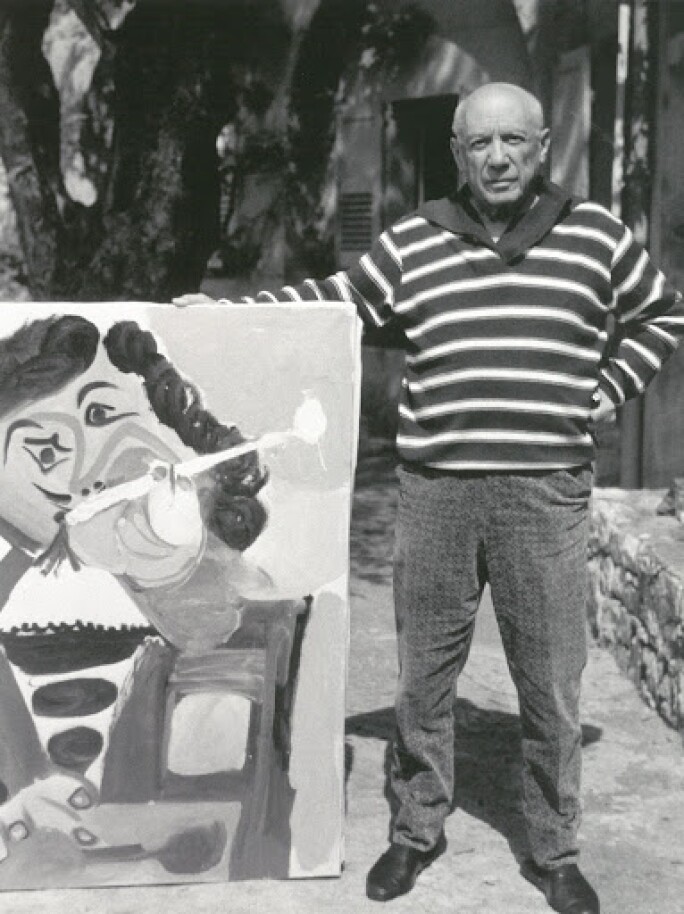
In 1961, Picasso turned eighty. As a widely recognized maître of twentieth century art he had nothing to prove and yet, as he recalled, he was gripped by the feeling that he had "less and less t.mes and […] more and more to say" (Pablo Picasso quoted in Klaus Gallwitz, Picasso Laureatus, Lausanne and Paris, 1971, p. 166). This feeling is the driving force behind the creativity and spontaneity of his mature work and his significant recourse to archetypal figures and symbols. The seemingly limitless energy that characterizes so much of his work reaches its apotheosis in this final burst of creativity.
The first depictions of musketeers—which the scholar Gert Schiff described as "an army of seventeenth-century soldiers [which] invaded Picasso’s pictorial world"—appear in his oeuvre in 1966, firstly in the form of numerous drawings and engravings (Exh. Cat., New York, The Solomon R. Guggenheim Museum, Picasso, The Last Years, 1963-1973, 1983, p. 31). The artist’s fascination with this romantic archetype can be traced back to his Spanish childhood and his love of Cervantes’ Don Quixote. The musketeer was a character that embodied the courtly mannerisms of the Renaissance gentleman, whom Picasso resurrected for a twentieth-century audience (see figs. 1-2). Considering the artist's age, the image of the musketeer is also evocative of a certain nostalgia for the youthful vigor of his early years. The musketeers of Alexandre Dumas’ novel, which served as another key source of inspiration in his work from this period, were famously known just as much for their good living and loving as for their swordsmanship.
They all have big, hypnotic eyes: eyes brim with fury or eyes that know of terrible secrets; quirky, melancholic, or hungry eyes; eyes of blackguards; eyes of soldiers-turned-mystics.

Describings the male sitters in Picasso’s oeuvre, Marie-Laure Bernadac observed: "If woman was depicted in all her aspects in Picasso’s art, man always appeared in disguise or in a specific role, the painter at work or the musketeer. In 1966, a new and final character emerged in Picasso’s iconography and dominated his last period to the point of becoming its emblem. This was the Golden Age gentleman, a half-Spanish, half-Dutch musketeer dressed in richly adorned clothing complete with ruffs, a cape, boots, and a big plumed hat […] All of these musketeers are men in disguise, romantic gentlemen, virile and arrogant soldiers, vainglorious and ridiculous despite their haughtiness. Dressed, armed, and helmeted, this man is always seen in action; somet.mes s the musketeer even takes up a brush and becomes the painter" (Brigitte Léal, Christine Piot and M.-L. Bernadac, The Ultimate Picasso, New York, 2000, p. 455).
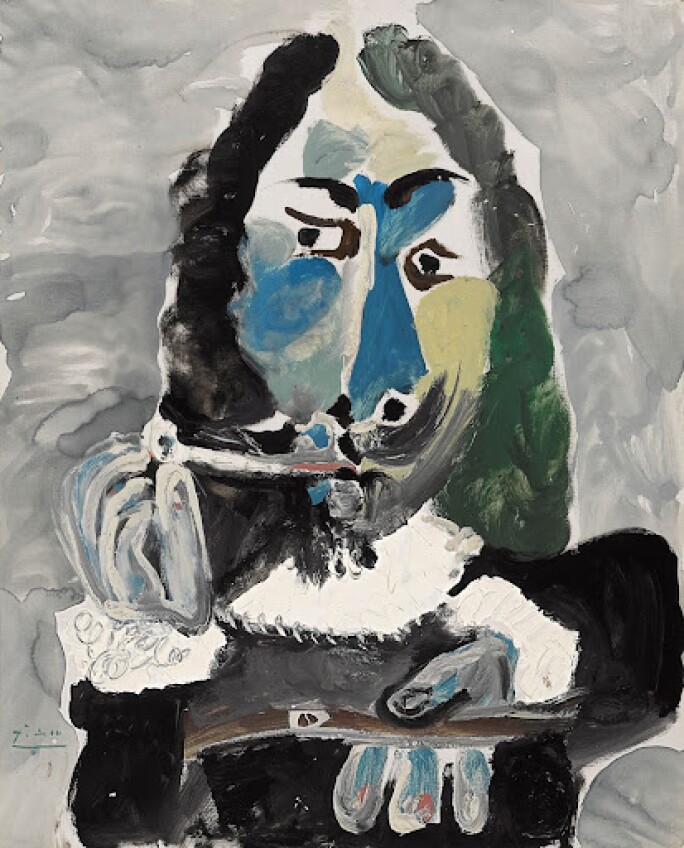
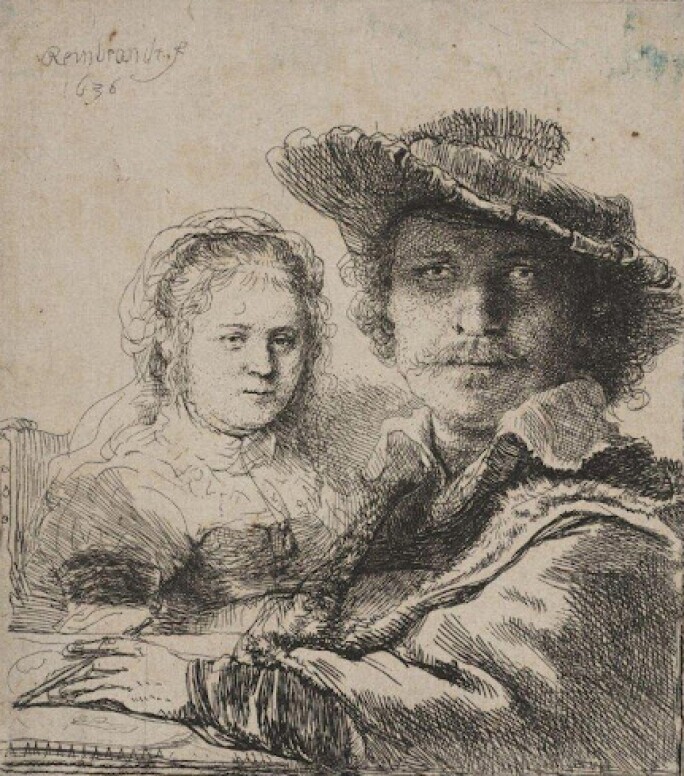
In Buste d’homme, Picasso equally pays tribute to the work of two painters he had adored throughout his life, Diego Velázquez and Rembrandt van Rijn. It was through these reinterpretations and investigations of the Old Masters that Picasso reaffirmed his space within the realm of Western art history (see figs. 3-5). As Schiff notes in the catalogue accompanying the seminal 1984 exhibition at the Guggenheim Museum dedicated to Picasso’s late work, "Many of these musketeers are in a general way related to portraits by Rembrandt, even if it is not always possible to point to specific prototypes. What remains of the models is often merely something of the lineaments of a furrowed face, a searching look, a disheveled head of hair and beard, or the play of light and shadow. However, not many musketeers remain recognizably “Dutch”. In most the spiritual climate is closer to El Greco, Velásquez, Murillo or Antolinez. Even the most diagrammatic ones are imbued with Spanish fervor, are hidalgos rather than staalmeesters" (Exh. Cat., New York, The Solomon R. Guggenheim Museum, Picasso, The Last Years, 1963-1973, 1983, pp. 36-37). Such is the case with the present work; the overall composition and the sitter’s clothing clearly evocative of traditional Dutch portraiture, while his facial features—the hair and the eyes in particular—are undeniably Southern European.

CENTER: Fig. 4 Diego Velázquez, SELF-PORTRAIT, circa 1645, Galleria degli Uffizi, Florence
RIGHT: FIG. 5 EL GRECO, PORTRAIT OF JORGE MANUEL THEOTOCÓPULI, CIRCA 1597-1603, MUSEO DE BELLAS ARTES, SEVILLE
In its execution, Buste d’homme displays a deliberately strong graphic art quality. The subtle tones of whites, blacks, browns and grays, together with the level of detail with which the artist renders the hair, the facial features, the lace on the sitter’s collar and the plaiting on his shirt evoke the intricate etchings and drawings by Rembrandt, which Picasso studied extensively during his convalescence from an operation he had undergone in November 1965 (see fig. 6). As John Richardson notes on this, "...I did find Otto Benesch’s six-volume catalogue of this artist’s drawings. […] As soon as [Picasso] resumed working early in 1966, a troop of Rembrandian militia men in full regalia would materialize on his canvases" (Exh. Cat., New York, The Gagosian Gallery, Picasso: Mosqueteros, 2009, p. 19).
In its gestural quality, Buste d'homme likewise echoes Picasso’s own earlier graphic works (see fig. 7), while also reflecting his preoccupation with printmaking during this period. In 1968, the artist embarked on what became his largest print series, Suite 347. Named after the number of sheets it contains, the musketeer figure makes a recurring appearance throughout its pages. As Memory Holloway remarks, "In his last years, from the 1960s until his death in 1973, Picasso painted during the day and worked on etchings in the evening. […] By day, he painted nudes and musketeers, and his process was fast and iconic. By night, in the prints, he depicted scenes of abduction and pursuit and artists in their studios. Painting, quick and immediate, and slippery, provided him with a vehicle for examining the process, a sensual, material means to watch the figures unfold on the canvas. Printmaking, slow, layered, and scratchy, gave him the basis for conjuring up the memories of his past. In thinking and execution, painting and printmaking were like night and day; nevertheless, each fed the other in a circular sweep of sustained activity" (ibid., p. 174).

“The surface of the late paintings has a freedom, a plasticity, that was never there before; they are more spontaneous, more expressive and more instinctive than virtually all his previous work.”
The traces of this dichotomous practice are particularly evident in the present work: its rich black background contrasts the areas of white pigment in the upper left corner and around the sitter’s face and hair, which, coupled with the various methods in which Picasso applied the paint onto, and partially erased it from, the distinctly coarse plywood support, replicates the textural richness and experimental nature of an etching.
In their lively execution and dynamic quality, the scumbled lines and energized brushwork of Buste d’homme are emblematic of the freedom and spontaneity which Picasso found in his late work. It is no wonder that the enduring power of these great late canvases exerted substantial influence on the subsequent generations of Western painters, including, among others, Jackson Pollock, whose brushwork possesses a similarly gestural, graphic quality (see figs. 7-8).


Right: Fig. 9 JACKSON POLLOCK, FREE FORM, 1946, OIL ON CANVAS, THE MUSEUM OF MODERN ART, NEW YORK © 2023 Artists Rights Society (ARS), New York
Embodying the inventive and energized output of Picasso’s final years, the striking Buste d’homme captures the triumphant spirit of Picasso's musketeer-heros—the great late works which, through their exceptional caliber and homage to the Old Masters, affirm Picasso as one of the greatest painters of the Modern era.
The present work has been held in the same family collects
ion for over fifty years, having been acquired through the gallery Sala Gaspar in Barcelona in 1968, shortly after it was painted.