"You can then, in a sense, orchestrate objects and shadow in such a way that you’re rhythmically - almost like a musical composition - working these two elements: object, shadow, object shadow.”
Exemplary of Wayne Thiebaud’s career-long exploration of seriality and his now-iconic singular still-life renderings of midcentury American pop culture, Pop Bottles is a compelling expression of the artist’s lifelong preoccupation with and deft mastery of color. A particularly elegant embodiment of the artist’s meticulously arranged goods, Pop Bottles displays a neat row of a distinctly American commodity: the soda pop bottle. A subject reimagined by multiple masters of Pop—including Andy Warhol and Roy Lichtenstein—the pop bottle exemplifies the saccharine, carefree spirit and fashion of the midcentury, as well as the zeitgeist of global commodification and mass advertising. Indeed, what could be more “Pop,” than a pop bottle? Thiebaud simultaneously pays homage to his contemporaries beyond the Pop movement: most notably, Ellsworth Kelly, whose iconic Spectrum paintings – and, in particular, Spectrum V, executed the year before the present work – is readily evoked in the precise rainbow spectrum of liquids. A work which fuses Minimalism and Pop with an ease that conceals the seemingly opposing conceptual framework of each movement, Pop Bottles is a masterwork of Thiebaud’s early production. Acquired by Mr. and Mrs. Morton G. Neumann the year following its execution and held in the family’s collects ion ever since, Pop Bottles emerges as an icon of Thiebaud’s signature manipulations of color and decadent impasto and stands as an icon of its t.mes .

Within Pop Bottles, Thiebaud isolates his iconic, stylized color by giving each bottle a unique and vibrant jewel-tone hue, each rendered with subtle, gestural indications of materiality and the consequential interaction with light. Set upon a gray blue background and stark white foreground, Thiebaud’s brushwork creates rich textural detail that dances about his subject matter. Meanwhile, the artist’s signature blue shadows alternate to create a visually rhythmic, horizontal sightline that simultaneously separates and connects each bottle. This optical effect is deliberate: Thiebaud’s shadows occupy space as a means of relating objects to one another, signaling to the viewer that the scene is constructed from the artist’s own reality. At a closer glance, Thiebaud renders seven shadows for six bottles, indicating that the present composition is merely a snapshot within an indefinitely longer march of the ready-made objects. Just as in Thiebaud’s iconic candy counters and confectionary subjects, here, the artist elevates the subject of the pop bottles through his deft rendering, thus transforming the quotidian, mass-produced product into a seductive tableau of American life.
- Start
- 1956
- 1962
- 1961
- 1963
- 1970
- 1996
-
 Wayne Thiebaud, 'Pop Bottles', 1970Wayne Thiebaud stands out in a lineage of Pop Masters who used commercial items to explore American consumerism during the mid-to-late 20th century. Perhaps best recognized for his depictions of cakes, pies and candies in a quintessentially American diner style, Thiebaud paints his objects as synthetically-colored commodities. In an age of mass production and consumption, Thiebaud poignantly reimagines the traditional still-life genre.
 -
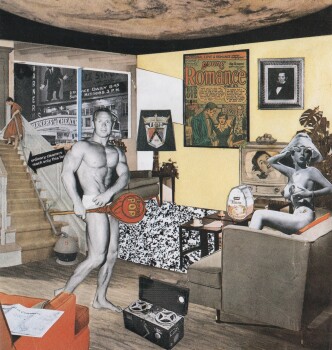
 Richard Hamilton, 'Just What Is It That Makes Today’s Home So Different and So Appealing?', 1956Widely recognized today as the first work of Pop Art, Richard Hamilton’s collage Just What Is It That Makes Today’s Home So Different and So Appealing? imbues the traditional still life with a new dimension. Depicting a domestic scene densely populated with new technological inventions – vacuum cleaners, televisions, and telephones – Hamilton captures the pivotal shift in American consumerism by constructing an image of innovation.
 -
 Andy Warhol, 'Green Coca-Cola Bottles', 1962Moving into the 1960s, the steady rise of the Pop Art Movement coincided with progress in mass production, as reflected in the now-iconic silkscreens of Andy Warhol. Considered by Warhol to be among the earliest examples of his Pop Art style, Green Coca-Cola Bottles illustrates the signature iconography of the Coca-Cola bottle, highlighting one of the ways in which he explored American identity through products of mass consumption and manufacturing.
 -
 Roy Lichtenstein, 'Step-on Can with Leg', 1961Within the rise of the Pop Art movement, Lichtenstein’s exploration of and fascination with consumer products became a central focus of his signature style, which is reminiscent of comic-books.
 -
 Wayne Thiebaud, 'Pie Counter', 1963A quintessential example of Thiebaud’s painted still lifes from the early 1960s, Pie Counter deftly explores composition, color, light and texture. Unlike his Pop Master contemporaries who eliminated the human touch in their works, Thiebaud embraced gestural strokes, reminiscent of the way a baker might frost a cake or spread whipped cream across a pie.
In the artist’s own words, “Pie has a long history and it has other implications: the idea of ‘Pie in the Sky,’ the old American preoccupation with Mom and Apple Pie, pie throwing contests, pie throwing in Chaplin films. One makes a pie out of ordinary stuff, like raisins, squash or apples and gift wraps it, in a sense with a crust. It’s very magical, very special.” -
Wayne Thiebaud, 'Pop Bottles', 1970Wayne Thiebaud’s contributions to the Pop Art movement reflected his own painterly touch to everyday consumer products: from bottles and ice cream cones to lipsticks and hot dogs, Thiebaud utilized bright, exaggerated colors to depict still lifes, extending traditional painting techniques.
Exemplified by Pop Bottles from 1970, Thiebaud’s interest in objects of mass consumption explores how American culture circulates imagery, thus emphasizing the beauty in the simple and the familiar. -
 David Hockney, 'Gladioli with Two Oranges', 1996A sprightly bunch of burgundy flowers bursting from a rounded glass vase, Gladioli with Two Oranges captures Hockney’s undertaking of traditional subject matter at the height of his artistic prowess. As rendered in this still life, David Hockney has successfully merged a deep appreciation for and awareness of art historical precedent with an unwavering desire to push the boundaries of contemporary art through his own, utterly unique painterly vision.



Though the aesthetics of the concurrent Pop and Minimalism movements were largely thought to be diaMetricas lly opposed, Thiebaud’s Pop Bottles proves this only ostensibly so – the identically manufactured glass bottles pay just as much homage to the mechanized process of Judd’s El Taller Chihuahuense as it does Warhol’s Factory. The rote, modular compositional quality of the present work owes a debt to his Minimalist peers, while the isolation of tone, hue, and value and use of bold primary and secondary colors recall the chromatic distinctions made in Kelly’s Spectrum paintings. In fact, the present work’s art historical dialogue is so far-reaching that it engages the very origins of the readymade, offering a midcentury answer to Marcel Duchamp’s iconic Bottle Rack of 1914, while its compositional perfection achieves the unique structural claritys with which Mondrian approached his paintings. Indeed, within the framework of objects set in simplistic seriality, Thiebaud offers a complex painting of infinite variations and invites the viewer to revel in the unique formal characteristics of each carefully rendered bottle. A breakthrough departure from the lush fullness of his dessert counters or his elaborately packed San Francisco cityscapes, Pop Bottles offers a moment of aesthetic integration, joining the most significant breakthroughs in the two leading movements of postwar art in the United States.
“Each era produces its own still lifes…My interest in painting is traditional and modest in its aim. I hope that it may allow us to see ourselves looking at ourselves.”

Thiebaud’s distinctive use of bold color to articulate shadows is readily evident in the purified, chromatic display of the present work, which notably pays homage to the masters in color who preceded him –particularly to Giorgio Morandi, who Thiebaud has acknowledged as a notable point of reference throughout his career. In Pop Bottles, Thiebaud reimagines his Modernist predecessor’s subtle tonal shifts and whispered monochromatic palette in favor of a punchy, spectral presentation of soda pop bottles alluding to his own characteristic palette. A decade after the present work was executed, Thiebaud penned an admiring and reflective homage to Morandi for the New York t.mes s on the occasion of the November 1981 opening of the Morandi retrospective at the Guggenheim. Revealing a long-harbored veneration for the late master, Thiebaud mused: “On his simple ‘stages’ objects are cast in various roles. Tableaux and friezes in scene after scene infer arresting little dramas” (Thiebaud, “A Fellow Painter’s View of Giorgio Morandi”, The New York t.mes s, 15 November 1981, Section 2, p. 36). In a later text, Thiebaud goes on to articulate the importance of depicting objects and shadows to his practice in relation to his analysis of Morandi’s meditative still-lifes, stating: “the object more or less stays the same…the shadow on the other hand, depending on the light source, can be highly variable…those options give you this great source of possibility in your compositions. You can then, in a sense, orchestrate objects and shadow in such a way that you’re rhythmically - almost like a musical composition - working these two elements: object, shadow, object shadow.” (Ibid., starting at 10:40).

Pop Bottles not only epitomizes Wayne Thiebaud’s career-long adoration for and exploration of confectionery items but also his rare and particularly deft union of Pop and Minimalism. Imbuing the serial, identical bottles with his highly individuated and subtly varied painterly touch, the vocabulary of Minimalism is cast in clear, electrifying relief, as his richly impastoed surface and vivid periwinkle shadows bring the pop bottles to life. The result is a joyful yet rigorous composition of lyrical magic. Recently honored with a landmark retrospective at the Fondation Beyeler, Riehen, Thiebaud remains a titan – the voice, even – of postwar Americana, whose work’s nostalgia, enduring cultural resonance, and irresistible charm remain archetypal.
Great collects ors: The (Art) World According to Hubert Neumann


