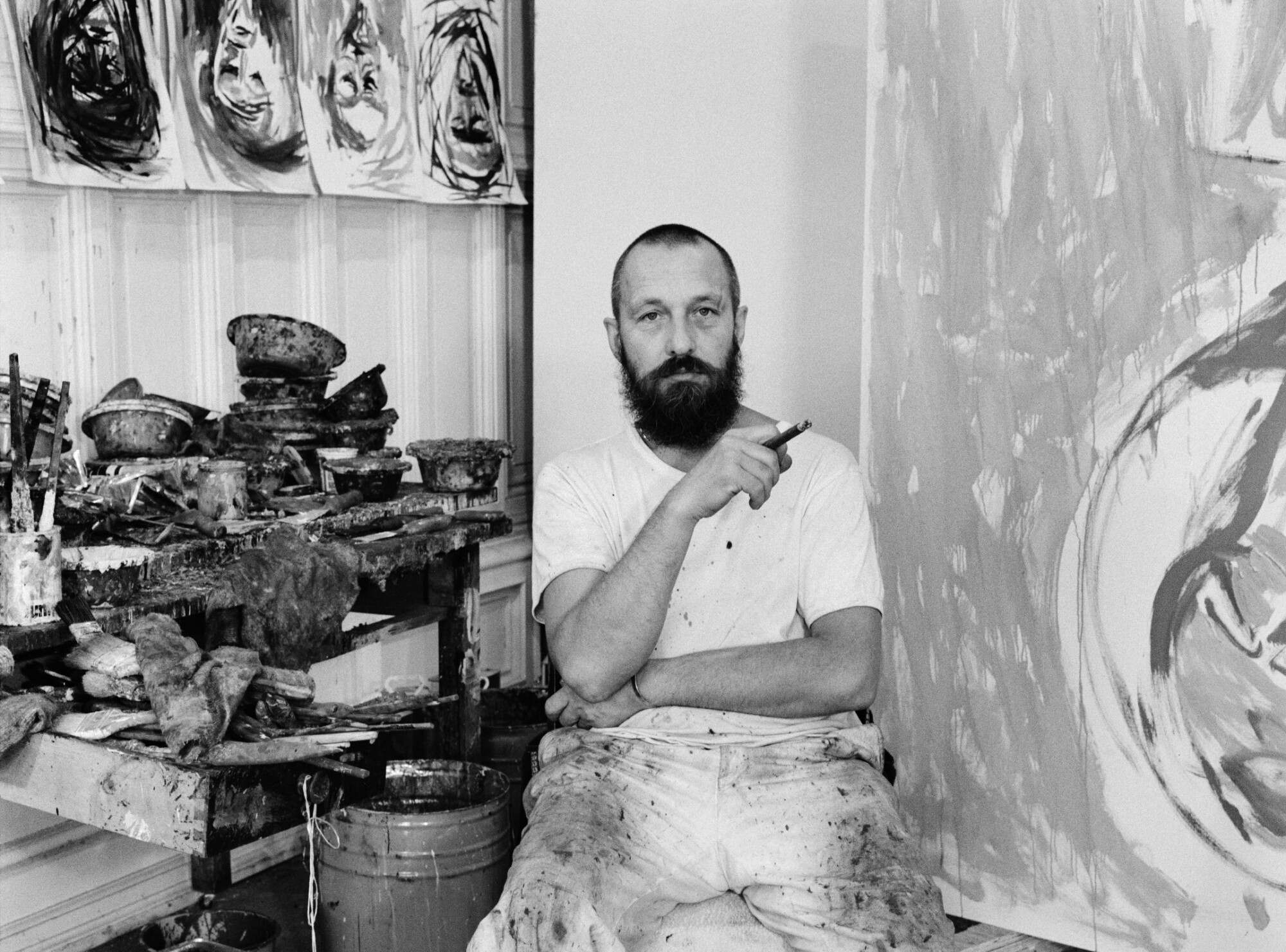
"I was born into a destroyed order, a destroyed landscape, a destroyed people, a destroyed society. And I didn't want to re-establish an order: I'd seen enough so-called order"
Ein neuer Typ (Held mit Fahne) [A new Type (Hero with Flag)] is an exceptional example of Georg Baselitz's Heroes series, his most influential and institutionally acclaimed body of work. In the summer of 1965, Baselitz began his Heroes, and within the span of one year, he produced one of the most pivotal series within his own oeuvre and, more broadly, twentieth-century German art. The eruption of creativity and artistic exploration during this period spurred an incisive analysis of human existence in the years following the Second World War. Heroes is comprised of 60 paintings, 130 drawings and 38 prints, an exceptional drawing, the hero and flag in the present work notably bear striking similarities and the same posture as Die großen Freunde [The Great Friends] housed in the Museum Ludwig, Cologne. Displaying the symbolically loaded motif of the flag, which is extremely rare within the Heroes drawings and only included in six paintings. Ein neuer Typ (Held mit Fahne) [A new Type (Hero with Flag)] was included in the major travelling survey The Heroes, at the Städel Museum in Frankfurt, Moderna Museet in Stockholm, Palazzo delle Esposizioni in Rome and Museo Guggenheim in Bilbao.


In Ein neuer Typ (Held mit Fahne) [A new Type (Hero with Flag)] the large Hero figure and its bold charcoal outlines stand in contrast to the earthy ochre of the watercolor and soft pared-back background. With his enlarged hands and bent arm, the hero stands tall while the monumental flag – a ubiquitous symbol of nationhood – is tilted downwards and lays at the ground. Baselitz's figure, including his robust, enlarged body and small head, is simultaneously powerful and exposed as he stumbles through the war-torn wreckage. The 'Hero' protagonist is thus archetypal of the vanquished and depleted survivors of devastated post-war Germany. The solitary wanderer in Ein neuer Typ (Held mit Fahne) [A new Type (Hero with Flag)] , with his tattered unadorned uniform, appears pensive as he looks ahead, his bare feet resting set against the mutilated ground. As pointed out by Eva Mongi-Vollmer in many Heroes works, "slack or discarded flags burden the protagonists instead of giving them support" (Eva Mongi-Vollmer, 'Heroes Without Deployment. The Years of Creation, 1965-66', in: Exh. Cat., Frankfurt, Städel Museum (and travelling), Georg Baselitz: The Heroes, June 2016 – November 2017, p. 23) and in Ein neuer Typ (Held mit Fahne) [A new Type (Hero with Flag)] this over sized symbol of a defeated nation reveals to heavy a load for the hero to bear.

- 1963
- 1965
- 1965
- 1966
- 1972
- 1980
- 1981
- 1983
- 1990
- 1995
- 2000s
- 2021
-
 1963Baselitz's First Gallery Opening in West Berlin
Baselitz's first solo exhibition debuted at new gallery founded Michael Werner and Benjamin Katz. Coinciding with the Berlin Festival, the exhibition drew a large crowd of critics who found the art repulsive and frightening. Two days after the exhibition, a newspaper article reported that two of Baselitz's paintings had been confiscated by the district attorney for their "lewd" and "obscene" nature.
George Baselitz, Die große Nacht im Eimer, Big Night Down the Drain, 1963
Museum of Modern Art, New York
Art © Georg Baselitz 2022 -
 1965Baselitz working in his studio in Florence, Italy
Baselitz was awarded a six-month scholarship to study in Florence while staying at the Villa Romana. With its lively cafes and sunny weather, Italy stood in stark contrast to the grim realities of post-war Germany that Baselitz knew and was the artist's first encounter with life in Southern Europe. Inspired by Italy's vital art tradition and great museums, Baselitz found that this opportunity offered him a chance to begin anew. -
 1965Beginning the Heroes Series
Shortly upon Baselitz’s return to Berlin from Florence following his scholarship, he began to create his Heroes series, which depict young men in ambiguous states of vulnerability and defiance, expressing the artist’s profound ambivalence to the chaos of post-war Germany.
Lot 111
Georg Baselitz, Ein neuer Typ (Held mit Fahne), 1965
Estimate: $300,000 - $400,000
Art © Georg Baselitz 2022 -
 1966Hero Paintings
Executed between 1965 and 1966, George Baselitz's suite of paintings known collects ively as the Hero paintings comprise his most important body of work and date to the inception of his mature practice. These paintings cemented him as one of the most provocative and pivotal artists of the Post-War era.
Lot 110
Georg Baselitz, Falle (Held), 1966
Estimate: $8,000,000 - $12,000,000
Art © Georg Baselitz 2022 -
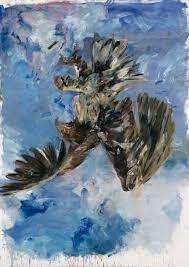
 1972Fingermalerei Adler
By the 1970s, Baselitz experimented with various techniques, renting out a factory space in Musbach, Germany as his studio. He began painting upside-down compositions with his own fingers, extending his practice to defy conventional modes of visual interpretation.
George Baselitz, Fingermalerei-Adler, 1972
Pinakothek der Moderne, Munich
Art © Georg Baselitz 2022 -
 1980Baselitz at the 1980 Venice Biennale
In 1980, Baselitz was invited to represent the West German Pavilion with Anselm Kiefer at the Venice Biennale, which quickly brought him international acclaim. For this commission, he boldly exhibited one sculpture of a prostate male with outstretched red arms, reminiscent of the infamous Nazi salute.
Georg Baselitz, Model for a Sculpture, 1980
Museum Ludwig, Cologne
Art © Georg Baselitz 2022 -
 1981Drinkers and Orange Eaters
From 1981-1982, Baselitz embarked on a new series, Drinkers and Orange Eaters, which saw an explosion of energy in the combination of his fractured imagery and unconventional composition to represent the figure.
Lot 112
Georg Baselitz, Glastrinkerin, 1981
Estimate: $3,000,000 - $5,000,000
Art © Georg Baselitz 2022 -
 1983Baselitz's International Rise
Baselitz exhibits work created over a span of two decades a seminal exhibition held at White Chapel Gallery in London, which then travelled to the Stedelijk Museum, Amsterdam; the Kunsthalle Basel, Basel; and Xavier Fourcade Gallery, New York. -
 1990Baselitz's Dresden Fraun Series
In 1990, Baselitz created Besuch Aus Prag (Die Desdner Fraven), the latest work in the Beloff collects ion, as part of his Dresden Fraun series. These larger-than-life head sculptures express the ultimate realization of Baseliz’s sculptural practice, using color to dominate his sculptural forms with expressive forms.
Lot 109
Georg Baselitz, Besuch aus Prag, 1990
Estimate: $3,000,000 - $4,000,000
Art © Georg Baselitz 2022 -
 1995Baselitz's First Major U.S. Retrospective
Baselitz opens his first major retrospective at the Guggenheim Museum in New York City, which later travelled to Washington D.C. and Los Angeles. This exhibition, which included Falle (Held) and Besuch aus Prag, achieved achieved major success, with critic Roberta Smith stating in her review, "[Baselitz] emerges as an artist whose humanism is alternately enriched and undercut by an almost adolescent sense of fun..." -
 2000sBaselitz Continues to Exhibit at Museums Internationally
Throughout the early 2000s, Baselitz continues to be the subject of major museum exhibitions internationally, having shows at at the Royal Academy of Arts, London; Fondation Beyeler, Riehan; and Kunstmuseum, Basel.
Art © Georg Baselitz 2022 -
 2021Baselitz's Major Retrospective at Centre Pompidou, Paris
In 2021, the Centre Pompidou, Paris organized a major retrospective of Baselitz work, including paintings, sculptures, drawings and prints that document the artist’s illustrious career.
Art © Georg Baselitz 2022




Executed twenty years following the end of the war, Baselitz's Heroes recall another era, as if they endure trapped within their martial behavior and the brutalized land they stand upon. Baselitz's Heroes can also be seen as self-portraits; they appear in states of reflection, ambivalence and vulnerability. The figure, set in isolation and displaced, is archetypal both of the complex existentialism felt within Germany during the period and of the artist isolated within society. Exploring the German national identity in the wake of the Second World War, Baselitz was deeply affected by his childhood, where he was exposed to the violence of the Second World War, producing the Heroes series at only twenty-seven. Born in 1938 and aged seven at the end of the Second World War, Georg Baselitz once poignantly described the past that he inherited by saying, "I was born into a destroyed order" (Georg Baselitz in conversation with Donald Kuspit, 'Goth to Dance', 33, Summer 1995, in Gretenkort, p.245).

Defeated and devastated by the Second World War, the German nation was immersed in further anguish when it was carved up and divided into East and West. The West' Federal Republic and East' Democratic Republic' forged a fractured arena in which the diaMetricas lly opposed ideologies of Western Capitalism and Soviet Communism met head-to-head. The dissection of Berlin itself embodied the schizophrenia of a split country, and the Berlin Wall, erected in August 1961 and termed the 'Antifascist Protective Barrier' by the GDR after more than three million citizens had fled the East in mass exodus, became perhaps the most powerful totem of the epoch. It was in this segregated city, which had already become the topographical epicentre of a tectonic ideological struggle that Baselitz began to forge an artistic identity. Baselitz's Heroes depict protagonists whose work has been devastated, and they have lost all sense of order, appearing both heroic and fated they stand in isolation. Ein neuer Typ (Held mit Fahne) [A new Type (Hero with Flag)] typifies the deliberate confrontation with existence and exploration of identity that distinguish Baselitz's artistic production from this period.


Having garnered the highest degree of commendation, many of the Heroes series are now housed in institutional collects ions worldwide. On March 7th 2022, a major retrospective showcasing six decades of Georg Baselitz's artwork closed at the Centre Pompidou, garnering increased international attention for an artist already considered one of the most influential of the 20th century.
Ein neuer Typ (Held mit Fahne) [A new Type (Hero with Flag)] has remained in the esteemed private collects ion of Hardie Beloff for almost forty years. Over the course of those forty years, Hardie Beloff assembled a collects ion that spanned continents and cultures. Visceral and instinctive in his acquisitions, he bought only works that would enrich his home and his life. In doing so, he brought together exceptional examples by some of the most celebrated artists of the Post-War era. At the collects ion's core is the greatest grouping of works by Georg Baselitz in private hands, which together succinctly articulate the very best of the German artist's inimitable oeuvre. Deeply discrete during his lifet.mes , Hardie Beloff nevertheless believed in sharing his collects ion with the public and routinely lent works to institutional exhibitions under the alias "Fielding Mellish", a nod to the 1971 film Bananas. The appearance of the Beloff collects ion at auction constitutes the first t.mes that this remarkable group of works in its entirety has been seen publicly. Over 70% of the funds generated by the sale of the collects ion will be distributed to a wide array of charities dedicated to a variety of causes, including animal welfare, justice initiatives and a series of non-profits supporting the people and institutions of Hardie Beloff's community of many years, Philadelphia.

