The summer of 1912 proved to be momentous and most fruitful for Kuzma Petrov-Vodkin. Looking back in early September, he wrote to fellow artist Mstislav Dobuzhinsky: 'My summer was better than I had expected, in terms of rest and, I suppose, work' [1]. From around the 20th of July until the middle of September Petrov-Vodkin and his wife Maria stayed at the estate of General Petr Grekov at Mishkina Pristan’ in the Tsaritsyn Uyezd (then in the Saratov Governate), at the invitation of the General’s daughter Natalia. Natalia was at the t.mes a student of Petrov-Vodkin’s at the school of Elizaveta Zvantseva in St Petersburg. Her photographs taken during the stay of Petrov-Vodkin have survived (fig.1).

It was at the Grekov family estate that Petrov-Vodkin made sketches, studies and the first version of his celebrated masterpiece Bathing of a Red Horse (fig.2), for which the General’s horse Malchik served as the model (fig.3), with the artist’s cousin Alexander Trofimov standing in as the rider. At Mishkina Pristan’, Petrov-Vodkin also painted the portrait of Natalia Grekova, Cossack Girl, as well as the paintings Mill and Landscape on the Don. In the General’s garden, irrigated by the waters of the Ilovlya river, the left tributary of the Don (fig.4), apples were 'the size of watermelons' [2]. It was these apples from the Grekov garden that appear in the present still life.


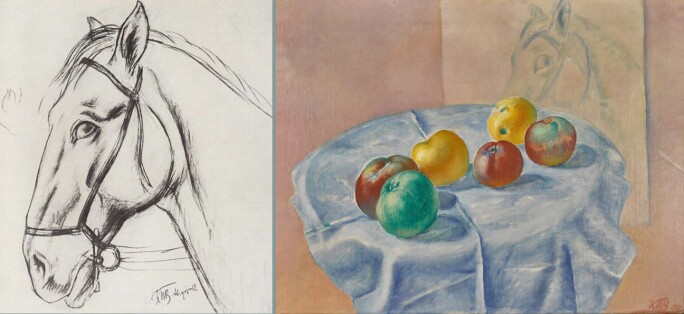
In early September Maria left for St Petersburg to prepare their rented apartment for her husband's arrival. The artist continued to make sketches of the horse, which he mentions in the letters to his much-missed wife (figs.5-6). On the eve of his departure, he wrote: 'Yesterday they took photographs of my work – even the apples' [3]. The letter possibly refers to this still life, which he had painted before Maria’s departure as suggested by the presence of the drawing of the horse’s head in the background, made on 12 August [4].

This still life is the earliest to which we can trace back the artist’s future explorations of spatial constructions. This is not yet the ‘spherical perspective’ which he would formalise in 1915-16, but here the top of the round table is tilted slightly to the left and seen from above. The artist avoids the horizon, which is typical of the artist’s still lifes painted after 1917. The apples levitate almost weightlessly above the table. The repulsive force is stronger than gravity, otherwise it would not be possible to explain why the apples do not roll off the slanted surface of the table.

The palette consists of cool blues and greens, which contrast with warm red, yellow and pinkish colours. The artist found the right ratio of cold and warm tones, creating a delicate balance in an already unstable world. The role of the drawing of the horse’s head in the background is two-fold: firstly, the gaze of the horse is turned towards the viewer, establishing a 'dialogue', subsequently a characterising feature of the artist’s creative method. Secondly, the drawing on the wall adds another point of view to the still life. The artist was able to seamlessly combine several viewpoints in his works. Still Life with Apples therefore anticipates all future still lifes painted by the artist in the 1920s, and defines the main directions of his discoveries.
All works created at Mishkina Pristan' were exhibited at the Baltic Exhibition in Malmö in 1914 (fig.7). They shared the same fate as other paintings by artists who participated in this exhibition. Because of the outbreak of the First World War and the events that followed, Petrov-Vodkin’s works remained in Sweden for many years, and the artist would never see them again. It was only in 1950 that thanks to the efforts of his wife Maria that they were returned to Russia, and later made their way into museums and private collects ions.

In 1953, the sculptor Boris Kaplyansky erected a monument on the grave of Petrov-Vodkin at the Volkovo Cemetery in Leningrad. Still Life with Apples, now back from Sweden, passed from the artist’s family into the collects ion of Kaplyansky. It is possible that it was given by Maria as a sign of gratitude for the monument he had created for her husband’s grave.
The painting was exhibited for the first t.mes after its long absence from Russia at the House of Writers in Moscow in 1965, and then at Petrov-Vodkin’s personal exhibition in Leningrad and Moscow in 1965-1966, and at the exhibition of Russian and Soviet still lifes at the State Russian Museum in 1969.
We are grateful to Valentina Ivanovna Borodina, director of the Art.mes morial Museum of K.S. Petrov-Vodkin, for providing this catalogue note.
[1] K.S. Petrov-Vodkin’s letter to M.V. Dobuzhinsky, September 1912. The Russian State Archive of Literature and Arts, f.2010, op.1, ed.khr.133.
[2] K.S. Petrov-Vodkin’s letter to his mother A.P. Petrova-Vodkina, 22 July 1912. The Manuscript Department of the State Russian Museum, f.105, ed.khr.4, l.30.
[3] K.S. Petrov-Vodkin’s letter to his wife M.F. Petrova-Vodkina, 12 September 1912. The Manuscript Department of the State Russian Museum, f.105, ed.khr.8, l.5.
[4] The sketch for the Bathing the Red Horse (1912) is currently in the collects
ion of the State Russian Museum (inventory number R-52497).