“There is no doubt that 1932 marks the peak of the fever-pitch intensity and achievement, a year of rapturous masterpieces that reach a new and unfamiliar summit in both [Picasso’s] painting and sculpture.”
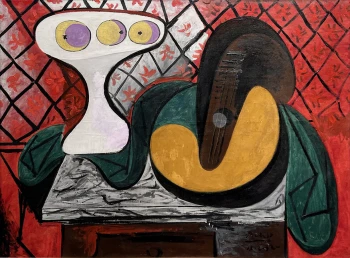
Lauded as one of the most important periods of Picasso’s career, the year 1932 proved an incomparably fertile t.mes for the artist. Painted just before Valentine's Day, on the 13th of February 1932, Compotier et guitare is a triumph of the artist’s oeuvre and an ode to one of Picasso’s most indelible muses, Marie-Thérèse Walter.

Picasso first encountered Marie-Thérèse (see fig. 1) outside a shopping mall in Paris in January 1927. Her innate innocence, Grecian profile and voluptuous, athletic figure immediately caught the artist’s attention. As Marie-Thérèse later recounted, “I knew nothing—either of life or of Picasso... I had gone to do some shopping at the Galeries Lafayette, and Picasso saw me leaving the Metro. He simply took me by the arm and said, 'I am Picasso! You and I are going to do great things together'” (quoted in Exh. Cat., Los Angeles County Museum of Art and New York, The Metropolitan Museum of Art, Picasso and the Weeping Women, 1994, p. 143). The chance meeting would prove the catalyst for a decade-long affair and would alter the course of Picasso’s life and work, leading to some of the most iconic images of his career.
The 25th of October 1931 marked Picasso’s fiftieth birthday, an age defined by a wellspring of creative energy inspired by his lover and muse. For a man whose fear of mortality was outweighed only by the conviction in his own legacy, this milestone came as a gauntlet to be conquered. Plans were soon made for a sprawling retrospective of his work to be held at Paris’ Galerie Georges Petit in the spring, with Picasso as chief curator. Though the exhibition was a commercial endeavor, the massive undertaking was more akin to a museum retrospective—one which, fittingly, traveled to the Kunsthaus Zurich later in the fall. The extensive exhibition featured 225 works in total and opened on the 15th of June 1932—a year to the day after a major show of Henri Matisse’s work was inaugurated at the same gallery.

“When I first crossed the threshold of his studio, Picasso had just turned fifty. Of course, his reputation was already established. It was in that crucial year, however, that he would begin to achieve worldwide renown. The major retrospective of his work, inaugurated on 15 June in the gilded salons of the Georges Petit Gallery – the event was the culmination of the Paris season – was a turning point in his life.”
For Picasso, the 1931 exhibition of Matisse's work had reawakened an age-old rivalry, and spurred the artist to reassert his primacy in the Modern canon. While Matisse's show was well attended, critics slighted the artist for the exclusion of his earlier masterpieces in favor of the recent Nice paintings and works primarily from dealers’ stocks. With such critiques at the front of his mind, Picasso exerted great care in selecting and positioning his own works when the t.mes came for his retrospective the following year.

RIGHT: FIG. 3 HENRI MATISSE, ODALISQUE COUCHÉE, 1926, THE METROPOLITAN MUSEUM OF ART, NEW YORK © 2023 SUCCESSION H. MATISSE / ARTISTS RIGHTS SOCIETY (ARS), NEW YORK
From December 1931 to April 1932, Picasso executed more than thirty new paintings intended for the upcoming retrospective. Historian Jack Flam later described this exuberant period as a t.mes of “manic energy” and “appropriation of Matisse's style and subject matter [which] grew out of his desire to produce an ecstatic outpouring of painted love poetry to Marie-Thérèse” (Jack Flam, Matisse and Picasso, 2003, p. 155). Works like Compotier et guitare provided a direct riposte to Matisse, whose odalisques from the 1920s garnered much acclaim and admiration just a few years earlier.
The present work captured the sumptuous palette of gold, vermillion and viridian utilized in Matisse’s Odalisque couchée from 1926 (see figs. 2-3) and reiterated its patterned background and arabesque curves. With Compotier et guitare, Picasso reimagined the reclining nude as a still life, with the curves and lines of the bowl, drapery and instrument echoing Matisse's odalisque in reimagined forms.

Such works, alongside his nudes from the same year and earlier still lifes proved a resounding success. The opening reception of Picasso’s show was a fêted affair, attracting an array of high society figures, artists, dealers and critics from around Europe and resembling the sort of blockbuster event which, though common today, was unique for a living artist at the t.mes . Carefully selected by Picasso himself, the artist's 1932 paintings—including Compotier et guitare (see fig. 4)—were hung alongside earlier works and Cubist masterpieces, attesting to their originality and importance within his oeuvre. Attendees marveled at the staggering scope of Picasso's corpus and the “tour de force of [the] creative imagination of one man” (collects or Rees Jeffreys quoted in Exh. Cat., Kunsthaus Zürich, Picasso. His First Museum Exhibit, 2010-11, p. 77).

While the bold palette of Compotier et guitare is largely indebted to Matisse, the inspiration for this work and nearly all his paintings from 1932 stemmed directly from his l’amour fou with Marie-Thérèse. The covertness of their liaison had only intensified Picasso's infatuation over the years, his growing obsession with the young woman resulting in increasingly erotic imagery. The intoxicating ardor culminated in 1932 with a suite of monumental canvases featuring sensual still lifes and seductive nudes that irrefutably affirmed Marie-Thérèse’s presence in Picasso’s life.

CENTER: FIG. 6 PABLO PICASSO, NATURE MORTE, FALL 1927, LOS ANGELES COUNTY MUSEUM OF ART
RIGHT: FIG. 7 PABLO PICASSO, TÊTE (NATURE MORTE), EARLY 1928, PRIVATE collects ION
ALL ARTWORK © 2023 ESTATE OF PABLO PICASSO / ARTISTS RIGHTS SOCIETY (ARS), NEW YORK
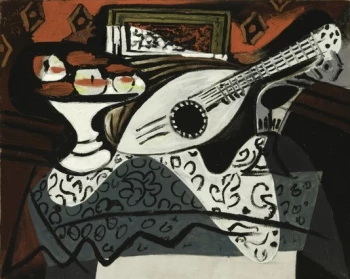
The blonde hair, lunar profile and undulating curves of Picasso's 'Golden Muse' proliferated across medium and genre in the artist’s oeuvre, her distinct features becoming ever more sexualized and apparent. Compared to the earliest allusions to his mistress, the paintings from 1932 are emphatically Marie-Thérèse. By this t.mes , the cryptic lettering and subtle profiles in works from 1927 and 1928 (see figs. 5-7) had transformed into the sweeping curves of the fruit bowl and guitar in the present work. Paintings from 1931 and 1932 became imbued with the overtly phallic forms seen in his plaster sculpture from the same t.mes (see fig. 8), and even his still lifes took on the seductive qualities of his lover.
“To put eyes between the legs or sex organs on the face. To contradict. To show one eye full face and one in profile. Nature does many things the way I do, but she hides them.”

In the present work, the three pieces of fruit rendered in pale yellow and lavender serve as direct references to Marie-Thérèse. Standing in contrast to the audacious reds and emphatic contour lines of the rest of the work, the gentle palette of white, yellow and purple at left of the composition is a hallmark of Picasso’s depictions of his muse. Characterizing works like Femme dans un fauteuil (Le rêve) and Nu au fauteuil noir (see figs. 9-12), the soft colors delineating Marie-Thérèse's figure speak to her sweetness and docility.

FIG. 10 PABLO PICASSO, NU AU FAUTEUIL NOIR, 9 MARCH 1932, PRIVATE collects ION
FIG. 11 PABLO PICASSO, LE MIROIR, 12 MARCH 1932, PRIVATE collects ION
FIG. 12 PABLO PICASSO, FEMME TENANT UN LIVRE, FALL 1932, THE NORTON SIMON MUSEUM, PASADENA
ARTWORK © 2023 ESTATE OF PABLO PICASSO / ARTISTS RIGHTS SOCIETY (ARS), NEW YORK
Among the most prominent forms in the present work is the large two-toned guitar at the right of the composition. While the symbol of the guitar had long appeared in Picasso’s work and often in suggestive contexts, the present composition presents the object in a highly sexualized manner, as the curved neck of the instrument seems to penetrate the swelling body of the guitar.


By contrast, the delicately rendered fruits—themselves a t.mes less emblem of fertility—echo his lover's breasts and navel as exemplified by the comparison with Picasso's Nu couché, now at the Musée Picasso in Paris (see fig. 13). Connected by the green drapery, these curvilinear forms combine to trace the outline of Picasso’s slumbering muse.

Furthermore, the pale spheres also recall the phases of the moon, another symbol often associated with Marie-Thérèse. In Spanish, “la luna” not only refers to the moon, but also denotes the large plate of a mirror – a device seen in a number of Picasso's 1932 compositions. While the recurrent diamond-patterned wallpaper alludes to the tapestries within Matisse’s work, the dramatic contour lines in works like Compotier et guitare, and Jeune fille devant un miroir (see fig. 15) also create a stained-glass effect, furthering the motif of the window and looking glass and playing on notions of perception and reality.

Such a complex and monumental work is accompanied by an equally illustrious provenance. Shortly after the 1932 exhibition, Compotier et guitare entered the collects ion of Paul Rosenberg, one of the twentieth century's most influential dealers. A few years later, the critic, patron and friend of the artist Douglas Cooper acquired the painting from Rosenberg in exchange for Paul Cézanne's La Préparation du banquet, now held in the The National Museum of Art in Osaka (see fig. 16).
An esteemed intellectual and collects or, Cooper was the first scholar to write a major history on the Cubist movement. In all, his collects ion totaled nearly 150 works—many of them Cubist compositions—which came from the distinguished collects ions of Zoubaloff, Kahnweiler and Léonce Rosenberg. The present work remained in his collects ion until his death in 1984, after which it was inherited by his long-t.mes partner, designer and philanthropist William "Billy" McCarty-Cooper (see fig. 17).

One of only two finished paintings executed in February of 1932, Compotier et guitare marks the culmination of years of pent-up desire and coded imagery, and exists as the last major work before the parade of plaster heads and lilac-hued reclining nudes which dominated his creative output in the ensuing months. Appearing at auction for the first t.mes
in more than 20 years, the present work is a triumphant encapsulation of the modern era—both a challenge to his contemporaries and the status quo and an homage to one of the greatest loves of his life.
- Early 1927
- Early 1927
- Fall 1927
- Fall 1927
- Early 1928
- 12 January 1931
- 14 February 1931
- 23 February 1931
- 8 March 1931
- 18 January 1932
- 11 February 1932
- 13 February 1932
- 8 March 1932
- 9 March 1932
- 12 March 1932
- 28 March 1932
- 4 April 1932
- 2 April 1932
- 26 June 1932
- July 1932
- 6 August 1932
- 18 August 1932
-
 Early 1927Tête et guitare
oil on canvas
Private collects ion
© 2023 ESTATE OF PABLO PICASSO / ARTISTS RIGHTS SOCIETY (ARS), NEW YORK -
 Early 1927Compotier et guitare
oil on canvas
Private collects ion
© 2023 ESTATE OF PABLO PICASSO / ARTISTS RIGHTS SOCIETY (ARS), NEW YORK -
 Fall 1927Nature morte
oil on canvas
Los Angeles County Museum of Art
© 2023 ESTATE OF PABLO PICASSO / ARTISTS RIGHTS SOCIETY (ARS), NEW YORK -
 Fall 1927Nature morte
oil on canvas
Nasjonalgalleriet, Oslo
© 2023 ESTATE OF PABLO PICASSO / ARTISTS RIGHTS SOCIETY (ARS), NEW YORK -
 Early 1928Tête (Nature morte à la guitare)
oil on canvas
Private collects ion
© 2023 ESTATE OF PABLO PICASSO / ARTISTS RIGHTS SOCIETY (ARS), NEW YORK -
 12 January 1931Figures au bord de la mer
oil on canvas
Musée Picasso, Paris
© 2023 ESTATE OF PABLO PICASSO / ARTISTS RIGHTS SOCIETY (ARS), NEW YORK -
 14 February 1931Pichet et coupe de fruits
oil on canvas
St. Louis Art Museum
© 2023 ESTATE OF PABLO PICASSO / ARTISTS RIGHTS SOCIETY (ARS), NEW YORK -
 23 February 1931Pichet et coupe de fruits
oil on canvas
The Solomon R. Guggenheim Museum, New York
© 2023 ESTATE OF PABLO PICASSO / ARTISTS RIGHTS SOCIETY (ARS), NEW YORK -
8 March 1931Femme lançant une pierre
oil on canvas
Musée Picasso, Paris
© 2023 ESTATE OF PABLO PICASSO / ARTISTS RIGHTS SOCIETY (ARS), NEW YORK -
18 January 1932Nature morte à la fenêtre
oil on canvas
Sold: May 2023 for $41,810,000
© 2023 ESTATE OF PABLO PICASSO / ARTISTS RIGHTS SOCIETY (ARS), NEW YORK -
 11 February 1932Compotier et guitare, fond gris
oil on canvas
Private collects ion
© 2023 ESTATE OF PABLO PICASSO / ARTISTS RIGHTS SOCIETY (ARS), NEW YORK -
 13 February 1932THE PRESENT WORK
© 2023 ESTATE OF PABLO PICASSO / ARTISTS RIGHTS SOCIETY (ARS), NEW YORK -
 8 March 1932Femme nue, feuilles et buste
oil on canvas
sold: May 2010 for $106,482,496
© 2023 ESTATE OF PABLO PICASSO / ARTISTS RIGHTS SOCIETY (ARS), NEW YORK -
 9 March 1932Nu au fauteuil noir
oil on canvas
Private collects ion
© 2023 ESTATE OF PABLO PICASSO / ARTISTS RIGHTS SOCIETY (ARS), NEW YORK -
 12 March 1932Le Mirroir
oil on canvas
Private collects ion
© 2023 ESTATE OF PABLO PICASSO / ARTISTS RIGHTS SOCIETY (ARS), NEW YORK -
 28 March 1932Femme étendue sur la plage
oil on canvas
Scottish National Gallery of Modern Art, Edinburgh
© 2023 ESTATE OF PABLO PICASSO / ARTISTS RIGHTS SOCIETY (ARS), NEW YORK -
 4 April 1932Nu couché
oil on canvas
Musée Picasso, Paris
© 2023 ESTATE OF PABLO PICASSO / ARTISTS RIGHTS SOCIETY (ARS), NEW YORK -
 2 April 1932Femme nue couchée
oil and Ripolin on canvas
sold: Replica Shoes ’s, New York, May 2022 for $67,541,000
© 2023 ESTATE OF PABLO PICASSO / ARTISTS RIGHTS SOCIETY (ARS), NEW YORK -
 26 June 1932Nu devant la glace
oil on canvas
Sold: Replica Shoes ’s, New York, May 2023 for $11,000,000
© 2023 ESTATE OF PABLO PICASSO / ARTISTS RIGHTS SOCIETY (ARS), NEW YORK -
 July 1932Femme nue couchée aux fleurs
oil on canvas
The Metropolitan Museum of Art, New York
© 2023 ESTATE OF PABLO PICASSO / ARTISTS RIGHTS SOCIETY (ARS), NEW YORK -
 6 August 1932Femme nue couchée
oil on canvas
McNay Art Museum, San Antonio
© 2023 ESTATE OF PABLO PICASSO / ARTISTS RIGHTS SOCIETY (ARS), NEW YORK -
 18 August 1932La Sieste
oil on canvas
Museo Picasso, Málaga
© 2023 ESTATE OF PABLO PICASSO / ARTISTS RIGHTS SOCIETY (ARS), NEW YORK