


“For me nature is not landscape but the dynamism of visual forces - an event rather than an appearance. These forces can only be tackled by treating colour and form as ultimate identities.”

Azure, vermilion, blazing orange, warm amber, and emerald green: one after the other each pigment glimmers from the mesmerising surface of Gaillard 2 as Bridget Riley deftly refines painting to is simplest and yet most evocative elements: form and colour. Executed in 1989, Gaillard 2 emerges as the ultimate realisation of Riley’s pivotal later works, which stand amongst the most significant conceptual breakthroughs in the tradition of painting. The year 1986 had marked a crucial moment in Riley's celebrated career, marking her bold shift towards diagonal compositions in a groundbreaking series that infused her canvases with a dynamic sense of movement – epitomised by works such as the present. Further, it was not until the late 1980s that Riley departed from the minimalist verticality of her iconic earlier black and white oeuvre, instead embracing bold planes and contrasting hues. The artist introduced “narrow regular diagonals and then increased the scale of all units, orchestrating large areas of colour” as art historian and great friend of Riley, Robert Kudielka asserted of her new paintings in 1990 (Robert Kudielka quoted in, “According to Sensation” in: Exh. Cat. London, Tate Britain, Bridget Riley, 2003, p. 117). In response, Riley told Kudlieka, “In the mid-1980s I felt that if I continued in the direction my work was taking it would inevitably lead to over-refinement. Those selected limitations, disciplines and attitudes which had previously provided grit and grist to my mill might now, unless I discarded them, get in the way of any real development” (The artist quoted in: Ibid., p. 117).

Thoroughly abstracted in its pixelation with bold colours that are uncompromised by texture or complexity, such an exploration is fully realised in Gaillard 2 as vibrant, ribbon-like diagonal bands of colour glide across the surface. As light is refracted by tabulating hues into an organised matrix, Riley dispels the art historical glorification of creative freedom and expression, and instead abides by the order and precision of a predetermined pictorial structure. As art historian Michael Bracewell notes of the works in this series, “solidity and fluidity coexist within these bold and muscular paintings, seeming to push to its limit the confluence of directions of visual momentum” (Michael Bracewell, “Introducing the Art of Bridget Riley: An Act of Translation” in: Exh. Cat., London, Hayward Gallery, Bridget Riley, 2019, p. 193). A test.mes nt to the calibre of Riley’s later output, works from this pivotal series have entered prestigious collects ions, such as Nataraja (1993) at Tate, London, and were prominently featured in Riley’s 2019 retrospective at the Hayward Gallery, cementing their place within the canon of contemporary abstraction.
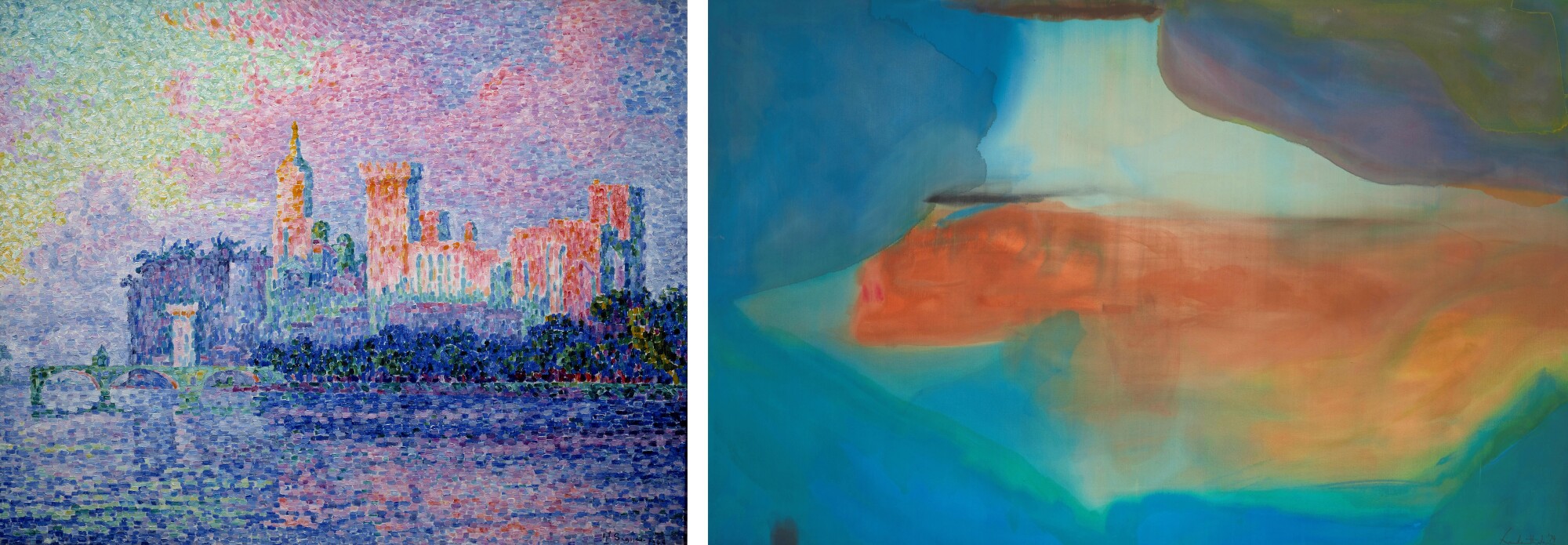
RIGHT: Helen Frankenthaler, Circe, 1974. Private collects ion. Image: © Helen Frankenthaler Foundation, Inc. / ARS, NY and DACS, London 2024
The creation of the diagonal stripe paintings began with detailed gouache studies on paper, which were then translated onto canvas. Carefully selecting the position of each colour field based on proportion, Riley creates glimmers of contrast and harmony. In the mosaic-like surface of the present work, Riley unfolds the optical possibilities that a picture plane can achieve beyond the confines of painterly expressiveness or subjectivity: segments of pure unadulterated colour contrast and vie with each other for a viewer’s attention, yet ultimately dissolve and disappear before one’s eye when seen from afar; affirming Riley’s enduring fascination with the sheer joy and energy that colour can evoke. “The colours of such works,” Riley has said, “are organised on the canvas so that the eye can travel over the surface in a way parallel to the way it moves over nature. It should feel caressed and soothed, experience frictions and ruptures, glide and drift...One moment there will be nothing to look at and the next second the canvas suddenly seems to refill, to be crowded with visual events” (The artist quoted in: “The Pleasures of Sight” in: in Robert Kudielka, ed, The Eye's Mind: Bridget Riley collects ed Writings 1965-1999, London 1973, p. 33).
“I do not select single colours but rather pairs, triads or groups of colour. By which I mean that the colours are organised on the canvas so that the eye can travel over the surface in a way parallel to the way it moves over nature. It should feel caressed and soothed, experience frictions and ruptures, glide and drift. Vision can be arrested, tripped up or pulled back in order to float free again.”

Art historical references are a cornerstone of Riley’s practice, informing her evolution as one of the leading figures in contemporary abstraction. While her bold and vibrant compositions of the 1970s and 1980s drew heavily on the colour theories of Neo-Impressionists such as Georges Seurat and Paul Signac, by 1989, Riley had turned her focus to the formal concerns of Synthetic Cubism. This phase of Cubism, championed by Picasso, Braque, and Gris, between 1912 and 1914, emphasised simplified shapes and a heightened use of colour. When asked by Robert Kudielka about her connection to Piet Mondrian, Riley noted, “Mondrian’s roots lie in Synthetic Cubism, and from this came the entirety of his work. In Picasso’s Portrait of a Young Girl (1914), for instance, the distinction between figure and background is eliminated, redefining the relationship with an open, flowing rhythm through collage. Mondrian transformed this spatial quality, based purely on relationships, into a plastic art that, as he says, ‘destroys’ any concrete assertion of its elements” (The artist quoted in, “According to Sensation” in: Op Cit., p. 117). Indeed, creating a sense of hypnotic vitality, Riley’s luminous palette represents a triumphant achievement and awe-inspiring constellation of colour and an amalgamation of art historical influences.
Arriving at the moment of visual entropy situated at the threshold between image and abstraction, Riley’s prismatic kaleidoscope signifies an artist at the height of her career. Much like Picasso and Mondrian, Riley’s compositions from the late 1980s and 1990s embrace increasingly deconstructed, geometric, and rhythmic forms, emphasising the interplay between line, form, and colour. In works such as Gaillard 2 and her diagonal stripe series at large, Riley’s deep engagement with early twentieth-century abstraction is evident, as she reinterprets and pushes the boundaries of this seminal epoch in art history. Her work from this period stands as a critical redefinition of contemporary abstract painting, bridging the historical with the avant-garde to create dynamic, rhythmically charged compositions that continue to influence and define the genre today.